Vegetable Crop Update – Aug 2, 2026

In this issue:
- Vegetable Disease Update
- Vegetable Insect Update
Vegetable Disease Update
Amanda Gevens, Professor & Extension Vegetable Pathologist, UW–Madison, Dept. of Plant Pathology, 608-575-3029, gevens@wisc.edu
Current P-Day (Early Blight) and Disease Severity Value (Late Blight) Accumulations
Thanks to Ben Bradford, UW- Madison Entomology for supporting this effort and providing a summary reference table: https://agweather.cals.wisc.edu/thermal-models/potato. A Potato Physiological Day or P-Day value of ≥300 indicates the threshold for early blight risk in potato and triggers preventative fungicide application. A Disease Severity Value or DSV of ≥18 indicates the threshold for late blight risk and triggers preventative fungicide application in potato. Data from the modeling source: https://agweather.cals.wisc.edu/vdifn are used to generate these risk values in the table below. I’ve estimated early, mid-, and late planting dates by region based on communications with stakeholders. These are intended to help in determining optimum times for preventative fungicide applications to limit early and late blight in Wisconsin.
| Location | Planting Date | 50% Emergence Date | Disease Severity Values (DSVs) through 8/1/26 | Potato Physiological Days (P-Days) through 8/1/26 | |
| Spring Green | Early | Apr 10 | May 7 | 32 | 667 |
| Mid | May 5 | May 20 | 30 | 595 | |
| Late | May 16 | June 2 | 30 | 499 | |
| Arlington | Early | Apr 12 | May 8 | 15 | 665 |
| Mid | May 6 | May 23 | 15 | 590 | |
| Late | May 20 | June 4 | 15 | 493 | |
| Grand Marsh | Early | Apr 13 | May 9 | 31 | 641 |
| Mid | May 6 | May 22 | 31 | 582 | |
| Late | May 21 | June 5 | 31 | 477 | |
| Hancock | Early | Apr 14 | May 11 | 23 | 634 |
| Mid | May 10 | May 30 | 22 | 519 | |
| Late | May 23 | June 6 | 21 | 466 | |
| Plover | Early | Apr 15 | May 12 | 23 | 636 |
| Mid | May 10 | May 30 | 22 | 524 | |
| Late | May 25 | June 6 | 21 | 472 | |
| Antigo | Early | May 12 | May 29 | 28 | 514 |
| Mid | May 25 | June 5 | 28 | 469 | |
| Late | June 8 | June 20 | 19 | 355 | |
| Rhinelander | Early | May 15 | June 6 | 18 | 450 |
| Mid | May 28 | June 10 | 16 | 413 | |
| Late | June 9 | June 25 | 10 | 316 | |
Late Blight of Potato/Tomato
Wisconsin potato production regions have accumulated 0-6 Disease Severity Values or DSVs over this past week. All locations with the exception of the Arlington area, and later plantings in the Rhinelander area, are at or surpassing the action threshold of 18. Fields with ≥18 DSVs should receive preventative fungicide applications to manage for late blight. https://vegpath.plantpath.wisc.edu/diseases/potato-late-blight/ An updated list of fungicides for management potato late blight in Wisconsin 2026 is provided here: https://vegpath.plantpath.wisc.edu/resources/late-blight-fungicides/
Early Blight of Potato
All Wisconsin potatoes have surpassed the treatment threshold of 300 P-Days. Continued preventative fungicide applications are warranted for these fields. In the past week regions of the state accumulated between 55 and 64 P-Days, slightly higher than the accumulations in the previous week. For support in selecting fungicides, please consult the A3422 Commercial Vegetable Production in Wisconsin: https://vegpath.plantpath.wisc.edu/resources/a3422/
Cucurbit Downy Mildew
Cucurbit Downy Mildew was reported on commercial cucumber in LaGrange Indiana on July 29, 2026 (northeastern IN county bordering MI). There were no field disease confirmations from Wisconsin. The spore trapping network in Michigan, coordinated by Dr. Mary Hausbeck, indicated presence of spores of Clade 2 on 7/27, but to date, no disease observed in fields in Michigan. This Clade 2 infects cucumbers and cantaloupes/melons. The pathogen has been reported in relatively few states this year as noted at the Cucurbit Downy Mildew Forecasting website and network (https://cdm.ipmpipe.org/). Fungicide considerations were discussed in a previous newsletter and can be found here: https://vegpath.plantpath.wisc.edu/2026/07/12/vegetable-crop-update-jul-5-2026/
Hail Damage in Potato and Vegetable Crops
Recent storms have left some WI potato and vegetable fields with varying degrees of hail injury. While plants often have a remarkable ability to recover from moderate defoliation or stem injury, the wounds created by hail can provide opportunities for bacterial pathogens to enter plant tissue. In some situations, a timely application of a copper-based fungicide/bactericide may help reduce the risk of bacterial disease development.
Copper products are protectant materials, meaning they act on the plant surface to suppress bacterial populations before infection occurs. They are not curative and will not heal hail wounds or eliminate bacteria that have already entered plant tissue. Their greatest value is when applied as soon as practical following the storm, particularly if warm, wet conditions are expected and the crop has a history or elevated risk of bacterial diseases.
For potatoes, copper products may help suppress bacterial diseases such as blackleg and soft rot (Pectobacterium spp. and Dickeya spp.), although efficacy can be variable because these pathogens may already be present internally within plants. Past research on potato in Washington by Dr. Dennis Johnson indicated a benefit from the addition of Tanos with copper on hail-damaged potato. Tanos is a pre-mix fungicide including famoxadone (FRAC 11) and cymoxanil (FRAC 27). Copper should be viewed as one component of an integrated management strategy rather than a stand-alone solution. In tomatoes and peppers, copper products may also provide protection against bacterial spot and bacterial speck. In brassicas, they may aid in reducing black rot spread following injury, and in cucurbits they may provide some suppression of angular leaf spot where disease is present or expected.
When considering a copper application after hail:
- Apply as soon as possible after injury if bacterial disease risk is elevated.
- Ensure thorough canopy coverage while avoiding excessive application rates that could increase the risk of phytotoxicity.
- Follow label directions regarding rates, intervals, and crop restrictions.
- Continue to scout fields closely over the next 7–14 days, as secondary fungal diseases or bacterial infections may develop following the initial injury.
Not every hail event warrants a copper application. If crop injury is minor, conditions quickly become dry, and bacterial diseases have not been a concern, plants often recover without additional intervention. Decisions should be based on the severity of injury, weather forecast, crop growth stage, field disease history, and the likelihood of bacterial pathogen activity. Although hail damage cannot be reversed, protecting wounded tissue from opportunistic bacterial infection may help preserve plant health and maximize yield potential where disease risk is high.
Vegetable Insect Update
Russell L. Groves, Professor and Associate Department Chairperson, UW–Madison, Department of Entomology, 608-262-3229 (office), (608) 698-2434 (cell), e-mail: rgroves@wisc.edu. Vegetable Entomology Webpage: https://vegento.russell.wisc.edu/
European corn borer
More information: https://vegento.russell.wisc.edu/pests/european-corn-borer/
The summer moth flight, which leads to second-generation larvae, peaks around mid-August in central Wisconsin. In tasseling corn, and approximately 90% of the eggs are laid on the two nodes directly above and below the ear (four nodes total). Young larvae hide behind leaf sheaths and under ear husks. They enter the silk channel at the ear tip. Larvae that hatch after tasseling enter the stalk or ear. The larvae that reach the fifth instar during September will overwinter along with a fraction of the population that entered diapause in August once they reached later larval stages.
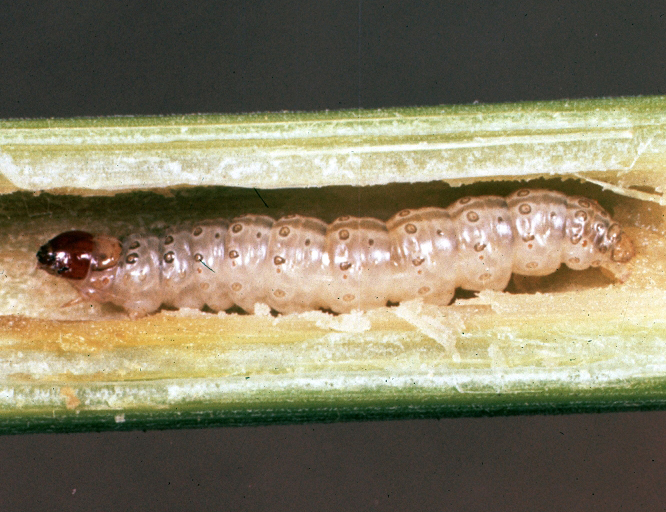
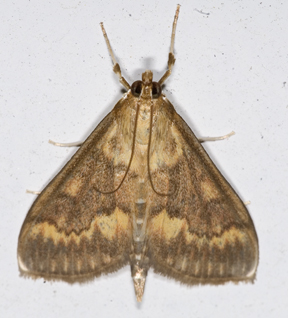
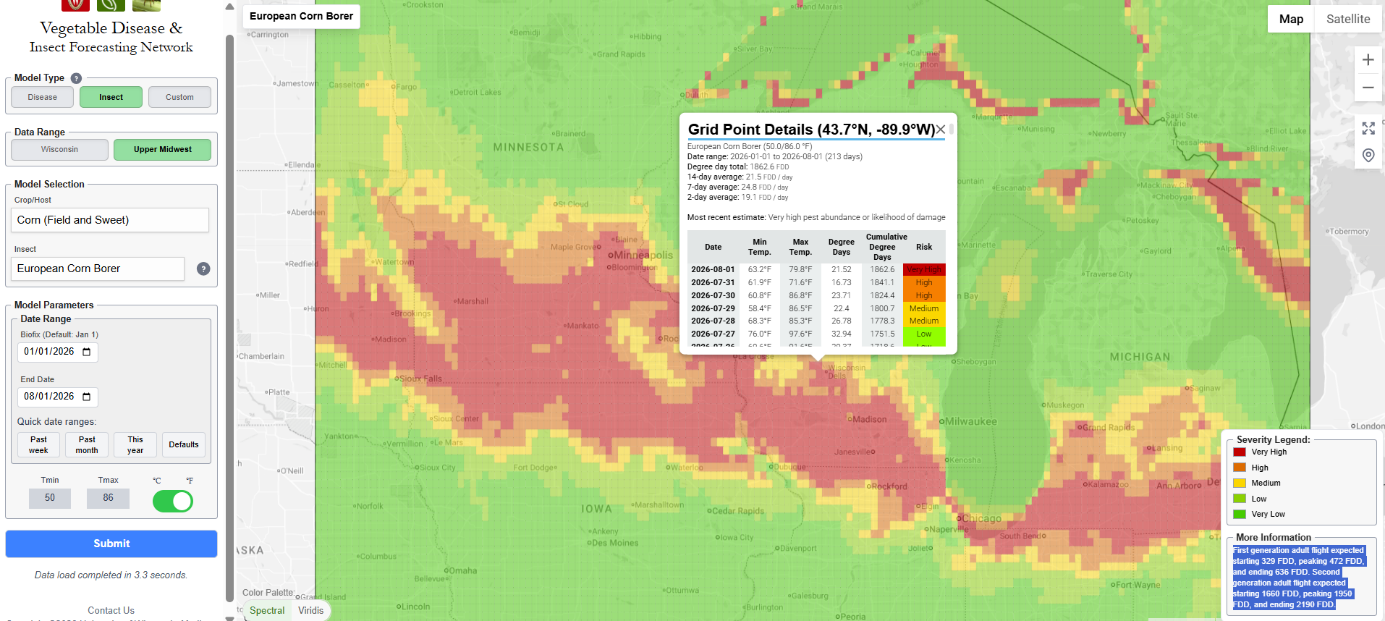
Population progression (as estimated by the Vegetable Disease and Insect Forecasting Network) has entered many portions of southern Wisconsin. Begin to scout fields weekly for feeding damage and also look for eggs that suggest a developing population. Check plants carefully, even if no feeding damage is apparent, to look for eggs that will hatch into small caterpillars in the coming week to 10 days. We expected adult activity to increase, and these populations can be observed by checking the Wisconsin Home Pest Survey and the Blacklight Trap Counts specifically. Although feeding damage and fecal material are signs of activity, it is better to rely on larvae counts to determine the level of infestation. Caterpillars cause varying amounts of damage depending on the plant’s maturity, so the need for treatment changes as the crop grows.
The major injury to field corn is stalk tunneling which impairs plant growth and reduces potential yield. Second-generation larvae cause additional yield losses from broken stalks and dropped ears. Although canning and fresh market sweet corn also suffer from stalk tunneling, the major damage in sweet corn is to the ears. Because borers damage the kernels, corn intended for canning or freezing must be handled and trimmed prior to processing. This type of damage in fresh market sweet corn results in loss of the entire ear because of consumer rejection. Most of the ear damage occurs from infestations arising during the row tassel (RT) stage. This is when tassels have emerged on most of the plants and pollen or silks are present on 10% of the crop.
Second-generation borers attack late-planted processing and fresh-market sweet corn. Blacklight insect traps provide useful records in June for first flight and are even more worthwhile to monitor in early to mid-August for monitoring the second flight. Scout areas that have different planting dates or varieties separately because these differences can affect the extent of egg laying.
- Scout ever 5-7 days. Sample at least 10 plants in each of five areas of a field.
- Examine leaves for egg masses and larvae; also look on husk leaves arising from the ear tip.
- Check emerging tassels and in leaf collars for larvae; treat if you find live larvae or eggs on 4-5% of the plants.
- Repeat treatments every 3-5 days if you continue to find live larvae or eggs on 4-5% of the plants. Two to three applications may be necessary during years with heavy infestations.
Full-grown larvae of the European corn borer range in length from 3/4 to 1 inch and vary in color from gray to creamy white. The body is covered with numerous dark spots and the head is black. Adults are straw-colored moths with a 1-inch wingspread. Male moths are slightly smaller and distinctly darker than females. Adult females lay eggs on the underside of leaves near the midvein. These egg masses are 1/8-3/16 inches long and contain approximately 20-30 eggs which overlap like fish scales. As they develop, the eggs change from white to a creamy color. Just before hatching, the black heads of the larvae become visible. This final egg stage is referred to as the “black-head” stage.
Corn earworm
More information: https://vegento.russell.wisc.edu/pests/corn-earworm/
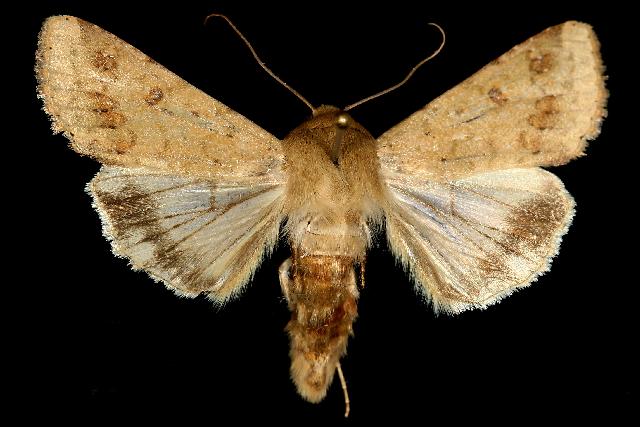
Full-grown larvae of the corn earworm are olive-brown, tan, maroon, pink, or black with three or four dark stripes along their backs. The head is yellow and not spotted. They measure up to 2 inches long when mature. Adults are robust, grayish-brown moths with a wing-span of 1 ½ inches. The front wings are marked with dark gray, irregular lines with a dark area near the wing tip. Eggs are tiny (1/32 inch), flattened spheres with prominent ridges. When deposited, the eggs are light yellow, but they darken to dusky brown before hatching.
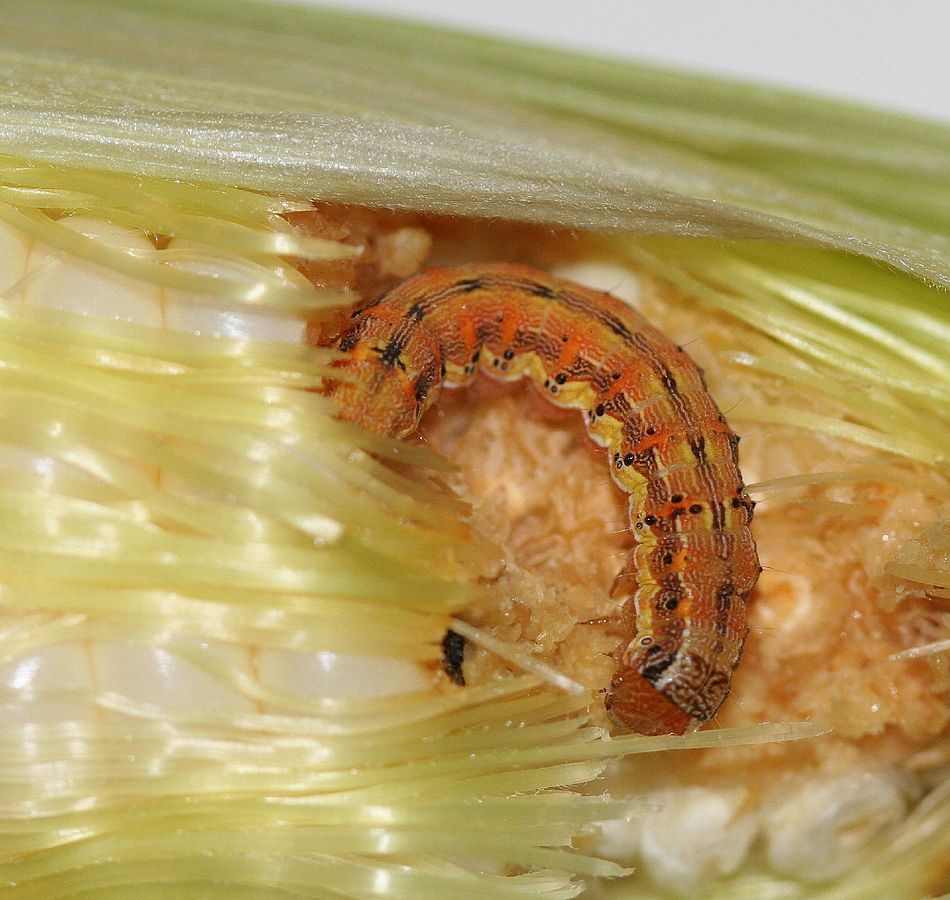
Corn earworm development can be predicted using degree day models, although it is important to set the biofix to the date that you first see corn earworm eggs (typically around Aug 1). Visit the Vegetable Disease and Insect Forecasting Network (VDIFN) website to view the corn earworm degree day model and models for many other common insect pests. Adult earworm moths are best surveyed using pheromone traps (Hartstack traps baited with an adult sex pheromone emitter). These traps use a special scent to attract male moths. Knowing when moths are present helps to determine when to treat fields. Place a trap 4 to 6 feet above the ground on the south or west side of fields on the south or west side of fields when corn is in the green silk stage. Pheromones should be changed every 2 weeks with the unused lures kept frozen until needed. Hercon pheromone lures have been very effective at attracting earworm moths. For accurate counts, be sure to remove used lures from the trap area.
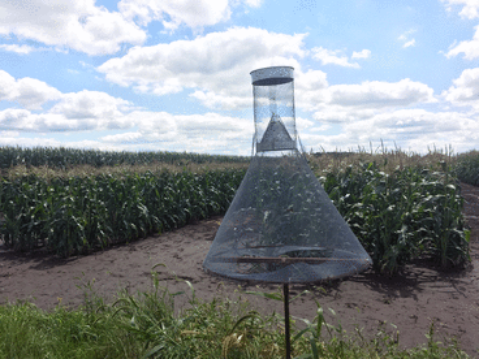
Another technique for monitoring earworms uses a black light to lure night-flying insects. However, black light traps are more expensive, less effective, and more difficult than pheromone traps to monitor. Counts in blacklight traps are consistently lower than those in pheromone traps in adjacent fields.
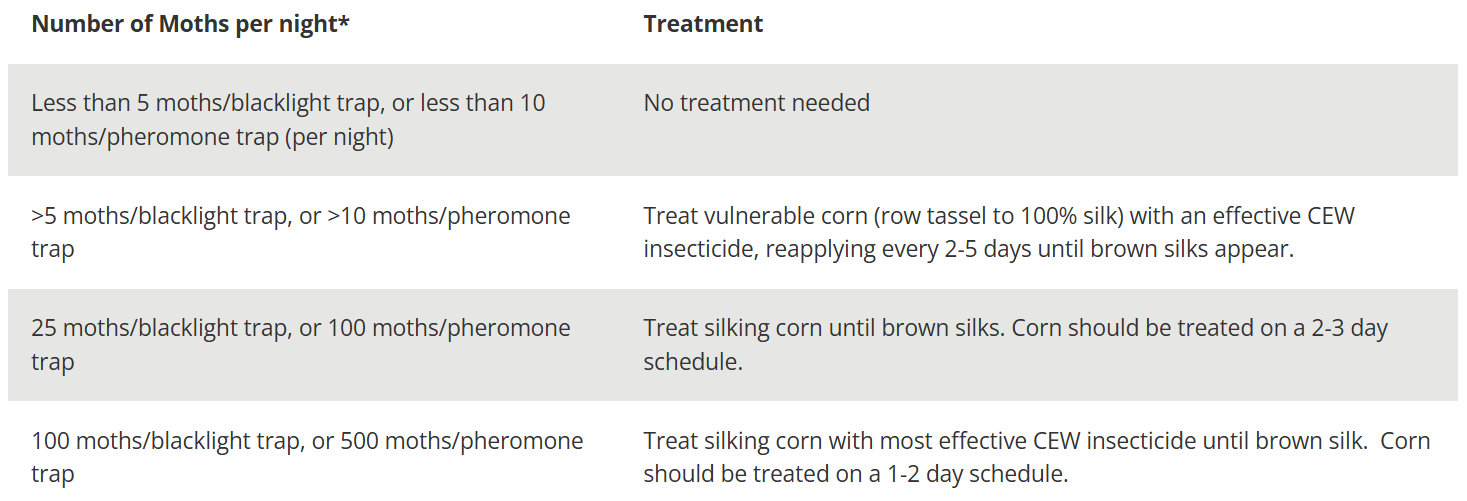
Pheromone trap catches of 5 to 10 moths or blacklight trap captures of 3 to 5 moths per night for three consecutive nights indicate that moths are probably laying enough eggs to warrant treatment of fields that are in the vulnerable stage between brush and silk browning to add precision to your scouting, check silks for the small, spherical corn earworm eggs before beginning a spray program.
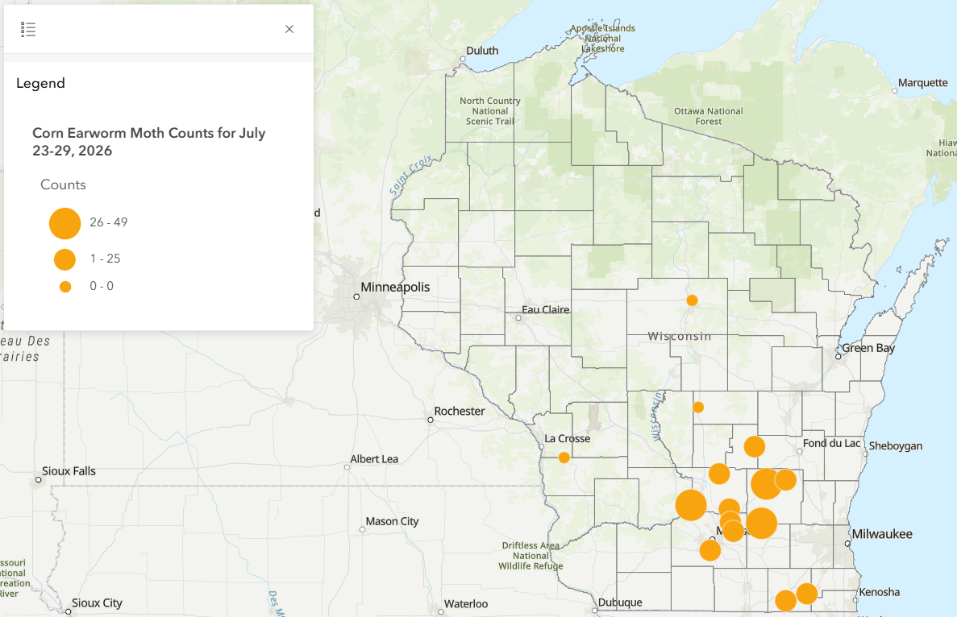
Captures of adult moths are underway in Wisconsin adult captures reported by the Wisconsin Home Pest Survey warrant continued scouting and populations monitoring. Although thresholds have not been exceeded at any specific site (to date), captures are expected to increase in the coming week.
Remember, once larvae enter the ear, they’re protected from insecticides. Therefore, treatment timing is critical, and control must be targeted at the adults, eggs, and young larvae before they’re protected. The amount of time for egg hatch varies with temperature, but during periods of hot summer days and nights, eggs can hatch within 24 hours after they’re laid. Thus, each day’s delay in treatment may reduce the number of clean ears by 10 to 15%.
Insecticides must be present on vulnerable silks when eggs hatch. The first application is the most critical and tank-mixes containing an ovicide (an egg killer) and synthetic pyrethroid are recommended. On sweet corn, treat every 3 to 4 days beginning when silks first appear and continuing until they brown. On hybrid dent seed corn, make 1 to 2 applications during this period. Discontinue treatments 10 days before harvesting fresh market sweet corn as additional sprays will not improve product quality.