Vegetable Crop Update – Aug 9, 2026
In this issue:
Vegetable Disease Update
Amanda Gevens, Professor & Extension Vegetable Pathologist, UW–Madison, Dept. of Plant Pathology, 608-575-3029, gevens@wisc.edu
Current P-Day (Early Blight) and Disease Severity Value (Late Blight) Accumulations
Thanks to Ben Bradford, UW- Madison Entomology for supporting this effort and providing a summary reference table: https://agweather.cals.wisc.edu/thermal-models/potato. A Potato Physiological Day or P-Day value of ≥300 indicates the threshold for early blight risk in potato and triggers preventative fungicide application. A Disease Severity Value or DSV of ≥18 indicates the threshold for late blight risk and triggers preventative fungicide application in potato. Data from the modeling source: https://agweather.cals.wisc.edu/vdifn are used to generate these risk values in the table below. I’ve estimated early, mid-, and late planting dates by region based on communications with stakeholders. These are intended to help in determining optimum times for preventative fungicide applications to limit early and late blight in Wisconsin.
| Location | Planting Date | 50% Emergence Date | Disease Severity Values (DSVs) through 8/8/26 | Potato Physiological Days (P-Days) through 8/8/26 | |
| Spring Green | Early | Apr 10 | May 7 | 37 | 732 |
| Mid | May 5 | May 20 | 35 | 660 | |
| Late | May 16 | June 2 | 35 | 564 | |
| Arlington | Early | Apr 12 | May 8 | 17 | 730 |
| Mid | May 6 | May 23 | 17 | 655 | |
| Late | May 20 | June 4 | 17 | 558 | |
| Grand Marsh | Early | Apr 13 | May 9 | 34 | 705 |
| Mid | May 6 | May 22 | 34 | 645 | |
| Late | May 21 | June 5 | 34 | 540 | |
| Hancock | Early | Apr 14 | May 11 | 23 | 698 |
| Mid | May 10 | May 30 | 22 | 584 | |
| Late | May 23 | June 6 | 21 | 530 | |
| Plover | Early | Apr 15 | May 12 | 23 | 700 |
| Mid | May 10 | May 30 | 22 | 588 | |
| Late | May 25 | June 6 | 21 | 535 | |
| Antigo | Early | May 12 | May 29 | 34 | 574 |
| Mid | May 25 | June 5 | 34 | 530 | |
| Late | June 8 | June 20 | 23 | 416 | |
| Rhinelander | Early | May 15 | June 6 | 18 | 508 |
| Mid | May 28 | June 10 | 16 | 470 | |
| Late | June 9 | June 25 | 10 | 375 | |
Late blight of potato/tomato
Wisconsin potato production regions have accumulated 0-6 Disease Severity Values or DSVs over this past week. All locations with the exception of the Arlington area, and later plantings in the Rhinelander area, are at or surpassing the action threshold of 18. Fields with ≥18 DSVs should receive preventative fungicide applications to manage for late blight. https://vegpath.plantpath.wisc.edu/diseases/potato-late-blight/ An updated list of fungicides for management potato late blight in Wisconsin 2026 is provided here: https://vegpath.plantpath.wisc.edu/resources/late-blight-fungicides/
Early blight of potato
All Wisconsin potatoes have surpassed the treatment threshold of 300 P-Days. Continued preventative fungicide applications are warranted for these fields. In the past week regions of the state accumulated between 57 and 65 P-Days, slightly higher than the accumulations in the previous week. For support in selecting fungicides, please consult the A3422 Commercial Vegetable Production in Wisconsin: https://vegpath.plantpath.wisc.edu/resources/a3422/
Cucurbit downy mildew
Cucurbit downy mildew was reported on commercial cucumber in LaGrange Indiana on July 29, 2026 (northeastern IN county bordering MI). There were no field disease confirmations from other states, including Wisconsin. The spore trapping network in Michigan, coordinated by Dr. Mary Hausbeck, indicated presence of spores of Clade 2 on 7/28, but to date, no disease observed in fields in Michigan. This Clade 2 infects cucumbers and cantaloupes/melons. The pathogen has been reported in relatively few states this year as noted at the Cucurbit Downy Mildew Forecasting website and network (https://cdm.ipmpipe.org/). Fungicide considerations were discussed in a previous newsletter and can be found here: https://vegpath.plantpath.wisc.edu/2026/07/12/vegetable-crop-update-jul-5-2026/
Vegetable Production Update
Yi Wang, Associate Professor & Extension Potato and Vegetable Production Specialist, UW–Madison, Dept. of Plant and Agroecosystem Sciences, 608-265-4781, Email: wang52@wisc.edu.
Weather outlook
This week, based on the UW–Madison Extension Weather Outlook, temperatures were normal (+/-2°F) in southern and eastern counties. Further north and west, temperatures were typically 2-4°F above normal. Two inches or more of rainfall were common across southern Wisconsin. In the northwestern counties, drought persisted, with total precipitation less than 0.5’’. Due to heavy rainfall, satellite-based soil moisture estimates indicated that drought conditions improved across eastern Wisconsin, but the north-central and northwestern parts still showed severe drought.
Looking ahead, rain chances over the next seven days are highest in the southern counties, with lower chances in the northern part of the state. The mid-August outlook indicates below-normal temperatures in the east and north, and precipitation leans slightly toward above-normal across the entire state. The outlook for late summer through mid-Fall (August to October) indicates a slight below-normal precipitation trend, especially in the far north.
Hollow heart
Some farms have started their first digging this past week. Reports showed that, so far, the yield looked decent and the quality looked good. Some fields produced tubers with hollow heart defects, but knobby and misshapen tubers have not yet been widely noted. Hollow heart in potatoes is a physiological disorder that appears as a hollow cavity at the center of the tuber’s pith. It can reduce quality and market value, especially in fresh-market potato varieties. Hollow heart cavities may be either star-shaped or lens-shaped with transverse or longitudinal orientation. Hollow heart is commonly associated with environmental stress or abrupt changes in growing conditions, particularly uneven soil moisture during tuber bulking. A period of heat/drought, followed by excessive watering or rainfall, can disrupt tuber development and cause the potato’s interior to split and form an internal cavity. Additionally, nutrient imbalances and cold soil temperatures may contribute to the problem.
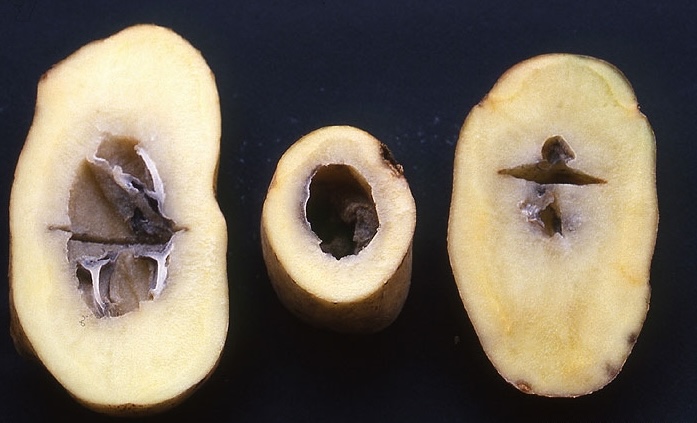
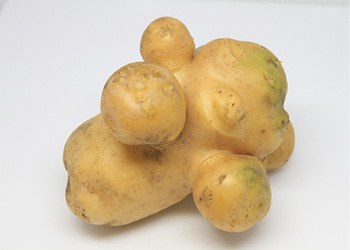
Heat /drought stress can also cause secondary growth or knobbiness on potato tubers (Figure on the right). Under the stress, normal cell division and tuber expansion are interrupted and paused. When better growing conditions return, cell division and tuber growth will resume, but in a different direction, leading to malformed tubers that are not marketable.
Some varieties, such as Russet Burbank, are more susceptible to hollow heart and knobbiness. Some tips to manage hollow heart and knobbiness:
Irrigation scheduling: Provide adequate and timely irrigation to cool the soil and reduce the impact of heat stress. Never allow soil moisture to drop below 65% of field capacity on the sands at this growth stage.
Nutrient management: Calcium is a key nutrient that can help potato plants reduce heat/drought stress and improve tuber quality. Calcium nitrate can help mitigate the adverse effects of heat/drought stress by reducing the damage caused by reactive oxygen species within the plants. Sufficient calcium can also help maintain normal cell functions under high soil temperatures, including the opening and closing of stomata and cell division. Meanwhile, nitrogen management is also crucial to ensure the general health of the plants.
Cultural practice: Maintain uniform planting depths and ensure proper soil drainage (linked to good soil health).
Vegetable Insect Update
Russell L. Groves, Professor and Associate Department Chairperson, UW–Madison, Department of Entomology, 608-262-3229 (office), (608) 698-2434 (cell), e-mail: rgroves@wisc.edu. Vegetable Entomology Webpage: https://vegento.russell.wisc.edu/
Aphids – https://vegento.russell.wisc.edu/pests/aphids/
Populations of aphids have been increasing on a range of commercial, field and specialty crops through late July and into August. The warm and dry conditions that prevailed throughout much of July contributed to population increases.
Also known as plant lice, aphids are soft-bodied, piercing-sucking insects that directly tap into the plant vascular system to feed. They feed on plant sap and excrete a sugary honeydew that attracts ants and creates the conditions for sooty mold, a type of fungus (saprophytic) that feeds on decaying organic matter.
There are several aphid species, all belonging to the insect family Aphididae, which can attack almost any type of vegetation. Aphids that pose the most serious problem to Wisconsin vegetable production include the green peach, melon, and potato aphids – all of which are vectors of problematic plant viruses.
It is difficult to generalize the life cycle of all aphids because of the diversity in their life history habits, which can range from single to multiple hosts as well as the number of generations produced within a season. One of the unique characteristics of aphids that sets them apart from all other insects is their ability to bear live young.
Aphids overwinter as eggs on a perennial, overwintering host. In spring, the eggs hatch and the aphids migrate onto their predominate summer host when it becomes available. Female aphids can then reproduce without mating and will hold the eggs in their bodies to give birth to live young so long as the quality of the host remains suitable. By eliminating mating and egg laying, aphids have successfully shortened their life cycle and thereby increased their reproductive capability.
Throughout the summer, wingless females predominate. However, winged forms often arise when populations become too large for the available food source, or the host plant quality deteriorates with seed set. In late summer, in response to the shortened daylight hours, wingless females and males are produced for the purpose of mating and laying fertilized eggs that will again find an overwintering host to survive adverse our winter conditions as eggs.
When scouting for aphids, look for “hot spots” of activity (feeding/infestation) scattered throughout the field. Because of the spotty nature of infestations, look for aphids on a number of plants in several areas. Depending upon the aphid species and associated host crops, it is important to examine the correct portion of the plant. In potatoes (looking for Green peach aphid (GPA) and Potato aphid (PA), examine the undersides of 25 whole leaves in middle and lower canopy positions of a plant in 8-10 locations within a field. In contrast, when scouting for corn leaf aphid (field, seed or sweet corn and sorghum), examine the terminals of 15-20 consecutive plants in 5-10 locations with a field and rate the plants as either infested or uninfested. Given the huge reproductive potential of aphids, an infestation level of 5%-10% indicates a potentially damaging infestation. Repeat checks at weekly intervals to determine the need to treat in each crop, respectively. It is important to re-emphasize, different aphid species will colonize different plant species, different locations within a plant, and can have vastly different economic injury levels based upon the crop to be harvested.
Reduced plant vigor, stunting and deformed plant parts are common symptoms of aphid infestations. In some cases, it is the production of honeydew or presence of sooty mold that alerts the producer to an aphid outbreak. Most important, aphids are excellent vectors of several viral pathogens, such as the mosaic viruses, which cause leaves to shrivel and that infect a wide range of hosts. In some cases, it is the appearance of virus symptoms that indicate aphid activity, or the occurrence of ants which often ‘tend’ or protect the aphids from natural enemies.


With special reference to seed potato production, growers are at risk of direct yield loss due to Potato virus Y (PVY) infection when levels exceed established tolerances. Commercial growers of fresh-market, processing, and chip potatoes are at risk of reduced yield and tuber storage quality if PVY-infected seed pieces are planted. Seed growers are at risk of having their lots downgraded or even rejected from certification due to PVY infection.
Seed versus Commercial Potato
Comparing commercial and seed potato production, the allowable numbers of potato-colonizing species (GPA, PA) that can be tolerated in a crop are very different. In early generation, foundation seed lots, our tolerance for GPA or PA populations is effectively ‘zero’. This is certainly a struggle, but with the amount of PVY inoculum planted in fields in 2024-26, the allowance of potato-colonizing species is ‘zero’.
For most aphid chemical management tools, the initial onset and timing of application occur with the appearance of the first, small colonies of potato-colonizing aphids. Spraying for colonizing aphids can reduce the spread of PVY within the field. Spray only when scouting indicates aphid populations have become established and scouts can identify small colonies of apterous (wingless) aphids. Critical factors affecting the efficacy of these spray applications include timing, application conditions and coverage.
Systemic insecticides applied at planting are critical components of early generation seed potato protection, however, they lose efficacy by mid-season. An initial foliar application should be applied to the entire field and followed by a second foliar application of the same formulated product no more than one week later (depending upon some label considerations). Only two successive applications of any compound should be implemented as a foliar option per crop season for control of colonizing aphids before rotation to a new mode-of-action. Continue to scout field throughout the time interval of the application series and consider rotation to another effective aphicide mode of action if colonizing aphids persist in the crop.
All compounds should be applied with a mild, penetrating surfactant and make efforts to ensure the tank pH is not alkaline (pH < 7.0). Ground-application is also advised as later season potato canopies can be quite dense and thorough coverage reaching the undersurface of a plant canopy is critical to contact colonizing aphids. In the commercial crop, treat fields with an appropriate insecticide when threshold levels have been reached or exceeded. One of the problems associated with the control of Green peach and melon aphids result from their resistance to several insecticides. In particular, Green peach aphids have been shown to develop resistance to several groups of insecticides including the organophosphate, carbamate and neonicotinoid insecticides. In commercial potatoes, aphid treatment thresholds depend heavily on production goals. For ware or processing crops, a common guideline is 5 to 10 wingless aphids per 25 leaves or treatment when populations are rapidly increasing.
Potato Field Day: How to Improve Groundwater Quality in Potato Systems Field Day – August 25 in Custer, WI
UW–Madison Extension is hosting a free Potato Field Day on Tuesday, August 25, from 10:00 a.m. to noon at 3429 County Rd Y, Custer, WI. This event explores innovative practices in potato cropping systems in the Wisconsin Central Sands aimed at maintaining profitability while protecting groundwater quality. Farmers, agronomists, and county land and water conservation districts will hear an overview of research solutions to water quality impacts in potatoes, results from an on-farm nitrogen rate trial, and a session on interseeding cover crops. The field day is sponsored and co-hosted by the Rural Partnership Institute and the Central Wisconsin Farmers Collaborative, a producer-led watershed group. Lunch is provided. For questions related to the event, contact Guolong Liang, Agriculture Water Quality Outreach Specialist, at gliang6@wisc.edu. For marketing questions related to this event, please contact Madeline Rastall, Communications Specialist, at madeline.rastall@wisc.edu.