Potato Pythium Leak
Description
Pythium leak is caused primarily by the soilborne oomycete, or “water mold” pathogen Pythium ultimum, now also referred to as Globisporangium ultimum. The pathogen persists in soil and most commonly infects tubers through wounds created during harvest and handling. Consequently, conditions at harvest can have a major influence on the amount of disease that ultimately develops in storage.
Symptoms
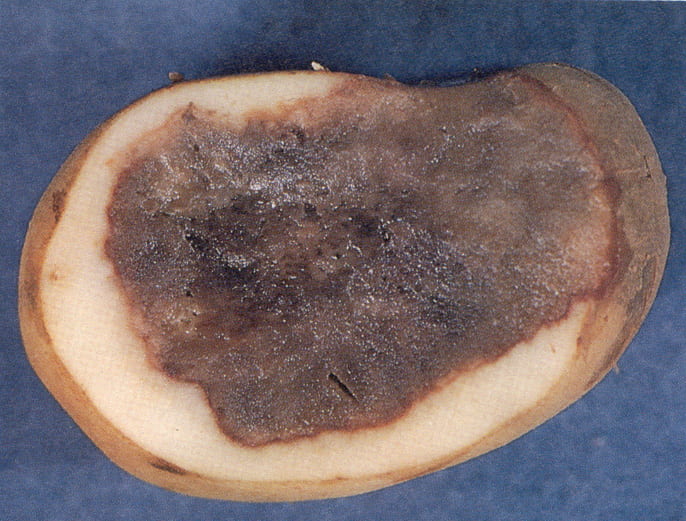
Early symptoms typically develop around a wound as light tan, water-soaked tissue. As infection progresses, the affected area becomes wet and spongy and may swell slightly. A distinct dark boundary can develop between diseased and healthy tissue. When infected tubers are cut open, internal tissue is generally grayish to brown, wet and spongy, and cavities may develop within the decayed tissue. One of the more characteristic symptoms gives the disease its name: when an infected tuber is squeezed, watery liquid may leak or stream from the affected tissue. With advanced decay, much of the internal tuber tissue can disappear, eventually leaving an empty, papery shell. Secondary bacterial soft rot organisms can quickly colonize Pythium-infected tissue, making symptoms less distinctive and greatly increasing breakdown in storage.
Favorable conditions
Although we most commonly think of Pythium leak as a disease initiated by tuber wounding at harvest, we have occasionally observed an unusual in-season expression of leak during particularly hot summers in Wisconsin. These cases have tended to appear during periods of sustained high temperatures in July and has been brought to my attention primarily in russet-type cultivars. In these situations, affected tubers may develop Pythium leak while still in the hill, well before normal harvest. High soil temperatures, combined with tuber physiological stress and conditions that may compromise the developing periderm or provide small sites for pathogen entry, appear to create an opportunity for infection. This is not the typical presentation of Pythium leak, but its occurrence over multiple hot production seasons is a useful reminder that Pythium risk does not necessarily begin with the harvester. When extended periods of high July temperatures occur, particularly in susceptible russet types, it can be worthwhile to include internal tuber inspection for leak symptoms during routine test digs.
Pythium leak is strongly favored by warm conditions, with disease development particularly favorable at approximately 77–86°F. Harvest injury is also critical because wounds provide important infection courts for the pathogen. The combination growers particularly want to avoid is therefore warm tubers, warm soil, and excessive harvest injury.
Hot, dry soil can increase tuber bruising and skinning during harvest, while high tuber pulp temperatures favor rapid Pythium infection and disease development. Potatoes already affected by physiological problems such as pink eye, enlarged lenticels, or compromised skin set may also be more vulnerable to post-harvest decay.
Management
There is no single practice that eliminates Pythium leak. Management instead depends on reducing opportunities for infection and getting harvested tubers through wound healing as successfully as possible. Key considerations include:
- Avoid harvesting during the hottest portion of the day when possible, particularly when soil and tuber pulp temperatures are high.
- Minimize tuber injury. Adjust harvesters, drops, conveyors and handling equipment to reduce cuts, abrasions and bruising.
- Pay attention to soil moisture. Extremely dry soil can increase harvest injury, while excessive moisture can favor water mold diseases and create additional tuber quality problems.
- Monitor tuber pulp temperature. Warm harvested tubers are at greater risk and deserve particular attention during storage loading.
- Remove badly damaged or decaying tubers when practical rather than carrying them into storage.
- Provide conditions that promote rapid wound healing after harvest and carefully manage ventilation as tubers are brought to appropriate storage temperatures.
- Monitor problem lots closely. Fields or loads with substantial harvest injury, pink eye, enlarged lenticels, poor skin set, or evidence of Pythium leak deserve additional attention during storage.
Fungicides can be useful components of a Pythium leak management program, but they should supplement rather than replace harvest and storage management. The biology of this disease makes preventing tuber injury and managing temperature particularly important.
In-season applications
Mefenoxam-containing products (FRAC 4) have historically been used for management of Pythium leak and pink rot in potato. Phosphorous acid/phosphite products (FRAC P07; historically referred to as FRAC 33) also have labels for potato tuber rot diseases, with some products permitting in-furrow and/or foliar applications.
Programs may begin at planting or around tuber initiation depending upon the specific product and label.
Where a field has a history of Pythium leak, an in-season fungicide program can be considered as one component of the management strategy. However, efficacy against leak is not always consistent, particularly because infection can occur through fresh wounds very late in the production cycle or during harvest. In addition, reduced sensitivity or resistance to mefenoxam has been documented in populations of Pythium-like pathogens in potato production regions. Fungicide selection should therefore be integrated with field history, disease risk, resistance-management considerations, and the current product label.
Post-harvest treatment
Phosphorous acid products are among the more useful tools available for treating tubers as they enter storage. Certain products are labeled for post-harvest application for suppression or control of Pythium leak, pink rot and late blight tuber rot. These treatments will not restore tissue that is already extensively infected, but they can help reduce disease development and spread as tubers move through handling and into storage.
Research has also evaluated the post-harvest premix of azoxystrobin + difenoconazole + fludioxonil (Stadium) against Pythium leak, with disease reduction demonstrated in some experimental studies and cultivars. Importantly, however, Pythium leak is not currently a labeled disease target for Stadium, so it should not be recommended specifically for leak management. For Wisconsin growers, the current Commercial Vegetable Production in Wisconsin recommendations should be consulted for product choices, rates, application timing, pre-harvest intervals and restrictions. Always follow the current pesticide label; labels supersede general recommendations. https://vegpath.plantpath.wisc.edu/resources/a3422/
Pythium leak can occur alongside several other harvest and storage diseases, including pink rot, bacterial soft rot, late blight tuber rot, and Fusarium dry rot. Once secondary organisms become established, visual diagnosis can become especially difficult. A useful clue for Pythium leak is the combination of a wound-associated lesion, very wet and spongy internal decay, a distinct dark boundary between diseased and healthy tissue, and water released from affected tissue when pressure is applied. Pink rot, in comparison, typically produces a more rubbery rot in which freshly cut infected tissue develops a characteristic pink-to-salmon discoloration after exposure to air. Bacterial soft rot generally produces very soft, cream-to-tan, granular tissue and can rapidly obscure the symptoms of the primary disease.
When significant tuber decay is appearing in a field or storage, accurate diagnosis is worthwhile because management decisions—and the potential for disease to progress during storage—differ among these diseases.
Pythium leak is primarily a disease of opportunity associated with warm tubers and injury. The pathogen may already be present in the soil; our goal is to minimize the opportunities it has to infect. For most crops, the strongest management program combines several approaches: know the field history, consider an appropriate in-season fungicide program where risk warrants it, scout tubers during hot weather, harvest under favorable conditions, minimize injury, manage tuber temperature, promote wound healing, and consider an appropriate labeled post-harvest treatment for higher-risk lots. If test digs reveal Pythium-like decay, pink eye, enlarged lenticels, poor skin set, or other tuber abnormalities, that information can be valuable before the crop disappears into the pile. Higher-risk fields can then be harvested, treated, stored and monitored accordingly.
For diagnostic and management support in Wisconsin, please consider contacting Dr. Amanda Gevens (gevens@wisc.edu) or our Plant Disease Diagnostic Clinic (pddc@wisc.edu).
Last updated: