Tomato Bacterial Canker
Description
Tomato Bacterial Canker has been diagnosed on a number of Wisconsin farming operations this summer so far. This potentially serious disease of field- and greenhouse-grown tomatoes caused by the bacterium Clavibacter michiganensis (historically referred to as Clavibacter michiganensis subsp. michiganensis). The disease can be particularly challenging because the pathogen can infect plants systemically, move readily during transplant production and routine crop handling, and cause substantial losses once established. In Wisconsin, bacterial canker has periodically been confirmed in commercial tomato production, and rapid recognition and containment are important when the disease is suspected. Laboratory confirmation is strongly recommended because several other tomato diseases and abiotic disorders can produce similar symptoms.


Where did it come from?
When bacterial canker appears in a greenhouse or field, one of the first questions is often, “How did it get here?” Unfortunately, there can be several answers. Contaminated seed is an important pathway for introducing Clavibacter into tomato production. Even a relatively low incidence of contaminated seed can be consequential when many seedlings are produced together in a greenhouse. Infected transplants are another important route of introduction into production fields. Plants can harbor the bacterium without immediately showing obvious symptoms, allowing apparently healthy transplants to move the pathogen from a propagation facility into the field.
Once present, Clavibacter can spread efficiently through activities that move plant sap or water between plants. Pruning, clipping, tying, staking, grafting, harvesting, transplant handling and other operations that wound plants can facilitate transmission. Contaminated knives, clippers, stakes, hands, gloves, equipment and other surfaces can move the bacterium from infected to healthy plants. Splashing water and overhead irrigation can contribute to localized spread as well. The bacterium can also survive in infected tomato debris and on contaminated production materials, making sanitation between crops particularly important.
For Wisconsin growers experiencing an outbreak, it is useful to work backward through the production system. Consider the seed lot and source, transplant supplier or propagation greenhouse, transplant trays and equipment, movement of workers between plantings, pruning and staking practices, irrigation system, and whether stakes, clips, trays or other materials were reused from previous tomato crops. Identifying the likely introduction pathway can be just as important as managing the current outbreak because it helps prevent recurrence.
Symptoms of bacterial canker
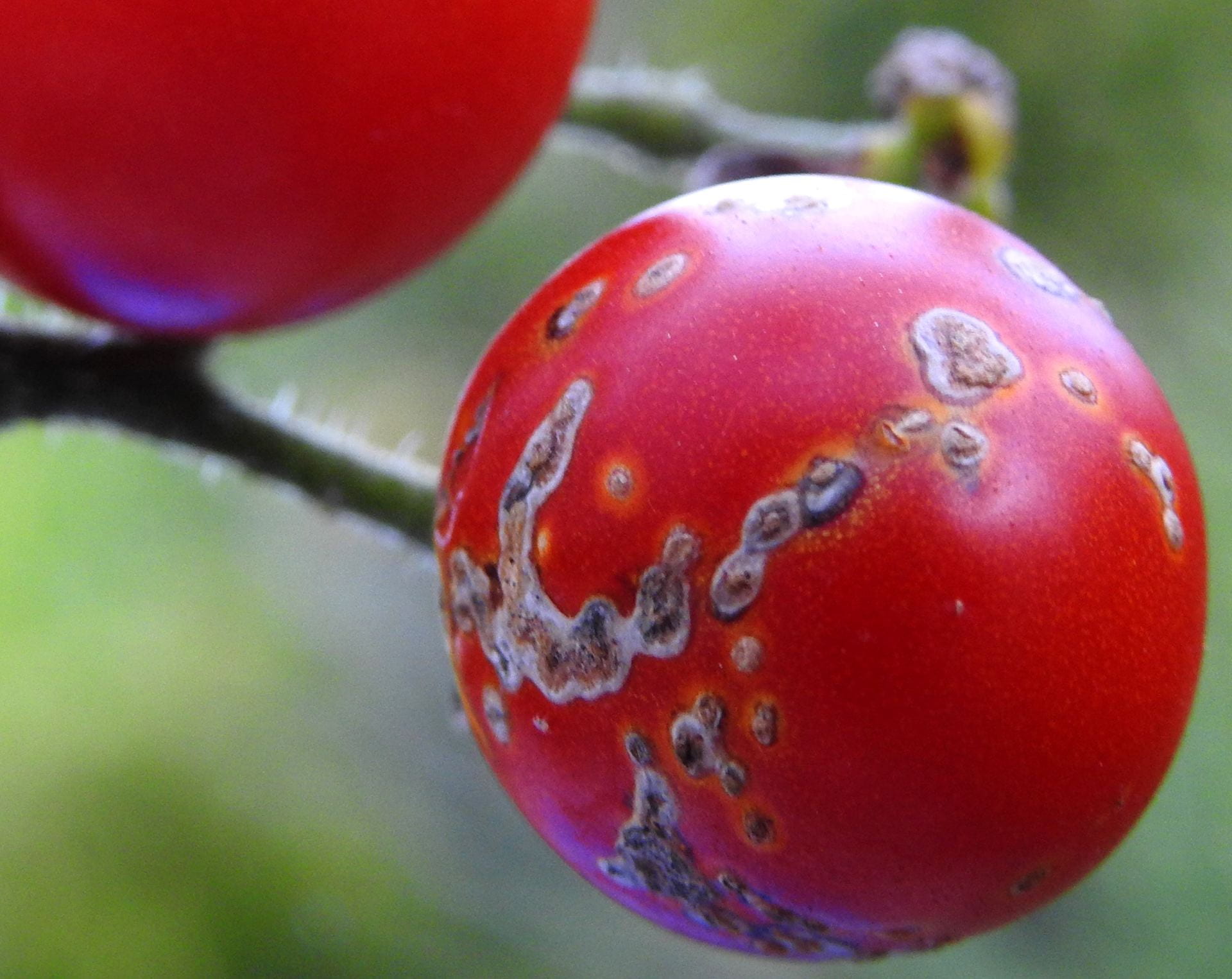
Symptoms can vary considerably depending on plant age, environmental conditions and whether infection is systemic or localized. This variability is one reason that field diagnosis alone can be unreliable. Systemically infected plants may initially appear unthrifty, followed by yellowing, curling and wilting of leaves. A particularly useful symptom is unilateral wilting, in which leaflets on one side of a leaf or portions of the plant wilt while the opposite side remains relatively healthy. As disease progresses, entire branches or plants may wilt and die. Internal stem tissues can become discolored, particularly the vascular tissue, and advanced infections may produce stem splitting or canker-like lesions.
Fruit symptoms can be especially diagnostic. Small, raised lesions may develop with a light-colored center surrounded by a darker halo—the classic “bird’s-eye spot.” However, not every infected plant or fruit will develop this textbook symptom. Systemically infected plants can also produce fruit that appears relatively normal externally while harboring the pathogen. Symptoms can overlap with those caused by bacterial spot, bacterial speck, vascular wilts and some environmental or physiological disorders. Do not rely solely on visual symptoms to make a bacterial canker diagnosis.
Wisconsin commercial growers who suspect bacterial canker should submit symptomatic plants to the UW–Madison Plant Disease Diagnostics Clinic (PDDC) for confirmation. The clinic provides plant disease identification and management recommendations for Wisconsin agricultural and horticultural producers. When possible, submit whole symptomatic plants or substantial portions of plants that include both symptomatic and apparently healthy tissue, rather than only dead or severely deteriorated material. Plants showing early wilting or vascular symptoms can be particularly useful. Including photographs showing the distribution of affected plants in the greenhouse or field and information about cultivar, seed or transplant source, planting date, symptom onset and distribution can also help with diagnosis.
The PDDC currently accepts physical samples and digital photo submissions. Current submission instructions should be checked before sending samples. UW–Madison Plant Disease Diagnostics Clinic, Department of Plant Pathology, 1630 Linden Drive, Madison, WI 53706-1598, Phone: 608-262-2863, Email: pddc@wisc.edu UW–Madison Plant Disease Diagnostics Clinic
Managing Bacterial Canker
There is no curative treatment for a tomato plant that is systemically infected with bacterial canker. Management therefore needs to focus on removing sources of inoculum and preventing movement of the bacterium to healthy plants.
For a greenhouse or transplant operation, a confirmed diagnosis should trigger an immediate review of the extent of the problem. Stop routine handling of the affected crop while the situation is being assessed. Flag symptomatic plants and avoid moving workers, tools or equipment from the affected area into apparently healthy tomato production areas. Remove confirmed and strongly suspect plants carefully so that they do not contact neighboring plants. Do not carry infected plants through healthy production areas unnecessarily.
Sanitation becomes critical. Clippers, knives and other tools should be disinfected frequently and certainly between affected and unaffected production areas. Clean and disinfect benches, carts, transplant equipment and other surfaces that may have contacted infected plants. Disposable gloves should be changed appropriately, and workers should move from healthy plants toward suspect or affected areas. Reusable transplant trays, stakes, clips and similar materials deserve scrutiny. Porous materials such as wooden stakes can be especially difficult to adequately sanitize. Where feasible, heavily contaminated or difficult-to-disinfect materials should be discarded rather than carried into another tomato crop.
In field production, identify the affected area and minimize operations that can mechanically move bacteria while plants are wet. If cultivation, tying, pruning or harvesting must continue, work healthy portions of the field first and affected areas last. Clean and sanitize equipment before moving to another tomato field.
Copper-containing bactericides may provide some protection against secondary surface infection, particularly when applied preventively, but they will not eliminate systemic Clavibacter infections or cure infected plants. Chemical management should therefore never substitute for sanitation, exclusion and removal of infected plants. Any pesticide application must follow the current Wisconsin-registered product label.
Management should continue after harvest. Remove tomato crop debris as thoroughly as practical and control volunteer tomatoes and susceptible solanaceous weeds that could help maintain the pathogen. Clean and disinfect greenhouse structures, production surfaces, tools and reusable equipment before beginning another tomato crop. In fields with a confirmed outbreak, rotate away from tomato and other susceptible solanaceous hosts; survival in infested crop debris can extend across multiple seasons. For future plantings, prevention begins with high-quality seed and transplants from reputable sources with appropriate bacterial disease management and testing programs. Hot-water seed treatment can be helpful in reducing viable pathogen associated with seed (122°F for 25 minutes, more info: https://hort.extension.wisc.edu/articles/hot-water-seed-treatment-for-disease-management/). Keep seed lots and transplant sources documented so that potential problems can be traced. In transplant production, minimize unnecessary plant handling, avoid working plants when wet, sanitize cutting and grafting tools frequently, and avoid moving workers and equipment from suspect lots into clean lots.
In summary, bacterial canker is a disease where exclusion and sanitation are much more effective than attempting to manage an established outbreak. Contaminated seed or transplants can introduce Clavibacter into a production system, and subsequent plant handling can amplify a small introduction into a much larger problem. If suspicious wilting, vascular discoloration, stem symptoms or bird’s-eye fruit lesions appear, isolate the affected area, minimize plant handling, and obtain a laboratory diagnosis quickly. Once confirmed, concentrate on removing infected plants, preventing mechanical spread, aggressively sanitizing the production system, and identifying the likely source of introduction so that the problem is not carried into the next crop. For diagnostic assistance, please contact me (gevens@wisc.edu) or the UW–Madison Plant Disease Diagnostics Clinic at 608-262-2863 or pddc@wisc.edu.
For diagnostic and management support in Wisconsin, please consider contacting Dr. Amanda Gevens (gevens@wisc.edu) or our Plant Disease Diagnostic Clinic (pddc@wisc.edu).
Last updated: