Beet Rhizomania
Description
Rhizomania is the name of a beet disease caused by Beet necrotic yellow vein virus (BNYVV) which is transmitted by the persistent soilborne organism Polymyxa betae. In 2025, the disease was confirmed for the first time in Wisconsin table beet production.
This disease is best known for its severe impacts on sugar beet systems, but table beet (Beta vulgaris) is also susceptible. Rhizomania primarily infects Beta genus plant species including sugar beet, table/red beet, and Swiss chard. Some weed hosts can be infected, which may help maintain populations in the soil. The pathogen can persist in soil for many years (10-15 years) due to long-lived resting spores of its vector, the microscopic soilborne organism Polymyxa betae, making early awareness and proactive management essential.
Characteristics of the disease
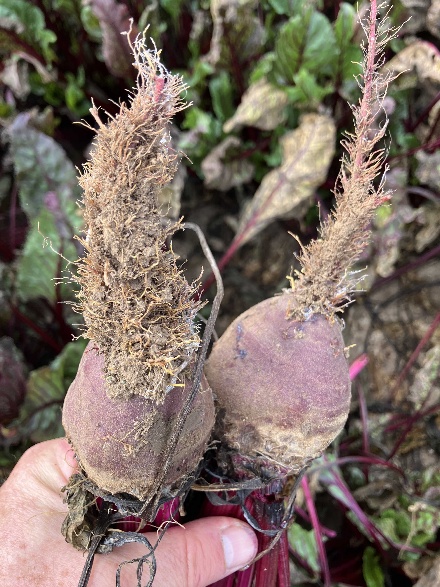
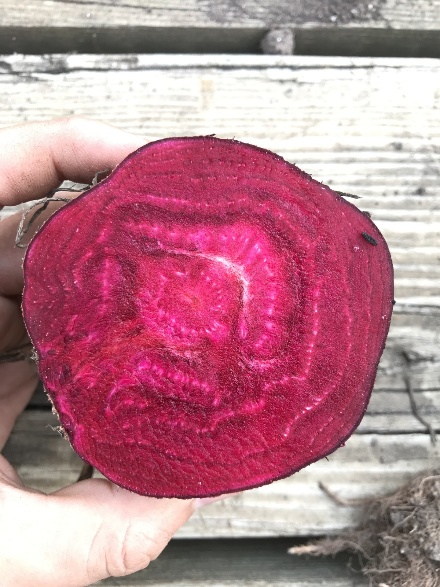
The BNYVV, once transmitted into beet root cells, disrupts sugar transport and hormonal balance in the plant. This leads to the proliferation of lateral roots giving the characteristic “bearded” or “hairy root” appearance of the beet root. White or pale pink “zoning” can sometimes be observed in infected roots. Polymyxa betae itself causes minimal direct damage to beet plants. Above ground, the plants show yellowing, wilting, patchy field decline, and yield loss due to reduce sucrose accumulation in the taproot. Figure 1, courtesy of Irwin Goldman of the University of Wisconsin–Madison depicts the hairy roots characteristic of Rhizomania on beet; and Figure 2, courtesy of Ethan Tippett and Mary Hausbeck of Michigan State University depicts the white/pale pink “zoning” when the root is transected.
Polymyxa betae is an obligate parasite of plant roots and cannot be cultured on standard media in the laboratory. It is not a true fungus, but is a plasmodiophorid protist surviving as durable resting spores (cystosori) that can persist for many years in the soil. The resting spores, embedded in root tissue develop to release swimming spores (zoospores) under moist soil conditions and temperatures ranging from 15-25°C (59-77°F).
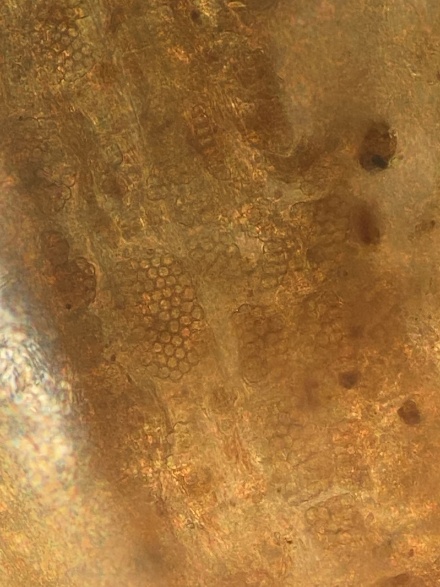
Figure 3, courtesy of Ethan Tippett and Mary Hausbeck of Michigan State University depicts the resting spores embedded in root tissue. The zoospores infect young beet roots through root hairs or epidermal cells and pass the BNYVV particles from the resting spores to the new beet plant host. Once inside the cell, the organism forms a gelatinous mass, referred to as a plasmodium, and ultimately new resting spores form within the root tissue for return to the soil – completing the life cycle of the pathogen. The disease is favored by wet soil and can spread within and between fields via infested soil on equipment, boots, and water.
Management
Growers are encouraged to intensify field scouting, especially in low-lying or poorly drained areas, practice strict sanitation to reduce soil movement, and document any suspicious patches for diagnostic confirmation. Where feasible, rotation out of beets and other susceptible hosts for multiple years, improving drainage, and consulting seed suppliers regarding rhizomania tolerance are important components of integrated disease management moving forward in Wisconsin. Once established, this disease is extremely difficult to eradicate due to the long-lived resting spores. Disease management strategies are focused on:
- Using resistant beet varieties including Grenade, Redval, Manzu, Palau as characterized by Michigan State Univ. (https://www.canr.msu.edu/news/managing-rhizomania-a-new-disease-for-michigan-red-beets)
- Preventing the movement of infested soil: power-wash equipment with soapy water after working in infested fields (including tillage equipment, planters, harvest cribs, and wheels of tractors, sprayers, and wagons); work infested fields after non-infested fields; practices are important even in years you are not growing beets as the soil will still contain the pathogen
- Avoiding dumping of infected and/or infested culls into production fields: cull beets and soil clinging to them can carry the pathogens
- Improving soil drainage: reduces the conditions which promotion zoospores production and infection of the pathogen and transmission of the virus
Where did the Rhizomania pathogen and vector come from?
Polymyxa betae is considered a naturally occurring soilborne protist that has long-existed in temperate and subtropical regions wherever host plants in the Amaranthaceae family (beets, spinach, chard, etc.) grow. Molecular and ecological studies indicate that P. betae is cosmopolitan, with divergent local genotypes.
Polymyxa betae was first described in Europe (1930s) as a plasmodiophorid parasite of beet roots, before BNYVV was understood. Rhizomania disease (caused by BNYVV, vectored by P. betae) was first recognized in Italy in 1952 and spread across Europe in subsequent decades. The vector (P. betae) itself was likely already widespread in beet-growing soils long before the virus spread — meaning the disease’s emergence followed introduction of the virus, not the vector.
In North America, P. betae has been present naturally in North American soils for decades, likely since before modern agriculture. What changed historically was the introduction of BNYVV onto the continent. Rhizomania was first detected in California in 1983, then spread through Idaho, North Dakota, Minnesota, Michigan, and Canada during the 1980s–1990s.
Additional resources
- Michigan State University – Rhizomania on red/table beets in Michigan. https://www.canr.msu.edu/news/managing-rhizomania-a-new-disease-for-michigan-red-beets
- Oregon State University Extension – Rhizomania on Sugar Beet. https://extension.oregonstate.edu/catalog/pub/pnw-657-rhizomania-sugar-beet-importance-identification-control
- University of California – IPM – Rhizomania in Sugarbeet – Integrated pest management overview with symptoms, causal agent, and resistant variety recommendations. https://ipm.ucanr.edu/agriculture/sugarbeet/rhizomania/
- University of Idaho/Rhizomania Publication (PNW0657) – Extension publication focused on detection and cultural control, including use of resistant varieties. https://www.uidaho.edu/extension/publications/pnw-0657
- CropWatch (University of Nebraska–Lincoln) – Rhizomania – Includes cultural practices and resistant varieties as part of management. https://cropwatch.unl.edu/plant-disease/sugarbeet/rhizomania
- American Phytopathological Society (APS Educational Center – Plant Health Instructor) – Overview of Rhizomania of Sugar Beet with disease biology and context. https://www.apsnet.org/edcenter/pdlessons/Pages/Rhizomania_of_Sugar_Beet.aspx
- ScienceDirect – Rhizomania Topic Page – Aggregated scientific content on rhizomania, including breeding and resistance research. https://www.sciencedirect.com/topics/agricultural-and-biological-sciences/rhizomania
- Plant Pathology Journal – Control of rhizomania in sugar beet — A success story – a recent research article on breeding and resistant variety outcomes. https://bsppjournals.onlinelibrary.wiley.com/doi/10.1111/ppa.14007
For diagnostic and management support in Wisconsin, please consider contacting Dr. Amanda Gevens (gevens@wisc.edu) or our Plant Disease Diagnostic Clinic (pddc@wisc.edu).
Last updated: