Vegetable Crop Update – Jul 26, 2026
In this issue:
Vegetable Production Update
Yi Wang, Associate Professor & Extension Potato and Vegetable Production Specialist, UW–Madison, Dept. of Plant and Agroecosystem Sciences, 608-265-4781, Email: wang52@wisc.edu.
Dry Weather and Irrigation Considerations for Vegetables
According to the UW–Madison Extension Weather Outlook, much of the state is dry. Temperatures were 6-8°F above normal statewide. Heat indices exceeded 100°F over a few days. Total rainfall amounts were mostly at or below ¼’’ except the western side of the state. Overall, the last month had precipitation totals below 75% of normal or less across the entire state. Most of Wisconsin has drier-than-normal soils in the top one meter (40’’).
The July-August transition outlook showed that temperatures lean towards near normal for most of the state, with precipitation tending to be below normal.
With the ongoing long dry spell, it is important to stay on efficient irrigation scheduling for gardening vegetables. Below are some practices to keep in mind:
1. Use drip irrigation
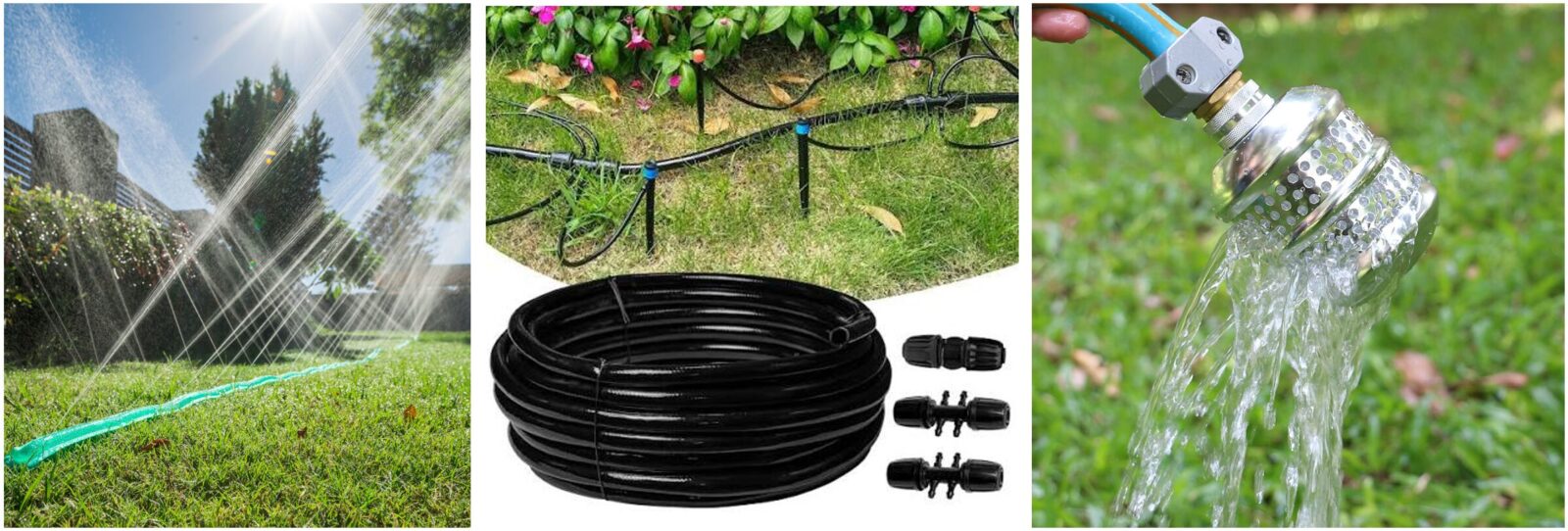
Drip or trickle irrigation is a good option for reducing water usage up to 50%, depending on the vegetable. The soaker hose, which allows water to seep out along its length at a low rate, is one of the least expensive and easiest to use in a vegetable garden. They typically run at low pressures for about 10-15 minutes per irrigation event. Other options include tubes with holes for water to drip out, and a hose bubbler, a hose-end attachment that irrigates the bases of plants.
2. Time your irrigation
Water during early morning, when wind is low and temperatures are cool.
3. Check soil moisture regularly
Check soil moisture regularly to avoid over-application. Squeeze soil in your palm; if it sticks together and does not collapse, it is moist, and irrigation should be delayed. If the soil has dried out to a depth of 4 inches, plan to water. This is especially important if using mulch, where water can be held in the soil for longer periods of time. Place soaker hoses or drip irrigation under the mulch used in the vegetable garden.
4. Know the critical watering periods for vegetable crops
Know the critical watering periods for vegetables and target the timing and amount of water accordingly. As a rule of thumb, water is most critical during the reproductive stages, which are flowering and fruit production. The critical watering periods for selected vegetables follow:
- Asparagus – Spear production, fern development.
- Cole crops: broccoli, cabbage, and cauliflower – The quality of cole crops is significantly reduced if the plants get dry anytime during the growing season. Water use is highest and most critical during head development.
- Beans – Beans have the highest water use of any common garden vegetable, using ¼ to over ½ inch of water per day, depending on natural rainfall and wind. Blossoms drop with inadequate moisture levels, and pods fail to fill. On warm, windy days, blossom drop is common. When moisture levels are adequate, the bean plant is a bright, dark grass green. As plants experience water stress, leaves become slightly grayish in color. Water is needed at this point to prevent blossom drop.
- Carrot and other root crops – These crops require a constant supply of moisture and are intolerant of dry soils. Cracking, misshaped, and hot-flavored root crops are symptoms of water stress.
- Corn – Water demand for sweet corn is most critical during tasseling, silking, and ear development. Yield is directly related to quantities of water, nitrogen, and spacing. Water stress delays the silking period but not tasseling. Under mild water stress, the crop may tassel and shed pollen before silks are ready for pollination. The lack of pollination may reduce yields or even eliminate ear production.
- Lettuce and other leafy vegetables – Water demand is most critical during head (leaf) development. For quality produce, these crops require a constant supply of moisture. They are intolerant of dry soils.
- Onions – Onions have an inefficient rooting system, making irrigation management a key factor in produce quality. They require a constant supply of moisture and are intolerant of dry soils.
- Peas – Water demand is most critical during pod filling.
- Potatoes – If potatoes become overly dry during tuber development, tubers will be knobby and develop hollow heart. Tuber yield and fry color will also be jeopardized.
- Tomatoes, peppers and eggplants – Water demand is most critical during flowering and fruiting. Blossom-end-rot (a black sunken area on the bottom of the fruit) is a symptom of too much or too little water. Those vegetables have a lower water requirement than many other vegetables, and therefore plants are often over-watered in home gardens.
- Cucurbits: cucumbers, summer and winter squash, and assorted melons – Water demand is most critical during flowering and fruiting. Cucurbits also use less water and could be over-watered.
5. Use mulch to limit evaporation
Mulching minimizes evaporation of water from the soil surface, reducing irrigation need. In the vegetable garden, use an organic mulch to a depth of 1-3 inches, depending upon the particle size of the mulching material. The larger the particle, the thicker the mulch layer should be. Mulch only after the soil has warmed sufficiently. Do not use wood or bark chips in a garden setting that requires annual soil preparation. The chips will interfere with future seedbed preparation.
Grass clippings make excellent mulch for the vegetable garden. Apply fresh clippings in thin layers (up to ¼ inch thick) and allow each layer to dry completely before adding more. The clippings quickly dry down, and additional layers can be added weekly. Do not place fresh clippings in thick piles, as they will mat, decay, and smell foul. Do not use clippings from lawns that have been treated with herbicides or other pesticides in the past month. A couple of sheets of newspaper may be used under the clippings to help control weeds. Do not apply newspapers more than a couple of sheets thick, or a soil carbon-to-nitrogen imbalance may occur. Do not use glossy print materials; their inks may not be eco-friendly soy-based like newspapers.
Vegetable Disease Update
Amanda Gevens, Professor & Extension Vegetable Pathologist, UW–Madison, Dept. of Plant Pathology, 608-575-3029, gevens@wisc.edu
Current P-Day (Early Blight) and Disease Severity Value (Late Blight) Accumulations
Thanks to Ben Bradford, UW- Madison Entomology for supporting this effort and providing a summary reference table: https://agweather.cals.wisc.edu/thermal-models/potato. A Potato Physiological Day or P-Day value of ≥300 indicates the threshold for early blight risk in potato and triggers preventative fungicide application. A Disease Severity Value or DSV of ≥18 indicates the threshold for late blight risk and triggers preventative fungicide application in potato. Data from the modeling source: https://agweather.cals.wisc.edu/vdifn are used to generate these risk values in the table below. I’ve estimated early, mid-, and late planting dates by region based on communications with stakeholders. These are intended to help in determining optimum times for preventative fungicide applications to limit early and late blight in Wisconsin.
| Location | Planting Date | 50% Emergence Date | Disease Severity Values (DSVs) through 7/25/26 | Potato Physiological Days (P-Days) through 7/25/26 | |
| Spring Green | Early | Apr 10 | May 7 | 26 | 612 |
| Mid | May 5 | May 20 | 24 | 540 | |
| Late | May 16 | June 2 | 24 | 444 | |
| Arlington | Early | Apr 12 | May 8 | 12 | 608 |
| Mid | May 6 | May 23 | 12 | 533 | |
| Late | May 20 | June 4 | 12 | 436 | |
| Grand Marsh | Early | Apr 13 | May 9 | 27 | 583 |
| Mid | May 6 | May 22 | 27 | 524 | |
| Late | May 21 | June 5 | 27 | 418 | |
| Hancock | Early | Apr 14 | May 11 | 21 | 575 |
| Mid | May 10 | May 30 | 20 | 461 | |
| Late | May 23 | June 6 | 19 | 407 | |
| Plover | Early | Apr 15 | May 12 | 21 | 577 |
| Mid | May 10 | May 30 | 19 | 465 | |
| Late | May 25 | June 6 | 18 | 412 | |
| Antigo | Early | May 12 | May 29 | 25 | 451 |
| Mid | May 25 | June 5 | 25 | 405 | |
| Late | June 8 | June 20 | 14 | 292 | |
| Rhinelander | Early | May 15 | June 6 | 18 | 387 |
| Mid | May 28 | June 10 | 16 | 350 | |
| Late | June 9 | June 25 | 10 | 254 | |
Late blight of potato/tomato
With the exception of the Arlington and northern-most, later-season plantings, Wisconsin potato production regions have accumulated Disease Severity Values or DSVs at or surpassing the action threshold of 18. However, in the past week, there was no accumulation of DSVs across the state. Fields with ≥18 DSVs should receive preventative fungicide applications to manage for late blight. https://vegpath.plantpath.wisc.edu/diseases/potato-late-blight/ An updated list of fungicides for management potato late blight in Wisconsin 2026 is provided here: https://vegpath.plantpath.wisc.edu/resources/late-blight-fungicides/
Early blight of potato
Most potato fields south of Rhinelander have surpassed the treatment threshold of 300 P-Days. Preventative fungicide applications are warranted for these fields. In the past week regions of the state accumulated between 51 and 61 P-Days, similar to the accumulation in the previous week. For support in selecting fungicides, please consult the A3422 Commercial Vegetable Production in Wisconsin: https://vegpath.plantpath.wisc.edu/resources/a3422/
In my early blight trials at Hancock, the disease was quite limited in spread over the past 2 weeks. Plants are showing overall health stress, however, with hotter-than-typical temperatures in the previous week.
Potato Blackleg and Aerial Stem Rot
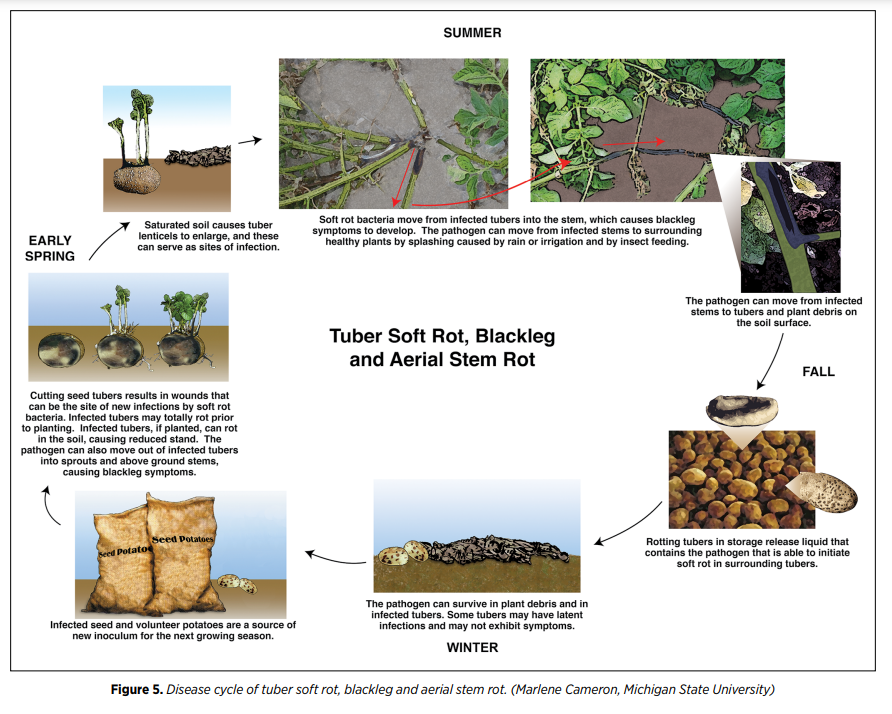
blackleg on potato caused by pectolytic bacteria, primarily Pectobacterium spp. has been abundant in fields in Wisconsin over the past week or so. Samples processed through our UW Plant Disease Diagnostic Clinic in the past few years have resulted in findings of Pectobacterium carotovorum subsp. carotovorum and Pectobacterium parmentieri primarily. Other pathogens that can be associated with these symptoms can include Pectobacterium atrosepticum and Dickeya spp. (The content below includes some elements from Dr. Amy Charkowski formerly of Colorado State Univ. now with the University of British Columbia, Dr. Phillip Wharton of Univ. of Idaho & a Blackleg, aerial stem rot, and tuber soft rot fact sheet from Michigan State Univ.).
Disease Background
The primary bacterial pathogens that cause aerial stem rot, potato blackleg and tuber soft rot are Pectobacterium atrosepticum, P. carotovorum, P. wasabiae, P. parmentieri, and more recently in the U.S., Dickeya spp. Previously, all of these pathogens were grouped in the same genus Erwinia. Dickeya and Pectobacterium affect many host species including potato, carrot, broccoli, corn, sunflower and parsnip; legumes and small grains are not known hosts. Dickeya dianthicola was confirmed in the eastern U.S. in just 2015, causing significant potato losses in some areas. Dickeya appears to spread over long distances via seed potatoes, was first reported in the Netherlands in the 1970s, and has since been detected in many other European countries, and now the U.S.
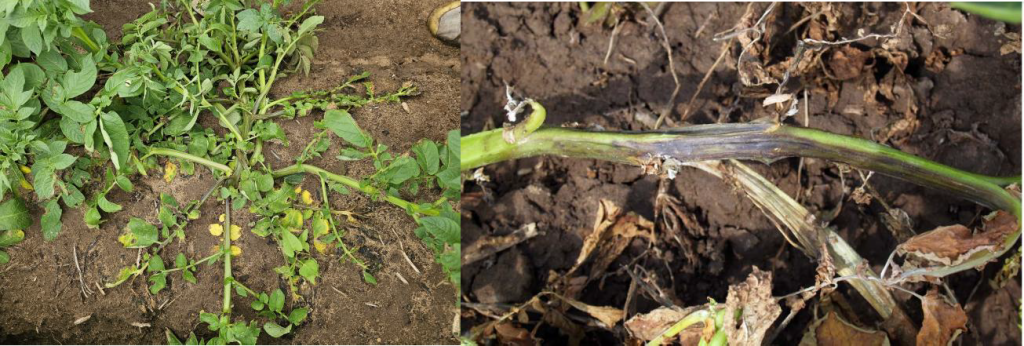
This summer, so far in Wisconsin, has yielded blackleg and aerial stem rot primarily caused by Pectobacterium spp. Under the right environmental conditions, infection of seed with blackleg pathogens can result in symptoms including poor emergence, chlorosis, wilting, leaf curling, tuber and stem rot, and darkened or black stems which are slimy, and death. These symptoms result from the cell-wall-degrading enzyme activity of the bacteria within the plant tissues on which they infect.
Aerial stem rot, blackleg and soft rot bacterial diseases are typically promoted by cool, wet conditions at planting and high temperatures after emergence. While the pathogens can be spread in infested seed, other sources of inoculum include soil, irrigation water, and insects. Levels of infection are dependent upon seed-handling/cutting techniques, soil moisture and temperature at planting and emergence, cultivar susceptibility, severity of infection of seed, and potentially, amount of bacteria in irrigation water, cull piles, or other external sources. Sanitation and disinfesting of potato cutting equipment and proper handling reduces spread and aids in control of the pathogen.
Treating seed to prevent seed piece decay by fungi can also contribute to blackleg control. Since the pathogen does well in cool, wet soils, avoid planting in overly wet soil. Crop rotation away from potato for 2-3 years for Pectobacterium and less than 1-2 years for Dickeya species will help control this disease as the bacteria do not survive well in soil. While seedborne or vascular blackleg (internal inoculum) cannot be reversed with applications of fungicides or bacteriacides, spread of the bacterial pathogen from infected to healthy plants and aerial stem rot (following damage to plants) may be managed in the field with fungicide tank-mixes that contain copper.
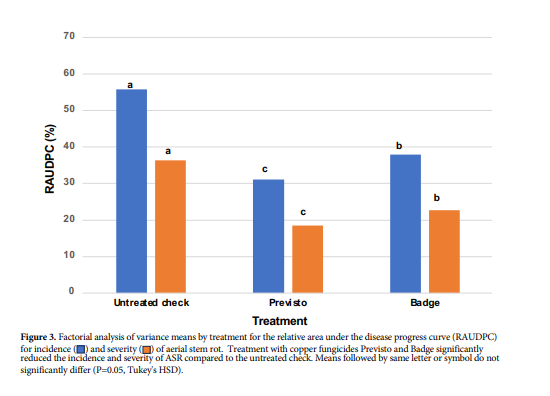
In 10 years of field trials in Idaho (under the direction of Dr. Phillip Wharton of Univ. of Idaho) evaluating weekly applications of copper-containing fungicides, aerial stem rot was most effectively controlled with Previsto (reduced disease incidence and severity by 25 and 18% respectively). Previsto is a Gowan product with 5% copper hydroxide. Badge also significantly reduced aerial stem rot when applied weekly (reduced disease incidence and severity by 18 and 14% respectively). Badge is also a Gowan product with 16.81% copper oxychloride and 15.36% copper hydroxide. Most often, conditions that favor plant-to-plant spread include high winds and driving rains or heavy overhead irrigation. Cultivars vary in susceptibility and some can have a tendency for lower canopy leaf scarring providing infection sites for stem rotting bacteria.
In work by Dr. Dennis Johnson of Washington State University, the famoxadone+cymoxanil (Tanos) plus mancozeb tank-mix alternated with mancozeb+copper hydroxide (ie: Kocide) was an effective chemical tool in reducing aerial stem rot in potato. Irrigation management to reduce excess water also greatly enhanced control of aerial stem rot. Copper hydroxide applications alone did not have as effective of control as Tanos+copper hydroxide. As Tanos is also an excellent late blight control material, its use as we surpass DSVs of 18 at this time offers an appropriate program for control of both diseases.
Although disease symptoms are often indistinguishable from those of the more established blackleg pathogen Pectobacterium spp., Dickeya spp. can initiate disease from lower inoculum levels, have a greater ability to spread through the plant’s vascular tissue, are considerably more aggressive, and have higher optimal temperatures for disease development. Dickeya is not a good soil survivor (generally <2 years) and rotation out of potato for at least 3 years will greatly reduce the disease. Dickeya and Pectobacterium thrive in water and low oxygen, and therefore over-irrigation, poor drainage or excessive rain will spread Dickeya and Pectobacterium. Both pathogens can spread after severe storms.
Generally, disease caused by Dickeya spp under warm, wet conditions leads to stem rotting with symptoms similar to those of P. atrosepticum. Under conditions with lower humidity, less rotting is observed with Dickeya spp but symptoms such as wilting, increased leaf desiccation, stem browning and hollowing of the stem can be present. Tuber soft rot, from either pathogen, ranges from a slight vascular discoloration to complete decay. Affected tuber tissue is cream to tan and is soft and granular. Brown to black pigments often develop at the margins of decayed tissue. Lesions usually first develop in lenticels, at the site of stolon attachment or in wounds.
Symptoms caused by Dickeya spp. tend to develop when temperatures exceed 25ºC (77ºF), while Pectobacterium predominate below 25ºC. Recent studies showed that Dickeya spp., particularly at temperatures of 27ºC (80ºF) or above, cause more severe rots than P. atrosepticum and are more likely to produce a creamier, cheesy rot. Dickeya dianthicola, the relatively newer blackleg pathogen in the US, has the ability to remain dormant in tubers when temperatures are low (for example, at harvest time and in seed storages).
Tubers infected with this form of Dickeya look healthy at planting, but the disease develops when soil temperature increases. Seed tubers may rot in the soil, causing poor emergence, or infected plants may emerge that eventually die but not before spreading the disease to neighboring plants. We have been detecting far less Dickeya spp. from symptomatic plants and tubers over the past few years in Wisconsin. This has also been a national trend.
Cutting seed will spread Pectobacterium within a seed lot. After several years of specific testing, Dickeya has been found to NOT spread by standard cutting approaches. If cutting seed, it’s important to ensure that the cut surfaces are suberized prior to planting to avoid new infections. Dickeya may be managed through biosecurity measures and on-farm precautions such as decontamination of farm machinery, eliminating plant debris and alternative hosts, and avoidance of mechanical harvesting during the early phases of pre-basic seed tuber multiplication.
Growers should make sure to thoroughly sanitize seed cutting equipment and planter between seed lots to mitigate pathogen spread (for several other pathogens). Seed should be warmed prior to planting so that it is approximately the same temperature as the soil, and to reduce water condensation on tubers. Bacteria cannot enter plant tissues unless there is a port of entry (for example, un-suberized cut surfaces of the seed tuber, or bruises) and a film of water or a wet surface.
At harvest, growers should reduce the chances of inflicting damage to the skin such as cuts and bruises. If soft rot is present in a portion of the field, this part of the field should not be harvested. In addition, harvesting equipment should be sanitized between lots. Improved storage management can reduce bacterial load on tubers and tuber rotting. Both physical (especially hot water treatment) and chemical methods have been explored with limited success. Dickeya grows slowly or not at all at seed storage temperatures, so if the crop looks good going into storage, it will likely not decay in storage due to Dickeya, but the bacteria will likely cause disease and spread the next year if infected potatoes are planted. Testing for Dickeya and Pectobacterium is available using new standard polymerase chain reaction (PCR) assays. Our UW Plant Disease Diagnostic Clinic can provide these tests.
Grower checklist for managing Pectobacterium and Dickeya
- Plant certified, disease-free tubers, into well-drained soil with temperature under 10°C.
- Plant whole seed tubers if Suberize cut seed before planting.
- Plant seed tubers during conditions that favor fast
- Clean and disinfest tools and equipment used for cutting and planting
- Avoid wounding during seed cutting, planting and
- Fungicidal seed treatment of potatoes to prevent seed piece decay can indirectly prevent seed contamination, especially during the cutting operation.
- Utilize crop rotation of two or more years with a non-host
- Avoid over-irrigation
- Avoid excessive fertilization, which may impact plant and tuber
- Consider copper fungicides, which are partially effective against disease and dry out existing
- Delay harvest until skin set is complete (up to 21 days after top-kill).
- Avoid wet conditions during harvest to prevent soil from sticking to tuber
- Store contaminated potato lots
- Provide adequate ventilation in
- Check storages regularly for temperature increase and If problems are detected, hot-spot fans can be used to cool the pile.
- Dry potatoes before storage or shipping.
Cucurbit downy mildew
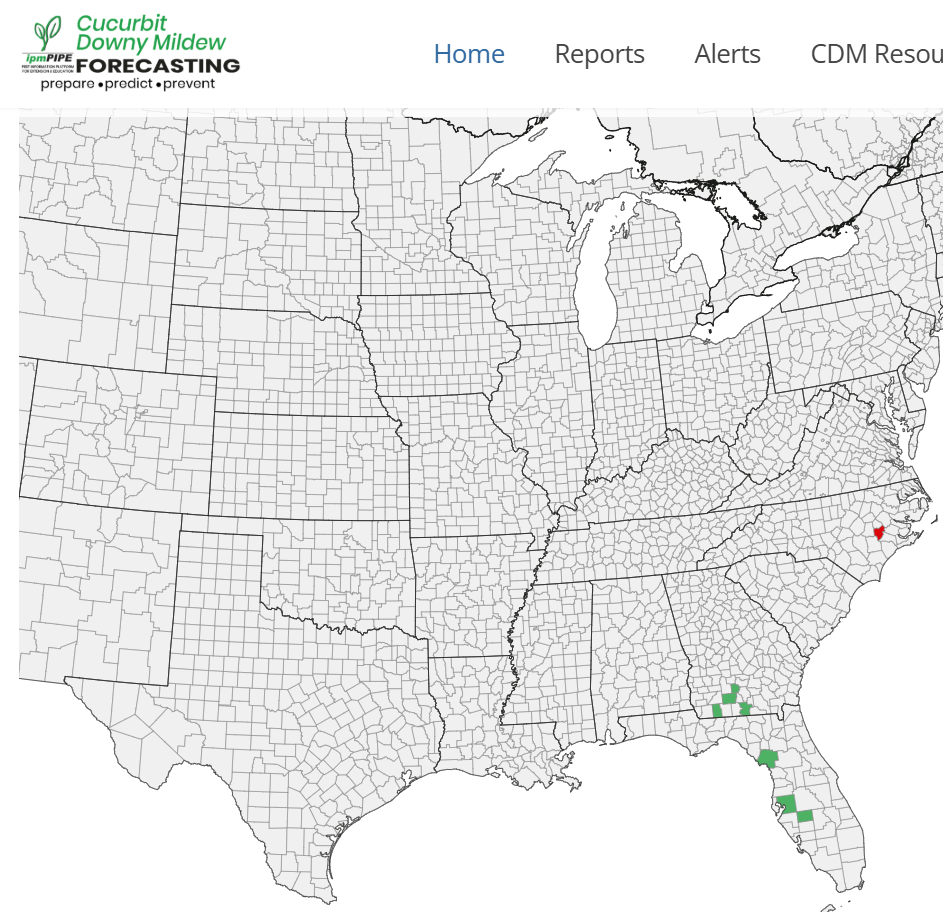
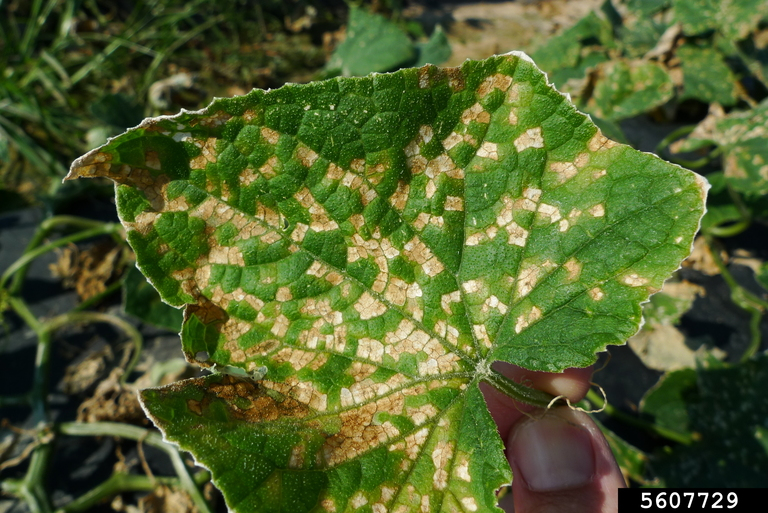
There are still no Cucurbit Downy Mildew reports on commercial or garden cucurbit plantings in the Midwestern US. This is good news for growers of cucurbits in WI. The spore trapping network in Michigan, coordinated by Dr. Mary Hausbeck, indicated presence of spores of Clade 2 on 7/21, but to date, no disease observed in fields. This Clade 2 infects cucumbers and cantaloupes/melons. The pathogen has been reported in relatively few states this year (map shown below), as noted at the Cucurbit Downy Mildew Forecasting website and network (https://cdm.ipmpipe.org/). In the past week, the disease was confirmed in cucumber in North Carolina. Fungicide considerations were discussed in a previous newsletter and can be found here: https://vegpath.plantpath.wisc.edu/2026/07/12/vegetable-crop-update-jul-5-2026/
Potato and Sugar Beet Diseases
Some Wisconsin farms produce both potatoes and sugar beets or include these crops within the same regional production landscape. While each crop has its own unique disease concerns, several important pathogens and disease-favoring conditions overlap between potato and sugar beet production. Understanding these shared challenges can improve crop rotation planning, scouting efforts, and long-term soil health while reducing disease pressure across the farm. Many of the most economically significant diseases of both crops originate in the soil. Although the pathogens are often different species, they thrive under remarkably similar environmental conditions.
Rhizoctonia. In potatoes, this pathogen causes black scurf on tubers, stem canker, poor emergence, and reduced stand establishment. In sugar beet, closely related strains of Rhizoctonia solani cause crown and root rot, leading to significant reductions in root yield and sugar quality. Although different anastomosis groups (AGs) tend to dominate each crop, fields with persistent Rhizoctonia require careful attention regardless of which crop is being grown. Warm soils, compaction, poor drainage, excessive residue, and plant stress all favor disease development. Management strategies that benefit both crops include selecting well-drained fields, reducing soil compaction, promoting rapid and uniform crop emergence, using effective fungicides (seed treatments and/or in-furrow) where appropriate, and avoiding plant stress.
Fusarium. Several Fusarium species occur commonly in Wisconsin soils. In potatoes they are associated with seed piece decay, dry rot in storage, vascular discoloration, and stem cankers. In sugar beet, Fusarium species contribute to root rot and vascular decline, particularly when plants are stressed by drought, heat, or other diseases. Because Fusarium survives for many years in soil and crop residue, long-term rotation and stress reduction remain the primary management tools.
Pythium. Water molds or oomycetes in the genus Pythium are a common challenge. Potatoes can have seed piece decay, poor emergence, and Pythium leak following harvest. Sugar beets frequently experience damping-off, seedling blight, and root rot during wet periods. Both crops benefit from high-quality seed or seed pieces, well-drained soils, avoiding planting into saturated soils, and proper fungicide seed treatments when warranted.
Aphanomyces. While Aphanomyces cochlioides primarily infects sugar beet and is not considered a pathogen of potato, its presence often signals poorly drained soils that also favor numerous potato diseases. Improving drainage and reducing periods of saturated soil benefits both crops regardless of the specific pathogen involved.
Verticillium. Potatoes commonly suffer from Verticillium dahliae, a major component of Potato Early Dying (PED), particularly when root lesion nematodes are also present. Sugar beet is generally affected by Verticillium albo-atrum, although disease incidence varies considerably among production regions. Although the pathogens differ somewhat, both reinforce an important lesson: maintaining healthy soils and minimizing plant stress can substantially reduce vascular disease severity.
Cercospora: Foliar Diseases. Sugar beets commonly get Cercospora leaf spot, while potato growers battle diseases such as early blight and late blight. Although these diseases are caused by different pathogens, they share many management principles including protect healthy foliage before disease becomes severe, scout fields frequently, rotate fungicide modes of action, preserve canopy health to maximize yield and quality. Sound fungicide resistance management has become increasingly important in both cropping systems.
Nematodes. Plant-parasitic nematodes deserve attention in both crops. Root lesion nematodes (Pratylenchus penetrans) significantly increases Potato Early Dying by interacting with Verticillium. Sugar beet may also be affected by lesion nematodes as well as sugar beet cyst nematode in regions where it occurs. Routine soil sampling for nematodes can provide valuable information before establishing high-value crops.
Disease Management Before Planting. Many disease problems begin months—or even years—before symptoms become visible. Successful disease management should include planning best crop rotation strategies, selecting resistant or tolerant varieties whenever available, improving soil drainage and structure, maintaining balanced fertility, reducing soil compaction, scouting fields regularly, rotating fungicide FRAC groups to manage resistance, monitoring soilborne pathogens and nematodes with recurring disease.
It’s important to also note that Potato virus Y (PVY) and Potato leafroll virus (PLRV) are not diseases of sugar beet, but potato and sugar beet share several aphid species—especially the green peach aphid—that move readily among crops and surrounding vegetation. While sugar beet does not act as a reservoir for these potato viruses, understanding aphid movement across Wisconsin agricultural landscapes can improve virus forecasting and integrated pest management. This highlights the importance of clean seed, volunteer potato management, and regional aphid monitoring in protecting potato production.