Vegetable Crop Update – Jul 19, 2026

In this issue:
- Vegetable Disease Updates
- Vegetable Insect Update
Vegetable Disease Update
Amanda Gevens, Professor & Extension Vegetable Pathologist, UW–Madison, Dept. of Plant Pathology, 608-575-3029, gevens@wisc.edu
Current P-Day (Early Blight) and Disease Severity Value (Late Blight) Accumulations
Thanks to Ben Bradford, UW- Madison Entomology for supporting this effort and providing a summary reference table: https://agweather.cals.wisc.edu/thermal-models/potato. A Potato Physiological Day or P-Day value of ≥300 indicates the threshold for early blight risk in potato and triggers preventative fungicide application. A Disease Severity Value or DSV of ≥18 indicates the threshold for late blight risk and triggers preventative fungicide application in potato. Data from the modeling source: https://agweather.cals.wisc.edu/vdifn are used to generate these risk values in the table below. I’ve estimated early, mid-, and late planting dates by region based on communications with stakeholders. These are intended to help in determining optimum times for preventative fungicide applications to limit early and late blight in Wisconsin.
| Location | Planting Date | 50% Emergence Date | Disease Severity Values (DSVs) through 7/18/26 | Potato Physiological Days (P-Days) through 7/18/26 | |
| Spring Green | Early | Apr 10 | May 7 | 26 | 551 |
| Mid | May 5 | May 20 | 24 | 480 | |
| Late | May 16 | June 2 | 24 | 383 | |
| Arlington | Early | Apr 12 | May 8 | 12 | 547 |
| Mid | May 6 | May 23 | 12 | 472 | |
| Late | May 20 | June 4 | 12 | 375 | |
| Grand Marsh | Early | Apr 13 | May 9 | 27 | 525 |
| Mid | May 6 | May 22 | 27 | 466 | |
| Late | May 21 | June 5 | 27 | 361 | |
| Hancock | Early | Apr 14 | May 11 | 21 | 519 |
| Mid | May 10 | May 30 | 20 | 404 | |
| Late | May 23 | June 6 | 19 | 351 | |
| Plover | Early | Apr 15 | May 12 | 21 | 520 |
| Mid | May 10 | May 30 | 19 | 408 | |
| Late | May 25 | June 6 | 18 | 355 | |
| Antigo | Early | May 12 | May 29 | 25 | 399 |
| Mid | May 25 | June 5 | 25 | 354 | |
| Late | June 8 | June 20 | 14 | 240 | |
| Rhinelander | Early | May 15 | June 6 | 18 | 333 |
| Mid | May 28 | June 10 | 16 | 296 | |
| Late | June 9 | June 25 | 10 | 200 | |
Late blight of potato/tomato
With the exception of the northern-most, later-season plantings, Wisconsin potato production regions have accumulated Disease Severity Values or DSVs at or surpassing the action threshold of 18 as of 7/18. However, in the past week, the accumulation of DSVs was low – just 0 to 5. Fields with ≥18 DSVs should receive preventative fungicide applications to manage for late blight. https://vegpath.plantpath.wisc.edu/diseases/potato-late-blight/ An updated list of fungicides for management potato late blight in Wisconsin 2026 is provided here: https://vegpath.plantpath.wisc.edu/resources/late-blight-fungicides/
Early blight of potato
Most potato fields south of Rhinelander have surpassed the treatment threshold of 300 P-Days. Preventative fungicide applications are warranted for these fields. In the past week regions of the state accumulated between 51 and 60 P-Days. For support in selecting fungicides, please consult the A3422 Commercial Vegetable Production in Wisconsin: https://vegpath.plantpath.wisc.edu/resources/a3422/
Tomato Septoria Leaf Spot
Tomato Septoria Leaf Spot is a common fungal disease of solanaceous crops caused by Septoria lycopersici. Symptoms appear on the leaves as circular, tan-to-gray spots with darker brown margins and dotted with dark, raised pycnidia inside the lesion. Unlike another common foliar fungal disease of tomato, early blight, these Septoria lesions are often surrounded by a yellow halo. The disease typically develops on lower leaves first, moving up to higher leaves as infection progresses. Lesions can converge and lead to defoliation of lower leaves, and in severe cases the death of an entire plant. Stem lesions appear similar to leaf lesions, but are often darker. Fruit lesions are uncommon, but appear similar to leaf lesions under very high-disease pressure. Bacterial tomato diseases, speck and spot, can also appear similar to early Septoria, especially when the lesions are very small. If unsure of the diagnosis, please reach out to a diagnostic service to assist in the determination for best management responses.
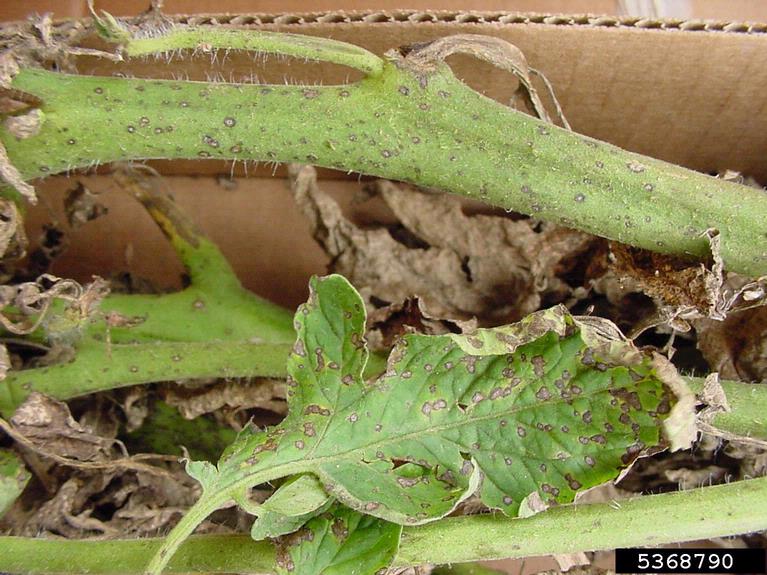
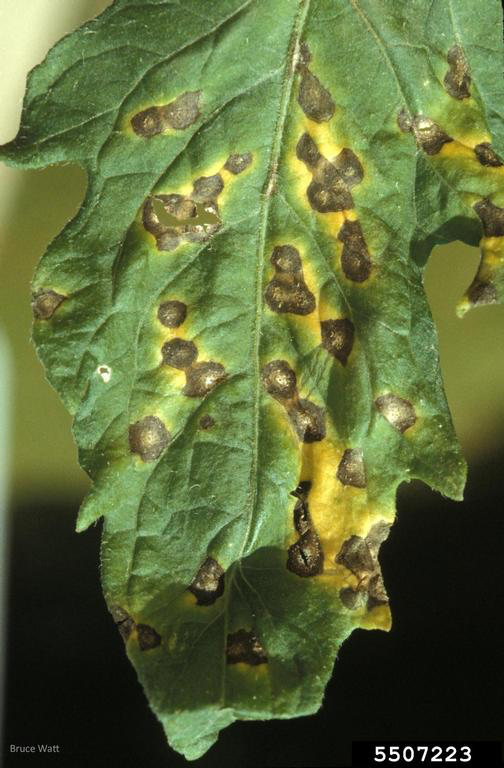
This pathogen can infect eggplants, peppers, and tomatoes, but is mainly a problem on tomatoes. The primary source of inoculum is infected solanaceous crop or weed debris in soil, as well as infected seeds and infested equipment. Spores (conidia) are produced and spread during wet and warm periods, especially when airflow is poor due to canopy closure and densely-spaced plants. These spores are spread from primarily debris to leaves via rainfall, irrigation, workers, equipment, and several insects, often reaching and infecting the lower and older leaves first. These spores penetrate the leaf tissue via the stomata, leading to lesion development within ~5 days. Pycnidia (asexual fruiting bodies) will develop ~14 days after inoculation, releasing more spores that will be spread and create new, secondary infections of healthy plant tissue including leaves, stems, and fruit. Favorable weather includes high humidity, moderate temperatures between 68 and 77 °F.
Rotations away from non-solanaceous crops for 2-3 years can reduce inoculum and help manage this disease. Varieties of tomato that are resistant to Fusarium and Verticillium wilt can demonstrate greater resistance to Septoria. Raised beds, staking, and mulch can help improve drainage, airflow, and reduce splashing of debris which can initiate the disease on lowest foliage. Prompt destruction of the tomato crop after final harvests in the fall can aid in reducing build up of inoculum for future years.
Scouting regularly allows early identification of disease before significant spread and damage. Disease spread can be limited by proper mulching, which can reduce plant-soil contact, as well as disinfecting tools and equipment like stakes and cages.
The following practices can also help prevent disease development:
- Plant resistant varieties
- Rotate away from susceptible solanaceous crops (1-2 years)
- Stake or trellis plants to improve airflow
- Remove ‘suckers’ or lowest lateral tomato plant growth (https://hort.extension.wisc.edu/articles/tomato-pruning/)
- Maintain proper spacing between plants
- Control host weeds
- Destroy infested plant debris
- Avoid over-irrigating (reduce leaf wetness)
If symptoms are noted in the lower canopy and weather is favorable, protective treatment may be justified on a 7-14 day schedule. Preventative applications of fungicides containing copper or chlorothalonil can be useful in areas with problematic Septoria lycopersici infections. Both fungicides provide broad spectrum disease control. Some formulations of copper fungicides may be acceptable for organic systems. For Wisconsin-specific fungicide information, refer to the annually updated Commercial Vegetable Production in Wisconsin (A3422) book: https://vegpath.plantpath.wisc.edu/resources/a3422/ Or, for home garden fungicide recommendations, see Home Vegetable Garden Fungicides (D0062), a fact sheet available through the UW Plant Disease Diagnostic Clinic website. Always follow label directions carefully. Below, I include a list of conventional fungicides registered for use on Septoria of tomato.
Fungicide options for Tomato Septoria Leaf Spot
| Fungicide | Active Ingredient | Rate | Use Details Re-entry Interval (REI); Pre-harvest Interval (PHI); Fungicide Resistance Action Committee Code (FRAC) |
| Kocide, Champ, Cueva, NuCop, others | Copper | Varies based on formulation | REI: 12-48-hours varies by formulation; PHI: 0-day, generally 0 day for copper fungicides but verify with label; FRAC M1 |
| Acadia LFC, AZteroid FC 3.3, Dexter SC, Heritage, Quadris, Satori, others | azoxystrobin | Varies based on formulation | REI: 4-hour; PHI: 0-day; FRAC 11 |
| Affiance | azoxystrobin, tetraconazole | 9-12 fl oz/acre | REI: 12-hour; PHI: 0-day; FRAC 11, FRAC 3 |
| Aprovia Top | benzovindiflupyr, difenoconazole | 10.5-13.5 fl oz/acre | Use of spreader sticker is recommended; REI: 12-hour; PHI: 0-day; FRAC 3, FRAC 7 |
| Ariston, Cymbol | chlorothalonil, cymoxanil | 1.9-3 pt/acre | REI: 12-hour; PHI: 3-day; FRAC M05, FRAC 27 |
| Cabrio EG | pyraclostrobin | 8-12 oz/acre | REI: 12-hour; PHI: 0-day; FRAC 11 |
| Bravo, Echo, Equus, Initiate | chlorothalonil | Varies based on formulation | REI: 12-hour; PHI: 0-day; FRAC M05 |
| Flint Extra | trifloxystrobin | 3-3.8 fl oz/acre | REI: 12-hour; PHI: 3-day; FRAC 11 |
| Fontelis | penthiopyrad | 16-24 fl oz/acre | REI: 12-hour; PHI: 0-day; FRAC 7 |
| Inspire Super | cyprodinil, difenoconazole | 16-20 fl oz/acre | Do not apply to small-fruited varieties like cherry tomatoes; REI: 12-hour; PHI: 0-day; FRAC 9, FRAC 3 |
| Luna Flex | fluopyram, difenconazole | 8-13.6 fl oz/acre | REI: 12-hour; PHI: 0-day; FRAC 7, FRAC 3 |
| Luna Sensation | fluopyram, trifloxystrobin | Rates vary by disease on label; Septoria is 5-7.6 fl oz/acre | REI: 12-hour; PHI: 3-day; FRAC 7, FRAC 11 |
| Luna Tranquility | fluopyram, pyrimethanil | 11.2 fl oz/acre | Field and greenhouse label; REI: 12-hour; PHI: 1-day; FRAC 7, FRAC 9 |
| Mural | azoxystrobin, benzovindiflupyr | 0.6 oz/5000 sq ft For use in vegetable plants grown for resale to consumers | REI: 12-hour; PHI: 0-day; FRAC 11, FRAC 7 |
| Pageant Intrinsic; Pompa | boscalid, pyraclostrobin | 9.7 to 18 oz/acre | REI: 12-hour; PHI: 0-day; FRAC 7, FRAC 11 |
| Velum Prime | fluopyram | 5-6.84 fl oz/acre | REI: 12-hour; can be applied the day of harvest; FRAC 7 |
| Dithane, Koverall, Manzate, Penncozeb | mancozeb | Varies depending upon formulation | REI: 24-hour; PHI: 5-day; FRAC M03 |
| Mettle 125ME | tetraconazole | 6-8 fl oz/acre | REI: 12-hour; PHI: 0-day; FRAC 3 |
| Miravis Prime | fludioxonil, pydiflumetofen | 9.2-11.4 fl oz/acre | REI: 12-hour; PHI: 0-day; FRAC 12, FRAC 7 |
| Priaxor | fluxapyroxad, pyraclostrobin | 6-8 fl oz/acre | REI: 12-hour; PHI: 0-day; FRAC 7, FRAC 11 |
| Quadris Opti | azoxystrobin, chlorothalonil | 1.6 pt/acre | REI: 12-hour; PHI: 0-day; FRAC 11, FRAC M5 |
| Quadris Top | azoxystrobin, difenoconazole | 8 fl oz/acre | REI: 12-hour; PHI: 0-day; FRAC 11, FRAC 3 |
| Reason 500SC | fenamidone | 5.5-8.2 fl oz/acre | REI: 12-hour; PHI: 14-day; FRAC 11 |
| Rhyme | Flutriafol | 5-7 fl oz/acre | REI: 12-hour; PHI: 0-day; FRAC 3 |
| Tanos | famoxadone, cymoxanil | 8 oz/acre | REI: 12-hour; PHI: 3-day; FRAC 11, FRAC 27 |
| Topguard EQ | azoxystrobin, flutriafol | 4-8 fl oz/acre | REI: 12-hour; PHI: 0-day; FRAC 3, FRAC 11 |
| Veltyma | mefentrifluconzole, pyraclostrobin | 7-10 fl oz/acre | REI: 12-hour; PHI: 0-day; FRAC 3, FRAC 11 |
Vegetable Insect Update
Russell L. Groves, Professor and Associate Department Chairperson, UW–Madison, Department of Entomology, 608-262-3229 (office), (608) 698-2434 (cell), e-mail: rgroves@wisc.edu. Vegetable Entomology Webpage: https://vegento.russell.wisc.edu/
Western bean cutworm – https://agweather.cals.wisc.edu/thermal-models/western-bean-cutworm
Pheromone captures reported by the Wisconsin Home Pest Survey and the Great Lakes and Maritimes Pest Monitoring Network continue to reveal adult moth captures over successive weeks throughout much of central and southern Wisconsin. Adult captures were as high as 250 moths/trap (Jefferson County) but averaged lower numbers statewide (N=25 moths/trap). Numbers can be expected to increase in the coming week as conditions for adult moth emergence are peaking.
We use of degree day models, together with pheromone traps, to aid in determining the time of field scouting activities. Approximately 25% of moths are expected to have emerged at 1320 degree days, 50% at 1422 degree days and 75% emergence at 1536 degree days. In Madison, we have accumulated 1376 DD50 as of Saturday, July 18 and with forecast warm temperatures, we will reach peak adult activity (1420 DD50) by the beginning of next week. Begin scouting at first appearance of moths and continue until after moth population’s peak. If a producer wishes to secure pheromone traps, these can easily be made from plastic milk jugs and the pheromone lure purchased by several online sources (e.g., Gemplers and Great Lakes IPM).
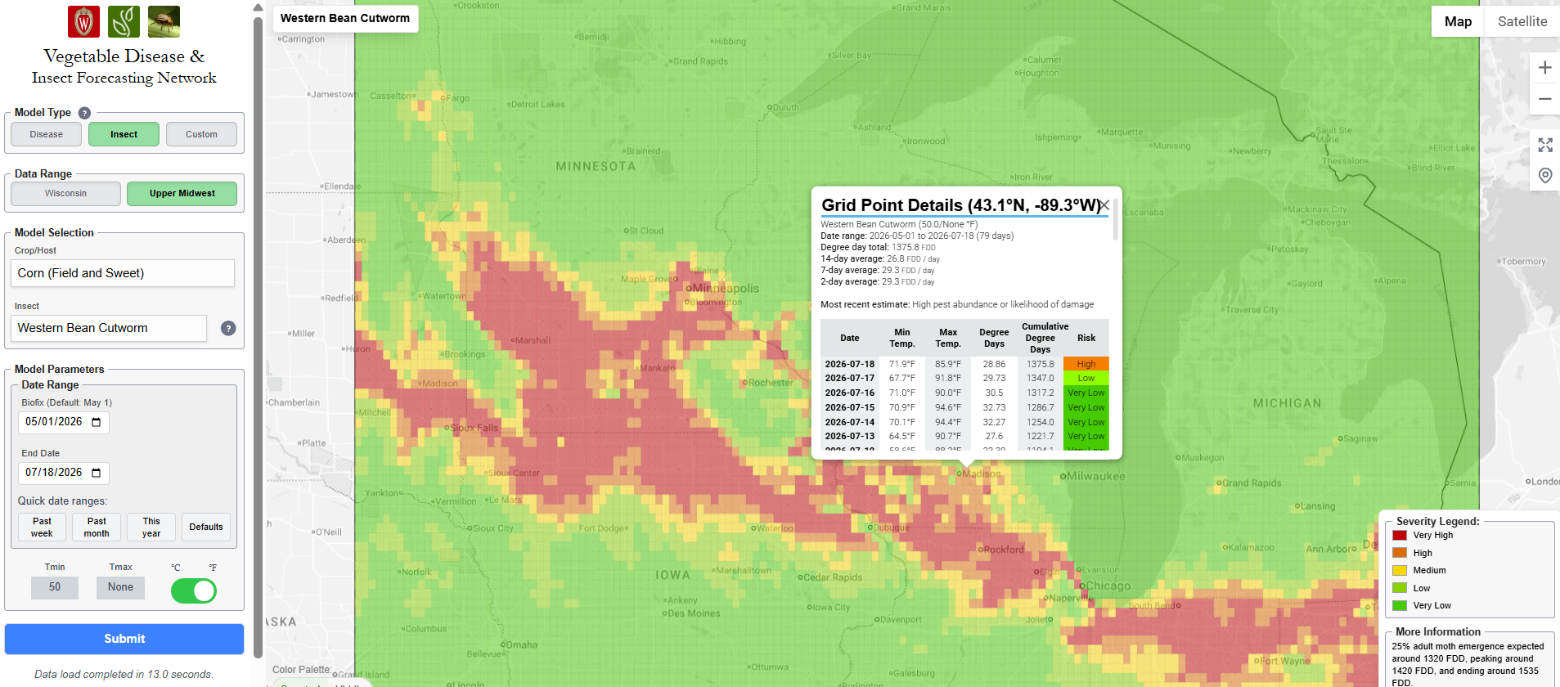
Field scouting should begin across much of southern and central Wisconsin now, and the scout should examine 20 consecutive corn plants at each of five locations/field. Look for eggs and or larvae on the upper leaves and continue scouting at weekly intervals until after the threat of western bean cutworm has subsided. For field corn, consider treatment when 5% or more of the corn plants have either eggs or larvae present, but before larvae have entered the ear. Once larvae have entered the ear, they are not susceptible to insecticide applications.
Western bean cutworms have one generation/year in Wisconsin. They overwinter as fully grown larvae pupate in May. Adults begin emerging in late June and are attracted to late vegetative corn to lay eggs. Eggs are usually laid on the upper-most leaves. After hatching, larvae will feed on pollen or, if the ear has emerged, on silk before moving into the ear to feed on developing kernels. When development is complete, larvae will move to the ground where they create a new larval chamber to overwinter.
Squash bug – https://vegento.russell.wisc.edu/pests/squash-bug/
Adult squash bugs emerge from the ground surface in early summer and complete their first full generation by late-July. Eggs are now being laid as cucurbit vines are rapidly expanding and developing. Eggs hatch in about 10 days and the nymphal stage lasts 4-6 weeks. Nymphs undergo 5 molts before reaching maturity and new adults will be appearing in late July and early August. The adult female lays eggs over an extended period (4-5 weeks) and all life stages may appear at once on an infested plant.
Squash bugs are a major pest of squash and pumpkins. Nymphs and adults feed on plant juices and release toxins into leaves. Feeding causes wilting, and leaves become dry and brown or black along the edges. This wilting may appear similar to bacterial wilt, but bacterial wilt is spread by the cucumber beetle. Early symptoms of infestation include yellow spotting on the leaves. Later in the season, adults will also feed on fruit, which can cease development and begin to rot. Young plants are more susceptible to severe damage.
Adults are about 0.5-0.75 inches in length, brownish-black, flat, shield-shaped bugs. They are sometimes mistaken for stink bugs. Adults congregate and emit a strong odor when crushed. Immature squash bugs initially have red heads and legs with whitish-green bodies but later have black heads and legs with gray bodies. Eggs are 1/16-inch, reddish orange to brown-colored and are laid in clusters on the undersides of leaves along the center vein.
Because they are protected by the lower surfaces of leaves, squash bugs may be difficult to control, and growers should check their transplants or new seedlings for the presence of adults. The threshold for treatment is one egg mass per plant during flowering.
Destroy crop residues in the fall to reduce the number of overwintering adults. Crop rotation will also reduce the incidence of infestation. Trellised plants are less susceptible to squash bug infestations. Young nymphs are the most susceptible to control practices, while adults are more difficult to control. In smaller plantings, adults can be congregated by placing boards on the ground near the plants as a hiding place. The squash bugs will aggregate at night under the boards, which can then be destroyed each morning.
Potato leafhopper – https://vegento.russell.wisc.edu/pests/potato-leafhopper/
Populations of adult potato leafhopper (PLH) are now increasing in many parts of southern Wisconsin, especially in areas adjacent to alfalfa cut in early to mid-July. Recall, these are annual pests of snap beans, hops, clover, alfalfa, and potatoes. Both adults and nymphs feed by inserting their mouth parts into the plant’s phloem and extracting sap and thereby injecting saliva containing toxic substances. It is the plant’s response to the saliva (salivary proteins) that results in the observed damage.

Migratory populations of the PLH entered the southern portion of Wisconsin in late May to early June, and populations remained low throughout much of the state. Regular scouting of susceptible crops is now recommended to ensure nymphal populations are not building in number. Leafhopper populations can build over successive weeks before any damage symptoms begin to show, and it is critical to gain control before they display the “hopperburn” symptomology. Leafhoppers tend to move into other crops in early summer and as second cutting of forage crops is underway in many locations of the state, it is a key time to scout for early migrants in vegetable plantings.