Vegetable Crop Update – May 4, 2026
In this issue:
- Rhizoctonia in vegetable crop systems
- Weather-based crop and disease decision-making tools summary – see here.
Amanda Gevens, Professor & Extension Vegetable Pathologist, UW–Madison, Dept. of Plant Pathology, 608-575-3029, gevens@wisc.edu
Rhizoctonia in Vegetable Crops
Rhizoctonia, caused primarily by Rhizoctonia solani, is one of the most common and economically important soilborne diseases affecting vegetable production systems. Its broad host range, persistence in soil, and ability to attack plants at multiple growth stages make it especially challenging in diversified vegetable operations. In Wisconsin, Rhizoctonia is particularly problematic during cool to warm spring transitions, periods of high soil moisture or poor drainage, and in fields with a history of vegetable or susceptible rotational crops.
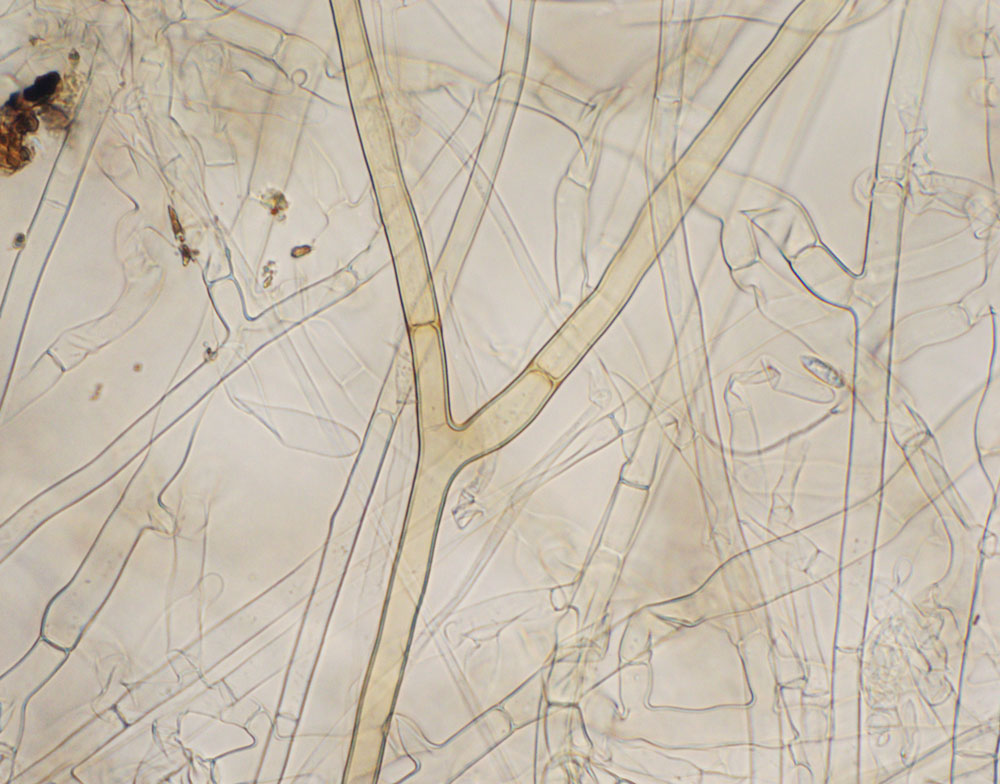
The pathogen survives long-term in soil and crop residue as mycelium or sclerotia, allowing it to persist between seasons and infect new crops readily. Rhizoctonia infects plants at or below the soil surface. Infection is favored by warm soil temperatures (60–85°F), high soil moisture or poor drainage, dense canopies that maintain humidity, and plant stress (fertility imbalance, mechanical or environmental). The fungus spreads through soil movement, equipment, and plant debris and does not rely on airborne spores, instead growing via hyphal contact between plants.
Crops impacted by Rhizoctonia are many and include potatoes, beans, carrots, cole crops (cabbage, broccoli), cucurbits, onions, and leafy greens. This range makes for a challenge in designing rotational strategies to suppress this disease.
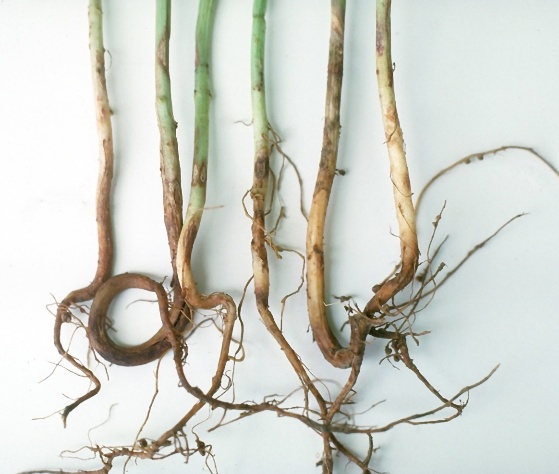
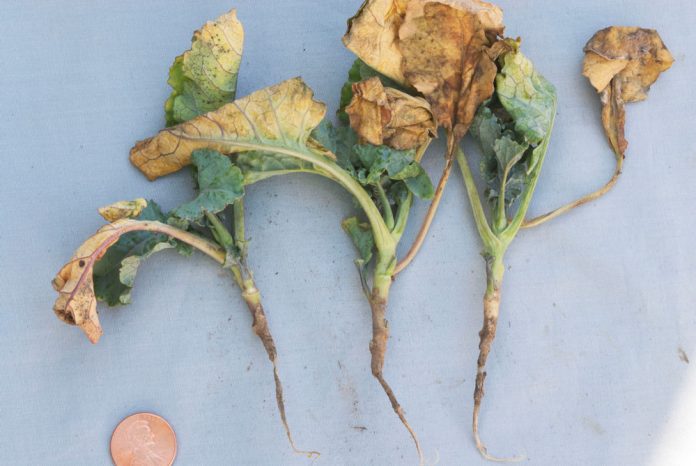
Early disease identification is indicated by evidence of plant damping off. This is noted with poor or uneven emergence, seed decay before emergence, seedling collapse after emergence, reddish-brown lesions at the hypocotyl or soil line (often appearing ‘pinched off’ or wirestem), and stunted, off-color pants with reduced root development (often with brown root lesions). Symptoms can develop later in the production season as noted by crown and stem rot. Typically, there are sunken, dry lesions at the soil line, wilting despite adequate moisture, and patchy field distribution. In the late season, symptoms can include enhanced brown to black root decay, crown rot leading to plant death, and foliar wilting during warm afternoons.
Management
Effective Rhizoctonia management in Wisconsin relies on integration of multiple practices, especially cultural practices including avoiding planting into compacted soils, minimizing excessive irrigation early on in crop establishment and avoiding planting into cold and wet soils. Avoiding deep planting (of seeds and transplants), and optimizing spacing to reduce canopy humidity can be advantageous. Crop rotations should be away from susceptible crops when possible, but this can be challenging due to the broad host range of the pathogen. Reducing infected crop residue helps to reduce inoculum in your field. Rhizoctonia severity is strongly associated with plant stress and poor soil conditions. Plant high-quality disease-free seed or transplants and limit mechanical injury to seedlings. Be sure that transplants are hardened off before setting into the field.
Fungicides are most effective when integrated with cultural practices and can include seed-applied treatments as well as in-furrow options at the time of planting. Registrations vary by vegetable crop, however, the following offers general recommendations. Fungicides with effectiveness in limiting Rhizoctonia include fludioxonil (ie: Maxim) or a biological as a seed-applied treatment; strobilurins (ie: azoxystrobin) and SDHI fungicides (ie: penthiopyrad) directed to planted row or as at-plant drench in early season can provide control. PCNB (Blocker) is registered for potato and cole crop Rhizoctonia control, but the supply is very limited due to the stopping of production in December of 2025. More information on this can be found here: https://vegpath.plantpath.wisc.edu/2026/01/06/important-update-on-blocker-fungicide-in-potato/. Biological products may suppress Rhizoctonia under lower disease pressure conditions (ie: Trichoderma at pre-plant; biological seed/transplant dip; Bacillus species post-plant). When planting early, preventative inputs are most effective at controlling this disease when coupled with integrated management strategies.
It’s important to confirm a diagnosis because fungicides that may be effective against true fungal pathogens, like Rhizoctonia, may not be effective against oomycete/water mold pathogens like Pythium or Phytophthora. You can submit samples to diagnostic labs (e.g., UW–Madison Plant Disease Diagnostics) in order to differentiate the plant damage from Pythium root rot, Fusarium root rot, and/or Phytophthora root rot. The clinic contact information for UW–Madison is provided here: UW Plant Disease Diagnostic Clinic, 1630 Linden Drive, Room 183. Madison, WI 53706. Phone: 608-262-2863. Email: pddc@wisc.edu. Website: https://pddc.wisc.edu/
In Wisconsin vegetable systems, Rhizoctonia often operates as a stress opportunist causing the greatest damage where compaction, moisture imbalance, or slow emergence already limit plant vigor. Management success depends less on any single input and more on system-level optimization of soil health and crop establishment.
For further information on inputs to manage commercial vegetables in Wisconsin, a link to the 2026 Commercial Vegetable Production guide (A3422) is here: https://vegpath.plantpath.wisc.edu/resources/a3422/