Important update on Blocker fungicide in potato
The situation: In mid-December 2025, AMVAC Chemical Corporation, the manufacturers of the fungicide Blocker (pentachloronitrobenzene, PCNB), decided to stop producing Blocker 4F and 10G. In effect, this concludes production of Blocker for the future. The Blocker that is on the shelves at this time is all that will be available for future use. It is estimated that this will leave potato growers with a supply that may satisfy only 25-33% of the potato use demand in 2026.
Potato growers in Wisconsin have relied upon Blocker for strong common scab and Rhizoctonia control and will face challenges in the 2026 growing season in planning for disease management. Additional vegetable crop production uses of Blocker include crucifer (cabbage, broccoli) Rhizoctonia and Clubroot management.
While the US Environmental Protection Agency has, for several years, proposed canceling registrations of Blocker due to ecological and human health risk concerns, this stopping of manufacturing of Blocker was a decision of AMVAC. There is no change to the registration of Blocker at this time, but access to this fungicide will be extremely limited in 2026 and non-existent beyond this year.
What is Blocker?: Blocker provides multi-site interference with fungal metabolism and has protectant activity. The fungicide is a non-systemic, broad biocidal soil treatment and has minimal vapor action. Blocker’s target pathogens are: true fungi including Rhizoctonia solani (stem canker, black scurf, wirestem), Sclerotinia sclerotiorum* (white mold), and Colletotrichum coccodes* (black dot); a filamentous bacterium Streptomyces scabies and other Streptomyces species (common scab), and a plasmodiophorid Plasmodiophora brassicae (club root). *Please note that the registration of Blocker 4F via chemigation (only) for potato white mold and black dot management is limited to Idaho, Nevada, Oregon, and Washington. AMVAC Chemical Corporation is the company that makes and registers Blocker products (Blocker 4F and Blocker 10G). AMVAC markets a suite of fungicides with PCNB under several brand names including Blocker, Terraclor, Turfcide, and Premion in the US. AMVAC will stop production of all these products.
For vegetable crop disease management, two formulations of AMVAC’s Blocker (4F and 10G) are registered. The differences are in formulation, not chemistry. The 10G granular formulation treats a broader soil zone and has higher bulk. The 4F flowable formulation provides precision in placement with lower carrier volume. The table below summarizes Blocker 10G and 4F.
| Summary of Blocker 10G and 4F formulations | ||||
| Blocker PCNB (FRAC 14) detailed for Wisconsin | Blocker 10G | Blocker 4F | ||
| Formulation | Granular 10% PCNB | 1 lb product = 0.10 lb a.i. | Flowable/liquid 40% PCNB 4 lb PCNB per US gallons | 1 pt = 0.125 gal, 0.5 lb a.i. |
| Crops and rates on labels | Potatoes | Stem canker/Black scurf Rhizoctonia solani
1.65 lbs. per 1,000 linear feet of row | Potatoes | Stem canker/Black scurf Rhizoctonia solani
5-10 pt/acre in banded application
Common scab Streptomyces scabies in 2ee registration
5-10 pt/acre in banded application |
| Cole crops
| Clubroot Plasmodiophora brassicae
3 pt/acre
5.62 gal/acre broadcast rate
55 fl oz/1000 linear feet or row
Rhizoctonia solani wirestem/bottom rot on cauliflower etc.
2.8 to 3.75 gal/acre broadcast drench in 50 gal of water/acre
1.9 to 2.8 gal/acre row drench treatment, apply in 35 gal water per acre
Pre-plant banding: 5.15 lbs. per 1,000 linear feet of row Broadcast treatment: 225 lbs. per acre
Cauliflower Wirestem pre-plant banding: 3.4 lbs. per 1,000 linear feet of row | Cole crops
vegetable seedlings
| Clubroot Plasmodiophora brassicae
3 pt/acre
Transplant Solution: 3 pt/100 gals of water
5.62 gal/acre
55 fl oz/1000 linear row feet
Band Application: Apply in 25 gals of water per acre or 5.5 fl. oz. per 100 ft. of row based on 40 inch row spacing. Spray as a 12- inch band centered on row and incorporate to a depth of 4-6 in prior to planting.
Wirestem, bottom rot Rhizoctonia solani
2.8-3.75 gal/acre
Broadcast Drench Application: Apply in 50 gal/water/acre as a soil drench at seeding.
Do not exceed 22.5 lbs. of A.I. /A in any one season
1.9-2.8 gal/acre
18-27 fl oz/1000 feet of row
Row Drench Treatments: Apply in 35 gal/water/acre based on 40-inch row spacing. Spray as an 8-inch band centered on the row at seeding.
| |
Alternatives to Blocker for potato Rhizoctonia control: Rhizoctonia control requires an integrated preventative approach including varietal tolerance, clean seed, avoiding planting into cold (ideally
>45°F) and wet soils, allowing suberization time and conditions (50-55°F with good airflow) for cut seed, immediately treating cut seed with fungicides, and using in-furrow fungicides. The seed-applied and in-furrow fungicides for use on Rhizoctonia include mancozeb (FRAC M3); benzovindiflupyr, flutolanil, fluxapyroxad, penthiopyrad and pydiflumetofen (FRAC 7), azoxystrobin, pyraclostrobin, and trifloxystrobin (FRAC 11), and fludioxonil (FRAC 12). Seed treatments and in-furrow treatments protect stems and stolons early, but do not eradicate soil inoculum. Encourage quick shoot emergence by choosing optimum planting times, conditions, and planting depth. Rotate away from potatoes for 3-4 years and avoid rotations with other susceptible crops including beets and beans; small grains and corn are best rotations to help reduce Rhizoctonia soilborne inoculum.
Alternatives to Blocker for potato Common Scab control: Potato common scab requires an integrated and preventative approach for management. Elements of management include use of tolerant or resistant varieties, maintenance of consistent soil moisture during tuber initiation (~3-4 weeks, avoid drying-rewetting cycles), management of soil pH to 5.0-5.2, crop rotation (3-4 years out of potatoes, beet, carrot, radish), use of seed with low or no common scab, avoidance of excess early nitrogen, maintenance of adequate calcium, and avoidance of over-application of manure before potatoes.
Chemical and biological inputs are generally variable in performance, but there are some with greater consistency in common scab management. At the end of this article, I summarize the results of our evaluations of fungicides, biologicals, insecticides, fumigants, and plant hormone inputs for the control of potato common scab in my program since 2009. Further, I’ve added, below, elements from other researchers with the goal of offering a comprehensive list of inputs in considering management strategies.
Fludioxonil (ie: Maxim) has demonstrated common scab control in past recent years. In our Wisconsin studies, our seed-applied fludioxonil treatments have not reduced common scab severity or incidence, but other locations have documented this outcome. When applied as a seed treatment in a Canadian study, fludioxonil reduced common scab incidence by 35%, and reduced common scab severity by 58%. The yield of marketable tubers increased by nearly 25% when compared to the non-treated control. The study, which also offers evaluation of other biological fungicides and fumigants, can be found here: https://www.tandfonline.com/doi/full/10.1080/09583157.2015.1079809 As with all aspects of common scab management, effectiveness of any one parameter can vary by location. (The citation of this paper is: Al-Mughrabi, Vikram, Poirier, Jayasuriya, Moreau. 2015. Management of common scab of potato in the field using biopesticides, fungicides, soil additives, or soil fumigants. Biocontrol Science and Technology. Vol. 26(1):1-23).
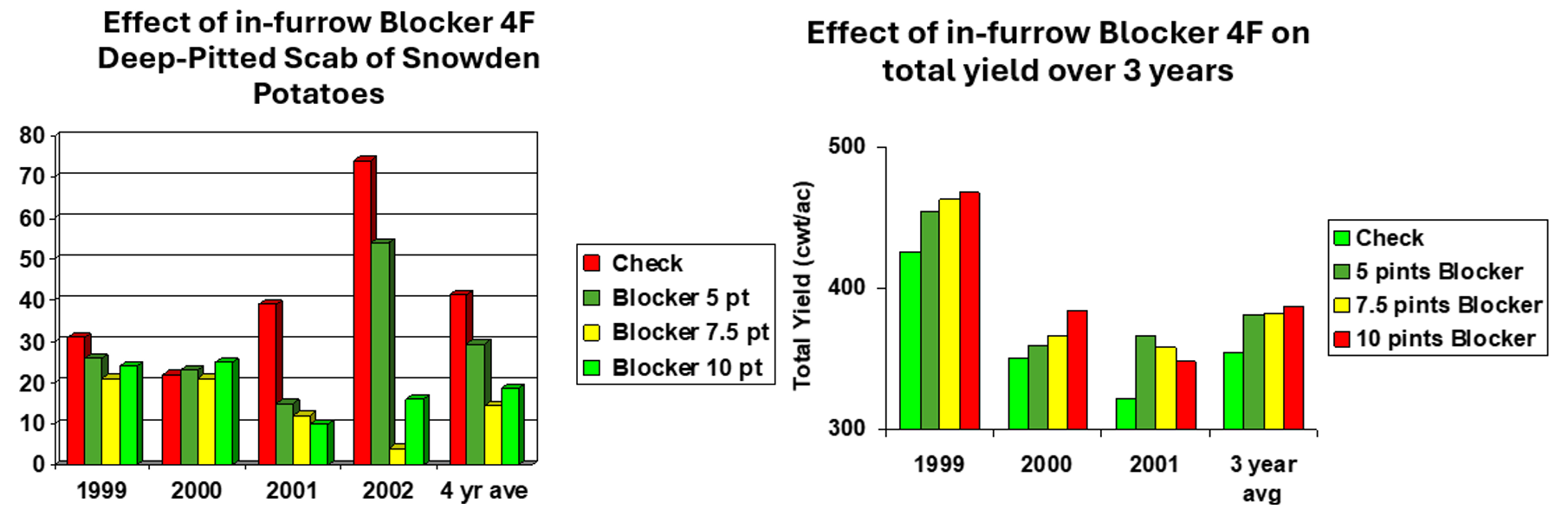
Ralph Frederick of AMVAC has conducted field research on Blocker 4F rates for reducing common scab. In his work, he has found that the standard 10 pt rate of Blocker 4F can be reduced to 7.5 pt and result in effective common scab management and increased yield. His work showed that the 5.0 pt rate was less effective (Figure below). In order to utilize the limited Blocker supply most efficiently, and across broadest acreage of susceptible potato crops in 2026 for common scab control, one option is to reduce the rate to 7.5 pt/acre.
For further information or if you have any questions, please reach out to Ralph Frederick of AMVAC at RalphF@amvac.com or 218-340-1609 regarding Blocker or his rate work; or Amanda Gevens, UW-Plant Pathology at gevens@wisc.edu or 608-575-3029 regarding disease management in vegetables.
| Treatments evaluated for potato common scab control (‘Yukon Gold’ potato grown in Streptomyces scabies disease nursery research plots), A.J. Gevens, University of Wisconsin–Madison | ||||
| Trade Name | Active Ingredient | Time of Application | Years Tested | Comment on Efficacy |
| Non-treated Control | NA | NA | 15 | Poor |
| Vapam | Metam sodium | Fall pre-plant fumigation | 7 | Poor/Variable |
| Pic Plus | Chloropicrin (85%) | Fall pre-plant fumigation | 2 | Good |
| Pic Plus + Serenade Soil | Chloropicrin (85%) + Bacillus subtilis | Fall pre-plant fumigation and in-furrow | 2 | Good |
| C60 Pic | Chloropicrin (60%) | Fall pre-plant fumigation | 2 | Good |
| C60 Pic + Regalia SSC | Chloropicrin (60%) + Reynoutria sachalinensis extract | Fall pre-plant fumigation | 2 | Good |
| Quadris Flowable 2F | azoxystrobin | In-furrow | 9 | Poor/Highly Variable |
| Quash 50WDG | Metconazole | In-furrow | 1 | Poor |
| Blocker 4F | Pentachloronitrobenzene (PCNB or Blocker) | In-furrow | 9 | Good |
| Blocker 4F + Mocap 15G | PCNB + ethoprop (15%) | In-furrow | 2 | Good |
| Mocap 15G | ethoprop (15%) | In-furrow | 3 | Good |
| Blocker 4F + Rejuvenate | PCNB + naphthalenic acid (NAA) | In-furrow | 5 | Good |
| Rejuvenate | naphthalenic acid (NAA) | In-furrow | 3 | Good/Highly Variable |
| Mocap 15G + NAA | ethoprop (15%) + NAA | In-furrow | 2 | Poor |
| Omega | fluazinam | In-furrow | 3 | Good |
| Nimitz | fluensulfone | In-furrow and with foliar applications | 3 | Good |
| Colonize | mycorrhizal inoculant | In-furrow | 2 | Poor |
| Colonize + Messenger | mycorrhizal inoculant + harpin protein | In-furrow | 2 | Poor |
| Agzyme | bio-stimulant and foliar nutrients | In-furrow | 1 | Poor |
| Serenade Soil | Bacillus subtilis strain 713 | In-furrow | 7 | Poor/Variable |
| MycoApply | mycorrhizae | In-furrow | 3 | Poor |
| Regalia 5SC | Reynoutria sachalinensis extract | In-furrow | 7 | Poor |
| Tiger-Sul 90CR | Elemental sulfur | In-furrow | 4 | Poor |
| AmegA SC | Iron, phosphite, plant oils, and surfactant | In-furrow | 1 | Poor |
| Double Nickel | Bacillus amyloliquefaciens | In-furrow | 7 | Good/Variable |
| AmyProtec | Bacillus amyloliquefaciens | In-furrow | 3 | Good/Variable |
| EF-400 + Bac Stop | Blend of horticultural oils | In-furrow and with foliar applications | 4 | Good |
| Nobactra blend | Antagonistic bacteria + horticultural oils | Seed treatment and In-furrow | 1 | Good |
Trial summaries can be found at https://vegpath.plantpath.wisc.edu/field-trials.