Vegetable Crop Update – Apr 26, 2026
In this issue:
- Seedcorn Maggot Update & Management
- Cabbage Maggot Update & Management
- Early Season Potato Disease Concerns
- Potato Scouting Class at UW-Hancock ARS on May 18
- Tutorial for How & Why the UW Veg Disease & Insect Forecasting Network Tool Works
Vegetable Insect Update – Russell L. Groves, Professor and Vegetable Extension Specialist, UW–Madison, Department of Entomology
608-262-3229 (office), 608-698-2434 (cell), e-mail: rgroves@wisc.edu, Vegetable Entomology Webpage: https://vegento.russell.wisc.edu/
Seedcorn maggot – https://vegento.russell.wisc.edu/pests/seedcorn-maggot/
The first generation of seedcorn maggot (SCM) has emerged as adults across southern Wisconsin and will rapidly progress across the state over the next 7-10 days. Seed corn maggots overwinter as pupae in the soil. Adult flies have begun emerging and the peak emergence for the first generation is now apparent across southern and central portions of Wisconsin.
You can find adult SCM flies active on bright sunny days near recently tilled soil and adults often swarm over brightly colored objects. Adults will mate and lay eggs in these risk areas and preferred egg deposition sites are locations with germinating or decaying seeds, plant residue, incorporated green manures or where organic fertilizers have been recently applied.
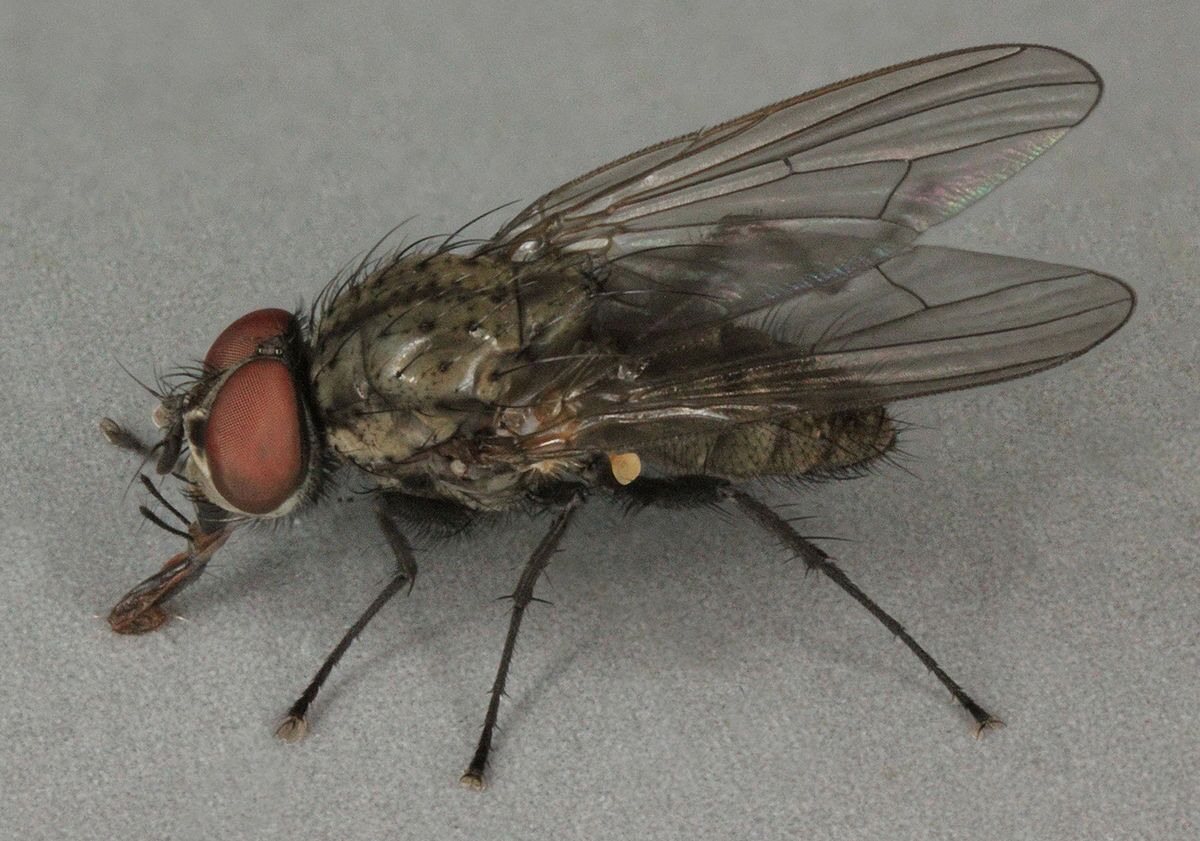
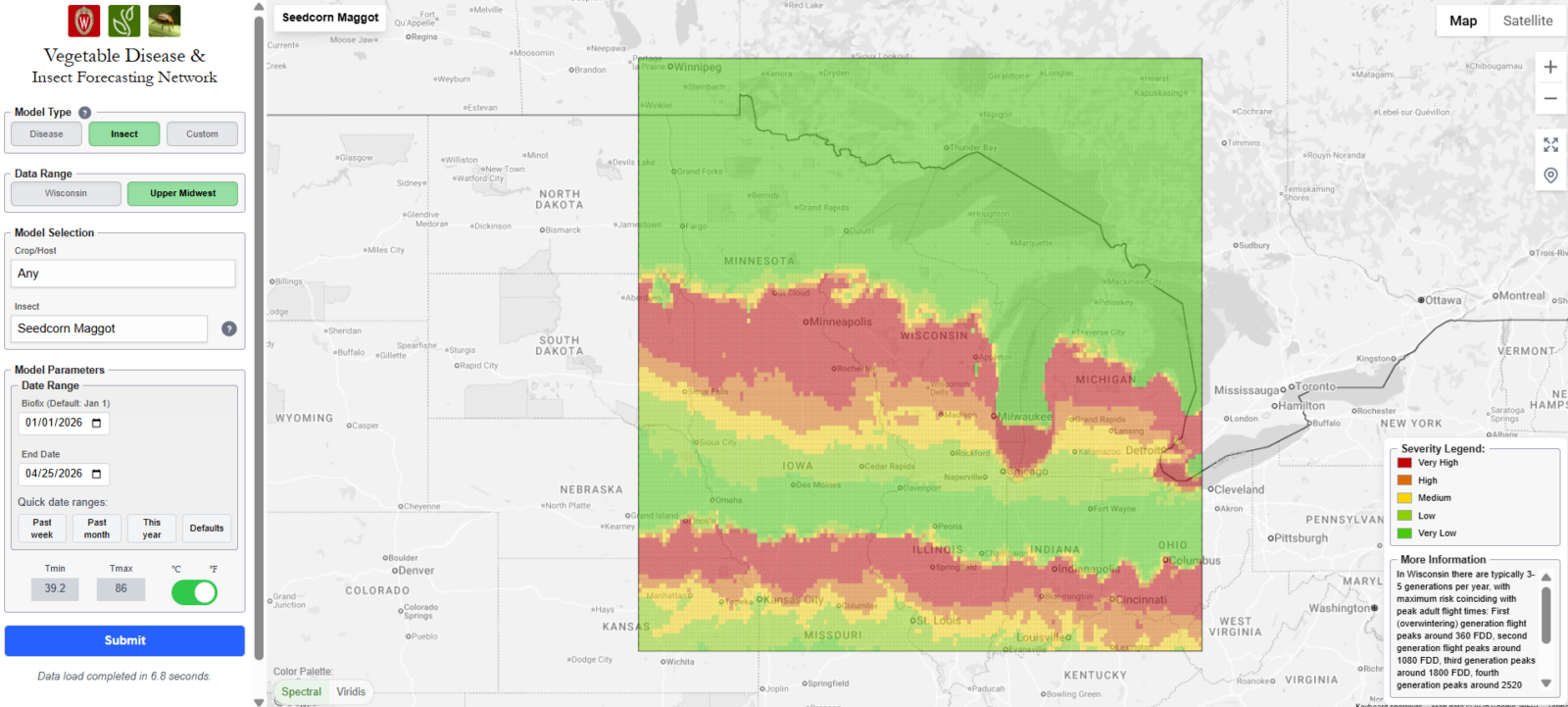
Adults often mate and lay eggs within 2-3 days of emergence. Eggs hatch 2-4 days later depending on soil temperature. The larval portion of the SCM life cycle occurs below ground over the course of a few weeks. Once hatched larvae burrow into the soil 6-8 cm to locate food resources. A complete life cycle for is typically 16-21 days and these are 3-5 generations per year in most portions of the state. In the image below taken from the Vegetable Disease and Insect Forecasting webpage, you can see the relative position of the 1st generation across the state of Wisconsin, and you can also see the relative position of the advancing 2nd generation (approaching from the south).
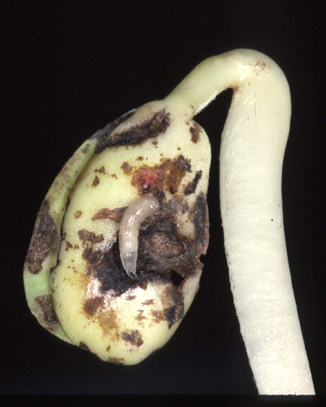
Once eggs are laid, the larvae hatch and begin to damage germinating seeds and young seedlings of a wide range of vegetable and agronomic crops. In addition to corn, seedcorn maggots have a large host range including common vegetable crops. SCM can cause economic damage to the recently planted seeds of beet, Brussels sprouts, cabbage, cantaloupe, carrot, cauliflower, cucumber, kale, lettuce, bean (lima, snap, red), onion, pea, pumpkin, tomato, and turnip.
Management for SCM is only effective when used in a preventative manner. Once direct larval damage is detected there is no control option for the pest. Therefore, there are no economic thresholds for this insect pest. SCM forecasting models predict peak flight windows and are very useful for growers. Documenting peak flights can help to forecast subsequent generations of SCM. (Source: https://agweather.cals.wisc.edu/vdifn).
Two common chemical delivery techniques are available for SCM management: seed treatment or an at-plant soil application. Numerous combinations of insecticidal compound and fungicide are available as pre-plant seed treatments directly from seed vendors. Many active ingredients are reduced risk insecticides which have lower non-target impacts, and these include spinosad (Entrust, Regard, Lumiverd), cyantraniliprole (Fortenza and Lumiposa) and chlorantraniliprole (Lumivia). Refer to the UW-Extension publication Commercial Vegetable Production in Wisconsin (A3422) for a list of registered insecticides and management recommendations.
Cabbage maggot – https://vegento.russell.wisc.edu/pests/cabbage-maggot/
Yet another damaging maggot species just entering the southern portions of the state is the cabbage maggot (Delia antiqua). Cabbage maggots feed both internally and on the surface of roots of susceptible brassica crops. Their tunneling provides a point of entry into the plant for pathogens such as soft rot bacteria and the blackleg fungus. Maggots can be especially damaging to seedlings, injuring the growing point of the root, and stunting plant growth. Affected seedlings and young transplants may become off-color or wilt during hot weather. Cabbage maggots thrive in wet, cool conditions, and injury to crops is most likely during first and second generations of the insect when plants are newly established.
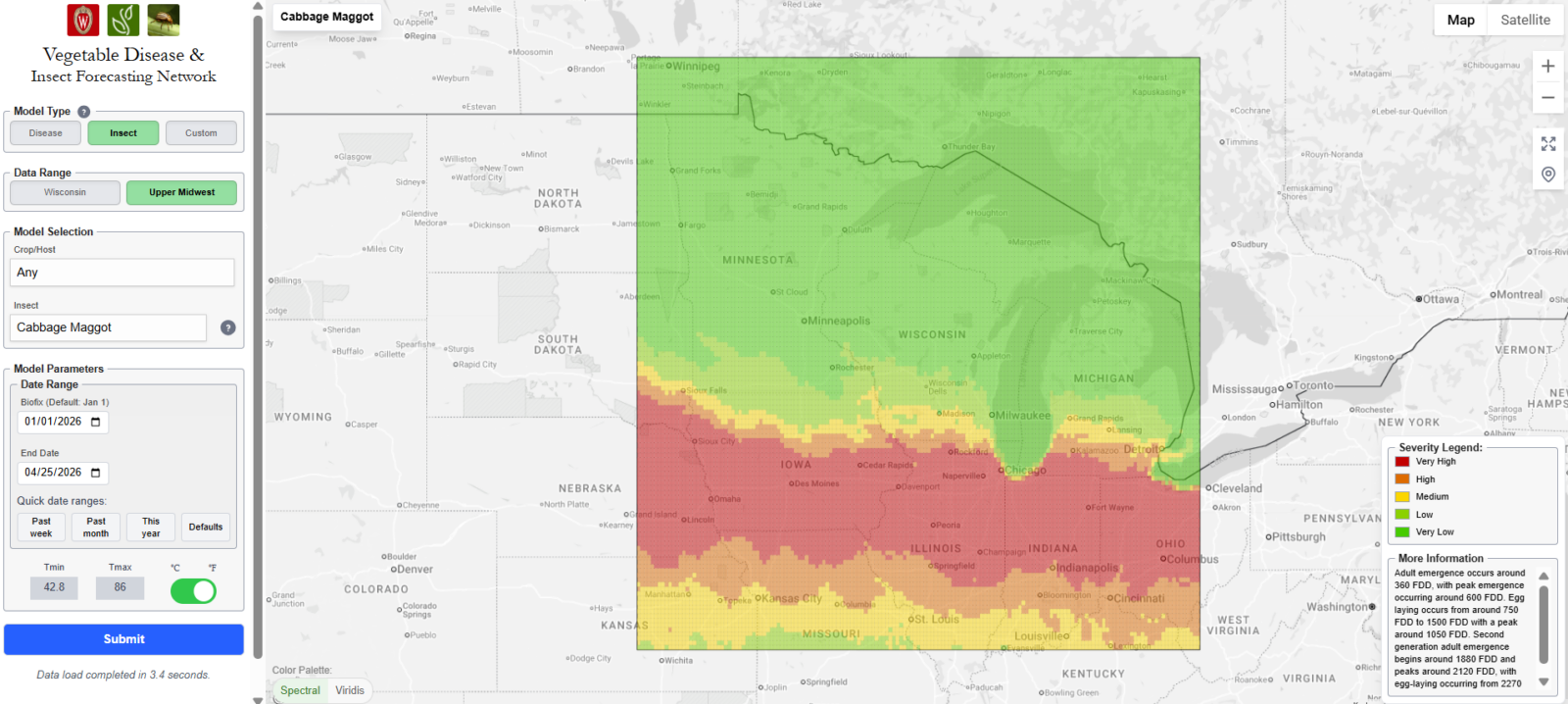
Fly emergence can be forecasted with degree day models, which can be counted after the ground has thawed. At a base temperature of 43°F, the first generation appears after 300 degree days have accumulated, and we are just approaching these values in southern regions of the state. The seedcorn maggot (described above) has a slightly lower development minimum temperature (39oF) and for this reason has advanced farther north across the state. The second and third generations will appear after 1476 and 2652 degree days have accumulated, and the 2nd generation often coincides with transplanting of susceptible brassica crops.
Not unlike seedcorn maggot control, cabbage maggot treatment is primarily preventative. Plants that already have eggs on them are likely to have damage from infestations. If possible, time planting dates to avoid peak fly emergence. Plantings after mid-June suffer less damage than early plantings. To avoid damage from this pest, till in cover crops 2-3 weeks before seeding or transplanting, and plant when soil temperatures are adequate (e.g., > 50 F) for quick emergence. Transplants should be planted one week before peak fly emergence. Floating row covers are also effective in protecting plants during flight periods. Do not plant cole crops in fields where animal manure has been freshly applied. Diatomaceous earth, parasitic nematodes, and predaceous ground beetles may also help reduce damaging populations. Crop residues should be worked into the soil immediately after harvest to reduce sites where maggots can overwinter. Insecticides at planting time are recommended in areas that have historically had problems with cabbage maggots. Verimark® can be used at planting and has recently received a transplant drench label for use in transplant cole crops. No insecticides are effective after the onset of a cabbage maggot outbreak.
Amanda Gevens, Professor & Extension Vegetable Pathologist, UW–Madison, Dept. of Plant Pathology, 608-575-3029, gevens@wisc.edu
Potato early season disease considerations
Wet and cool soils common in early potato plantings can delay germination and emergence. Such conditions also promote activity of plant pathogens such as Rhizoctonia solani, a potentially seed-, soil-, or debris-borne fungal pathogen which causes stem or stolon cankers resulting in reduced stands, stunted plants, and/or reduction in tuber number, size, or quality. With the range of temperature conditions in spring, hilling time can also impact Rhizoctonia and other seed and emerging plant disease risks.
Late in the season, Rhizoctonia can also cause black scurf on tubers. Cultural management approaches such as planting when soil temperatures are more consistently above ~46°F, planting into well-drained soils, avoiding planting too deep, and avoiding hilling prior to adequate emergence can limit early season stem and stolon canker. Several other seed-, soil-, and/or debris-borne diseases can also impact the potato crop as temperatures increase in the early season including Fusarium seed piece decay caused by the fungus Fusarium sambucinum (primarily) and bacterial soft rot of seed, bacterial blackleg, or bacterial aerial stem rot. The bacterial pathogens associated with these disease conditions are typically in the Pectobacterium or Dickeya genera. Most recently in WI, Pectobacterium species are the predominant bacteria causing soft rot/blackleg/stem rot.
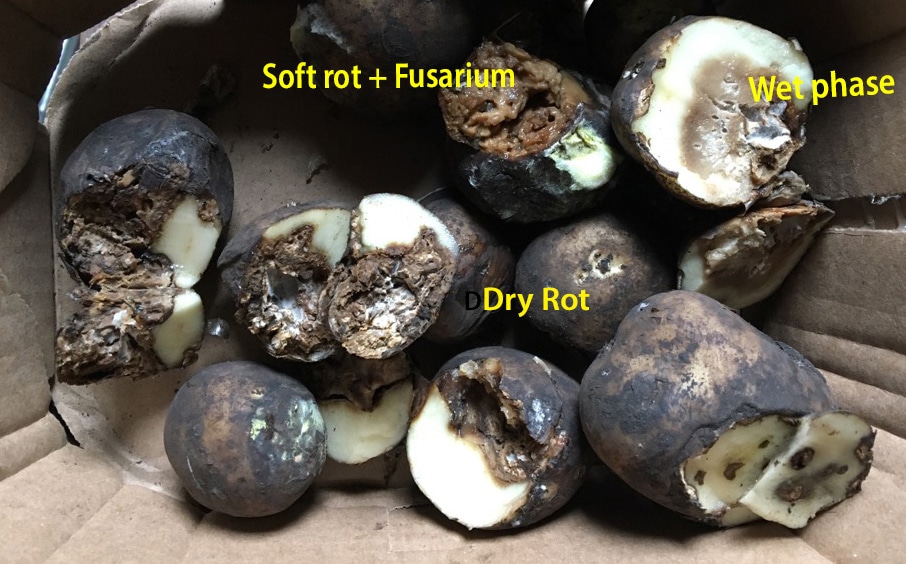
Fusarium, as a dry rotting pathogen which requires wounds for entry, can affect quality of seed potatoes in storage and lead to further disease concerns when potatoes are moved and warmed for planting. As a seed piece decay pathogen, Fusarium can impact the seed right after cutting and through sprouting. If initial and subsequent sprouts continue to be affected, the seed piece loses vigor and stand is reduced. Photo (above) courtesy of Dr. Eugenia Banks, Potato Specialist with Ontario Potato Board.
Fungicide seed and in-furrow treatments have a place in an integrated management plan which includes cultural practices such as planting certified seed, proper handling and sanitation of storage/cutting/curing facilities prior to planting and cultivar resistance. In combination, IPM practices minimize economic losses to disease, minimize environmental effects, limit risk of pesticide residues in the food supply, limit development of fungicide resistant pathogen strains which may overcome host disease resistance.
Bacterial pathogens that are inside (or systemic within) seed potatoes cannot be eradicated with use of seed-applied, in-furrow, or foliar-applied fungicides. However, management of fungal pathogens can reduce the overall disease pressure on the seed potato pieces which can help prevent secondary soft rotting bacterial infections. Best cultural management practices benefit seed in supporting optimum health in early development.
Several fungicides with effective control of multiple diseases are available with registration for application to seed pieces prior to planting. Listings can be found in our 2026 A3422 Commercial Vegetable Production Guide for Wisconsin. A bookmarked, searchable digital version of the Commercial Vegetable Production in Wisconsin book (A3422).
Potato Scouting Class
UW–Madison Division of Extension is again offering a spring Potato Scouting Class at the UW-Hancock Agricultural Research Station (N3909 County Road V, Hancock, WI) on May 18, 2026 from 8AM to Noon. The cost of the Class is $10/person payable by cash or check made out to “University of Wisconsin–Madison Extension.” Please contact Dr. Rue Genger (rue.genger@wisc.edu) with questions or for help with registration. The link below leads you to the registration form.
Dr. Jed Colquhoun, Dr. Amanda Gevens, Dr. Russ Groves, and Jordan Kampa, Pesticide Education Program Manager with UW–Madison Extension, will discuss the importance and techniques of scouting, professionalism and safety in the field, and soil sampling methods.
A flier for this education opportunity follows this newsletter.
Vegetable Disease and Insect Forecasting website tutorial video
In under 20 minutes, Ari Abbrescia, Organic & Sustainable Agriculture Outreach Specialist with UW–Madison Extension provides an informative tutorial on why and how the insect and disease models work to improve our understanding of when pest and pathogens may be active and managed for to proactively prevent vegetable crop damage.
Ari can be reached at: ariana.abbrescia@wisc.edu, Phone: 608-263-1054
Learn More: Organic Transition Resource Toolkit
Tutorial video: https://www.youtube.com/watch?v=y3oqd7exFG0