Vegetable Crop Update – Jul 5, 2026

In this issue:
Amanda Gevens, Professor & Extension Vegetable Pathologist, UW–Madison, Dept. of Plant Pathology, 608-575-3029, gevens@wisc.edu
Environmental Protection Agency (EPA) Draft Endangered Species Act (ESA) Fungicide Strategy – Feedback Requested by July 20 – extended 21 days from previous deadline of June 29
On May 1, the EPA released its draft Fungicide Strategy to bring the Agency into compliance with its obligations under the Endangered Species Act (ESA). The Fungicide Strategy largely follows the approaches used in the previously developed Herbicide and Insecticide Strategies. However, there are some differences regarding how vertebrate species are considered. Additionally, the draft focuses on regional patterns of fungicide use primarily driven by moisture/rainfall that increases disease pressure.
There was a 21-day extension of the public comment period for the “Draft Fungicide Strategy to Reduce Exposure of Federally listed Endangered and Threatened Species and Designated Critical Habitats from the Use of Conventional Agricultural Fungicides.” The public docket can be found at https://www.regulations.gov, docket number EPA-HQ-OPP-2026-2973. This extension was due to the complexity and length of the draft strategy and associated documents. There are currently ~35 comments posted to the site.
Current P-Day (Early Blight) and Disease Severity Value (Late Blight) Accumulations
Thanks to Ben Bradford, UW- Madison Entomology for supporting this effort and providing a summary reference table: https://agweather.cals.wisc.edu/thermal-models/potato. A Potato Physiological Day or P-Day value of ≥300 indicates the threshold for early blight risk in potato and triggers preventative fungicide application. A Disease Severity Value or DSV of ≥18 indicates the threshold for late blight risk and triggers preventative fungicide application in potato. Data from the modeling source: https://agweather.cals.wisc.edu/vdifn are used to generate these risk values in the table below. I’ve estimated early, mid-, and late planting dates by region based on communications with stakeholders. These are intended to help in determining optimum times for preventative fungicide applications to limit early and late blight in Wisconsin.
| Location | Planting Date | 50% Emergence Date | Disease Severity Values (DSVs) through 7/4/26 | Potato Physiological Days (P-Days) through 7/4/26 | |
| Spring Green | Early | Apr 10 | May 7 | 21 | 436 |
| Mid | May 5 | May 20 | 19 | 365 | |
| Late | May 16 | June 2 | 19 | 268 | |
| Arlington | Early | Apr 12 | May 8 | 12 | 429 |
| Mid | May 6 | May 23 | 12 | 354 | |
| Late | May 20 | June 4 | 12 | 257 | |
| Grand Marsh | Early | Apr 13 | May 9 | 22 | 406 |
| Mid | May 6 | May 22 | 22 | 347 | |
| Late | May 21 | June 5 | 22 | 249 | |
| Hancock | Early | Apr 14 | May 11 | 19 | 402 |
| Mid | May 10 | May 30 | 18 | 287 | |
| Late | May 23 | June 6 | 17 | 234 | |
| Plover | Early | Apr 15 | May 12 | 21 | 400 |
| Mid | May 10 | May 30 | 16 | 289 | |
| Late | May 25 | June 6 | 15 | 245 | |
| Antigo | Early | May 12 | May 29 | 17 | 275 |
| Mid | May 25 | June 5 | 17 | 230 | |
| Late | June 8 | June 20 | 8 | 118 | |
| Rhinelander | Early | May 15 | June 6 | 11 | 213 |
| Mid | May 28 | June 10 | 9 | 176 | |
| Late | June 9 | June 25 | 3 | 81 | |
Late blight of potato/tomato
Earlier planted potatoes in the areas of Spring Green, Grand Marsh and Hancock of Wisconsin have accumulated 18-22 Disease Severity Values or DSVs as of 7/4 – this is 8-9 more DSVs since last week. This indicates that late blight favorable weather has occurred, since ~50% crop emergence and we have accumulated enough late blight-favorable weather to warrant a preventative fungicide application to target this disease. Fields with ≥18 DSVs should receive preventative fungicide applications to manage for late blight. https://vegpath.plantpath.wisc.edu/diseases/potato-late-blight/ An updated list of fungicides for management potato late blight in Wisconsin 2026 is provided here: https://vegpath.plantpath.wisc.edu/resources/late-blight-fungicides/
Early blight of potato.
Earliest emerging fields in Plover and Southward have surpassed the treatment threshold of 300 P-Days. Currently, preventative fungicide applications are warranted for such fields. In the past week regions of the state accumulated between 50 and 67 P-Days.
Disease profile: Potato White Mold
Potato White Mold (sometimes called Sclerotinia stem rot) is a soilborne fungal disease caused by the soilborne Sclerotinia sclerotiorum that impacts potatoes and many other broad-leaved crops (>400 plant species). The severity of the disease, and resulting yield/quality losses, can vary greatly and depend upon the quantity of inoculum in soils, environmental conditions, and planting factors including cultivar, crop rotational history, and plant spacing. Symptoms have been showing up over the past 2 weeks in central Wisconsin potatoes.
Symptoms
Symptoms develop first in the lower leaves and stems of the plant, typically ~2 weeks after row closure. Water-soaked lesions typically form at the stem branch points or where stems are in contact with the soil. In potato, floral infections can occur and lead to stem infections either from movement through the base of the flower, or through the senescing flower dropping onto other lower plant parts and spreading infected tissues. Based on my field observations over the past few years in Wisconsin, most infections initiate on stem branch points and in stem contact with the soil. Lesions are often covered in white, cottony fungal growth. Lesions can expand and girdle stems resulting in wilting of sections of plants or entire plants leading to plant death. Eventually, lesions turn light brown and nearly white in color once they’ve dried out. At this time, you can often crack open the stems and find the black, hard fungal structures referred to as sclerotia. During the progress of infection, any additional contact with other plant parts can result in the spread of infection.
Disease cycle
The pathogen overwinters as sclerotia in the soil or in infested crop residue. Sclerotia can be moved in soil within a field during cultivation, in moving water, soilborne sclerotia form a mushroom structure under plant canopies, can move relatively short distances from where they’re discharged (roughly 1 mile). The apothecial cups form earlier in the summer/late spring from the sclerotia in the top 2 inches of soil when we have cool temperatures (50-70°F), high relative humidity (95-100%) and several days of moist soil. These conditions are typically met after canopies have closed and soil surfaces are shaded (and there is low air circulation). In many potato cultivars this aligns with 70-100% bloom. The movement is typically from the apothecial cup/mushroom to the plants immediately above/surrounding it. The soilborne sclerotia can also be moved to previously non-infested fields in soil and debris on contaminated equipment. There is little or no plant-to-plant spread of white mold during the growing season, with infections initiated from the overwintered sclerotia. The sclerotia can remain viable in the soil for roughly 5 years.
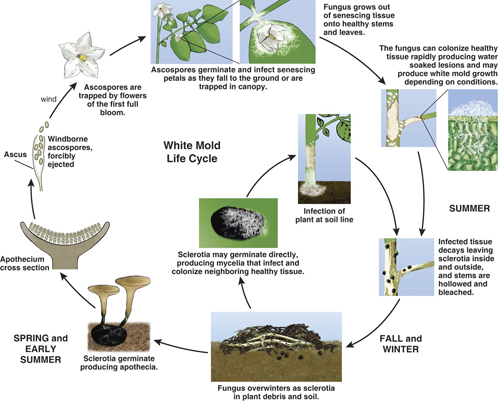
Management
An integrated program of cultural practices and fungicide applications is necessary to manage white mold in potato. Currently, the application of fungicides is a primary management approach. The choice of fungicide, application method, and timing of application are important. Fungicide treatments should be initiated when plants reach the bloom stage or at row closure, to help prevent the flower petals and stem junctions from becoming infected by ascospores. This timing also enhances coverage in the lower canopy to manage infections caused by limbs touching the soil and sclerotia directly. A second application of a highly effective white mold fungicide should then follow up 2 weeks after the first (2 weeks after initiation of bloom stage). The fungicides with strong white mold activity tend to also be very good at early blight and brown spot management as well.
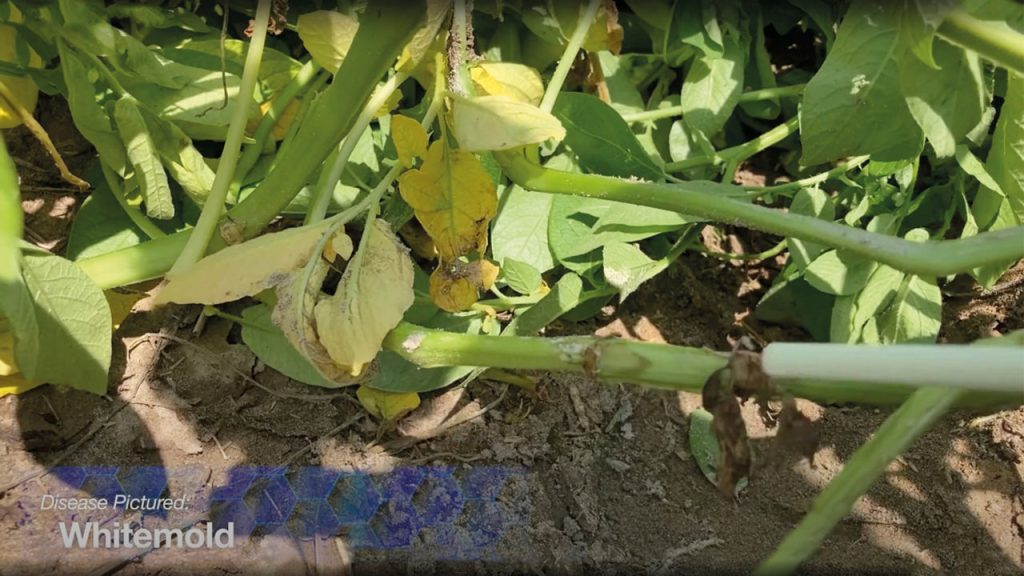
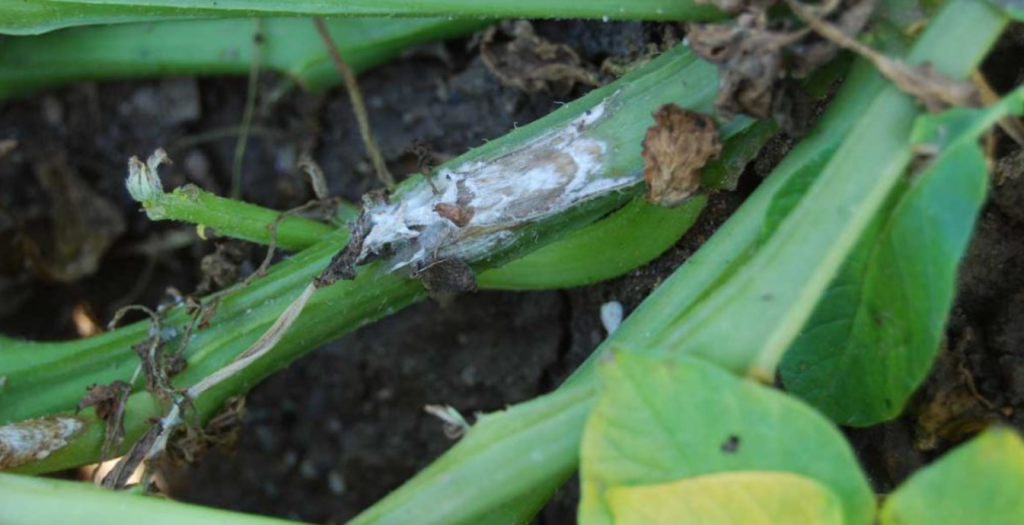
A listing of fungicides registered for white mold management in potato in WI is provided below (from Commercial Vegetable Production in Wisconsin):
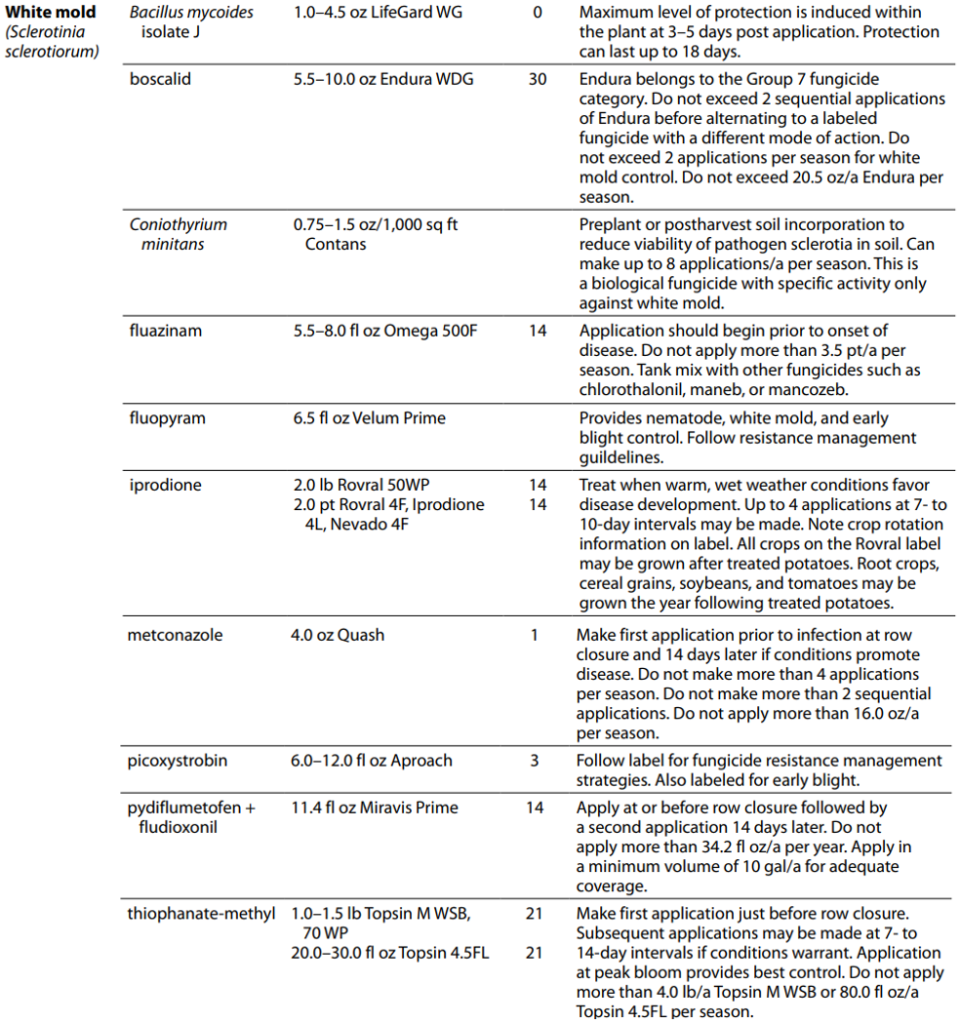
Several fungicides are labeled for the control of white mold on potato. Fluopyram, in the “Luna” fungicide series, is a systemic fungicide to protect buds, blooms, and new tissues. Luna Pro combines fluopyram with prothioconazole (FRAC 3). Luna Tranquility combines fluopyram (FRAC 7) with pyrimethanil (FRAC 9) for preventative and curative activity. Other fungicides recommended for controlling white mold include products containing the active ingredients boscalid (Endura), fludioxonil (ie: Miravis Prime with pydiflumetofen), fluazinam (ie: Omega), iprodione (ie: Rovral), penthiopyrad (Vertisan), and thiophanate-methyl (ie: Topsin).
For diagnostic and management support in Wisconsin, please consider contacting Dr. Amanda Gevens (gevens@wisc.edu) or our Plant Disease Diagnostic Clinic (pddc@wisc.edu).
Vegetable Insect Update – Russell L. Groves, Professor and Associate Department Chairperson, UW–Madison, Department of Entomology, 608-262-3229 (office), (608) 698-2434 (cell), e-mail: rgroves@wisc.edu
Vegetable Entomology Webpage: https://vegento.russell.wisc.edu/
Colorado potato beetles (2nd generation emergence)
https://vegento.russell.wisc.edu/pests/colorado-potato-beetle/
Second generation adults are appearing now in early-July across much of southern and central Wisconsin. Adults (emerging from second generation) have been up for 1-2 weeks across southern production areas and have been beginning to emerge in the Central Sands in just the past week. In the illustration below from the Vegetable Disease and Insect Forecasting Network (VDIFN), the presence of overwintered CPB adults is moving out of northern Wisconsin, and the appearance of the 2nd generation adults is just emerging across southern Wisconsin. These adults are often associated with some of the earliest planted potato fields in the spring. In northern regions, adult emergence from overwintering is nearing completion and there are many middle stage larvae (2nd-3rd instars) present in fields, especially early planted locations. The first week of July often signals the transition time of year from the 1st full generation to the appearance of the 2nd generation across much of central Wisconsin.
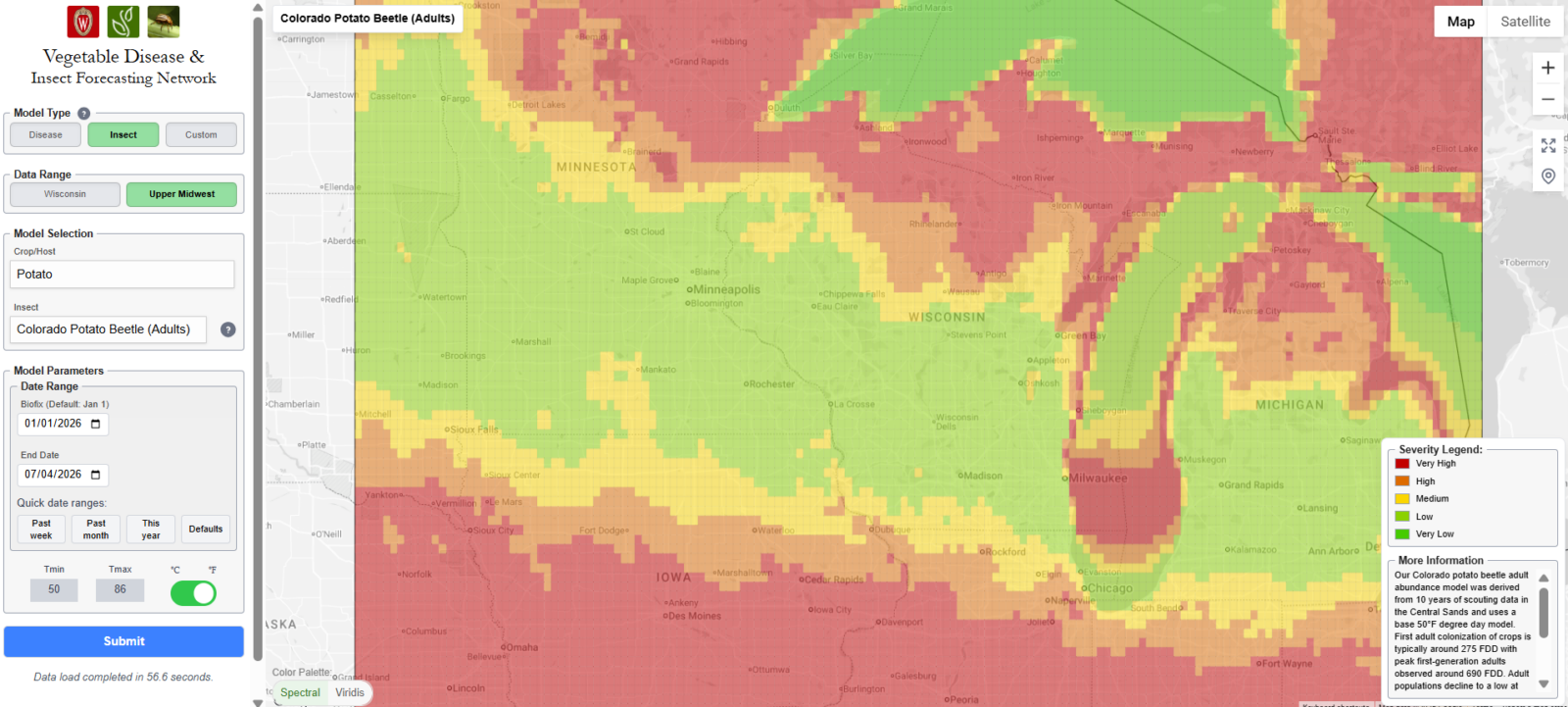
If control of the 1st generation was very successful, producers may see a very low or a slow to gradual appearance of adults. In these instances, managers and scouts should wait until (new) defoliation has reached 3-5% to initiate 2nd generation applications. In fields where excellent 1st generation control was obtained, the magnitude of the 2nd generation may be quite modest, but scouting should continue to alert producers should populations increase. Typically, there are two discrete generations of beetles per year in South-Central Wisconsin and only a single generation in Northern Wisconsin. Control options for 2nd generation CPB can be found on the UW Vegetable Crop Entomology, Colorado Potato Beetle Management site.
Potato virus Y and management
Important to note, aphid species that can colonize potatoes (Green peach aphid and Potato aphid) were initially detected in select fields in central Wisconsin this past week (June 28 – July 5). Low levels of Potato aphids were initially detected this week (AgSource, LLC) in the Rhinelander area. The Aphid Suction Trap Network (valid through mid-June) has indicated, however, that no potato-colonizing species have been detected so far this season.
Our specific degree day model for the top 10 aphid species present in Wisconsin (which includes the Green peach aphid (GPA)) suggests that elevated risk for transmission of Potato virus Y occurs when approximately 1,838 FDD (base 39) has been or surpassed. This ‘threshold of risk’ represents the ‘average’ timeframe over which generalized aphid activity increases across central and northern Wisconsin. Important to note, this represents the beginning of a period of elevated risk for PVY when several species of aphids become active and colonizing species begin to occur in potato. Important to note, with forecast (high and low) temperatures for the coming week it is likely that 1838 FDD39 will have accumulated in the growing region of Langlade County by the end of the week. It is important to scout fields now in seed production areas, and insecticide programs of control should be initiated to limit the establishment of these early populations in susceptible potato once scouting has confirmed their presence in fields. Given the amount of inoculum planted in the 2026 production season, it is important to be proactive about insecticide programs that can help to limit the increase of this virus in seed.
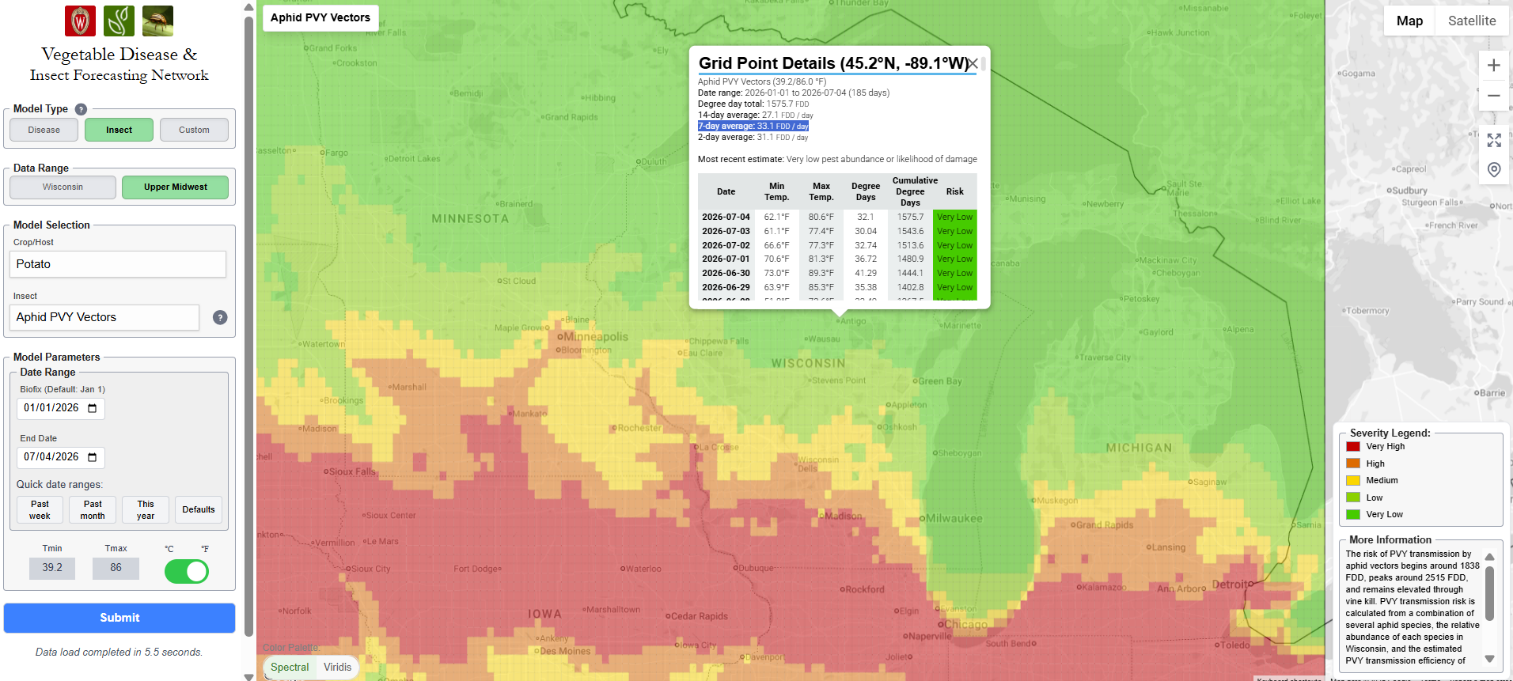
For most aphid chemical management tools, timing of application occurs with the appearance of the first, small colonies of potato-colonizing aphids. Spraying for colonizing aphids can reduce the spread of PVY within the field. Spray only when scouting indicates aphid populations have become established and scouts can identify small colonies of apterous (wingless) aphids. Critical factors affecting the efficacy of these spray applications include timing, application conditions and coverage. Remember – most aphid vectors of PVY do not colonize potato and their ability to transmit PVY to the plant will not be affected by systemic insecticides. In these instances, non-colonizing aphids (several species) will only intermittently move in and through potato over short durations. In these specific instances, we use anti-feedant compounds to include the paraffinic oils.
Several species of non-colonizing aphids (e.g soybean aphid, corn leaf aphid, bird cherry-oat aphid, corn leaf aphid, English grain aphid and pea aphid) can be present moving through the seed crop and at predictable intervals through the season. The timing of these flights have been modeled as a collective, or cumulative risk model and for Wisconsin and the upper Midwest and these map-based projections are available daily at the Wisconsin Vegetable Disease and Insect Forecasting Network site. Our current model predicts the risk of non-colonizing aphids is approaching northern Wisconsin, and producers are alerted to apply paraffinic oils on a 5-7 day reapplication interval.
The following management guidelines were developed specifically for Wisconsin seed producers consideration to limit the spread of PVY:
In-season field scouting
- Scout a sub-sample of all potato fields weekly during the production season for colonizing aphids. Twice monthly, scout all non-potato rotation crops for colonizing aphids.
- Aphid populations are often aggregated in a field. Anticipate where to look for “hot spots” of aphid activity.
- Migrating aphids often land./aggregate along southern, western, tree lines bordering fields. They often alight along field edges in more open fields. They often alight near drive rows within fields. Wind eddies are often created along edges and aphids will ‘fall out’ of the moving air in these eddies.
- All aphids are soft-bodied and pear-shaped with a pair of cornicles, or little horns, projecting from the rear end of their abdomens. Adult aphids may or may not be winged. Visit the following site (https://blogs.cornell.edu/potatovirus/pvy/aphid-vectors-of-pvy/#vectors) to see images of many aphids: some will colonize potato (green peach aphid, potato aphid, buckthorn/melon aphid). Most aphids will not colonize potatoes. Another gallery of aphid images is available at Wisconsin Vegetable Entomology.
- Because of the spotty nature of infestations, look for aphids on a number of plants in several areas of the field. Each week, examine a whole leaf (not just leaflets) from at least 25 consecutive plants. Take this leaf from the mid-canopy of 25 separate plants. Look carefully at both the top and bottom surface of leaves. Repeat this process at 10 locations within fields weekly.
- Look carefully at the aphids found in potato and determine if they are winged (alate) or wingless (apterous). At the Wisconsin Vegetable Entomology site, scroll to the bottom of the aphid page and look at the images for corn leaf aphid (wingless) and green peach aphid (winged). If small groups (e.g., 3-6) of wingless aphids are observed in potato, then you undoubtedly have a highly problematic, potato colonizing species getting established in potato.
- Examine your rotation crops in a comparable way for aphids. Do not be surprised to find aphids in these crops. As noted previously, attempt to source all rotation crops to contain an at-plant seed treatment containing a neonicotinoid insecticide (e.g., Cruiser, Gaucho, Poncho, etc.). If aphid numbers are observed to be increasing in any local rotation crop, it may be appropriate to spray. Do NOT spray an inexpensive pyrethroid insecticide on these rotation crops if you decide to spray. Apply a foliar neonicotinoid (e.g., Actara, Admire Pro, Assail, Belay, Scorpion, Venom).
Apply paraffinic oils to discourage non-colonizing aphids from the crop
- Initiate applications of paraffinic oils 2 weeks after full emergence from hilling, or just prior to the beginning of risk illustrated on the VDIFN site. Use an approved paraffinic oil at labeled rates weekly through the production season. Apply oil (and any insecticides) only after an irrigation event – not in advance. If possible, apply oils/insecticides during late evening to limit the potential for phytotoxicity.
- When you begin applications of paraffinic oils, also consider weekly applications of insecticides over the entire crop if you are finding colonizing aphids present. Following is a suggested list of insecticides (Mode of Action and maximum application rate) to accompany paraffinic oil applications and these can all be reviewed in the UW-Extension publication Commercial Vegetable Production in Wisconsin (A3422) for a list of registered insecticides and management recommendations
Consider applying insecticides to manage colonizing aphids
| Trade name | Chemical name | Mode of Action Class | Max labeled rate (single application) |
| Admire Pro | imidacloprid | Group 4A | 1.3 fl oz/ac |
| Actara 25WG | thiamethoxam | Group 4A | 3.0 oz/ac |
| Assail 30SG | acetamiprid | Group 4A | 4.0 oz/ac |
| Belay | clothianadin | Group 4A | 3.0 fl oz/ac |
| Beleaf 50SG | flonicamid | Group 29 | 2.8 oz/ac |
| Exirel 10SL | cyantraniliprole | Group 28 | 13.5 fl oz/ac |
| Fulfill 50WG | pymetrozine | Group 9B | 5.5 oz/ac |
| Movento HL | spirotetramat | Group 23 | 2.5 fl oz/ac |
| PQZ | pyrifluquinizon | Group 9B | 3.2 fl oz/ac |
| Sefina Inscalis | afidopyropen | Group 9D | 6.0 fl oz/ac |
| Sivanto HL | flupyradifurone | Group 4D | 7.0 fl oz/ac |
| Torac | tolfenpyrad | Group 21 | 21.0 fl oz/ac |
| Transform 50WG | sulfoxaflor | Group 4C | 1.5 oz/ac |
| Venom 70SG | dinotefuran | Group 4A | 1.5 oz/ac |
- Initiate applications after the appearance of colonizing aphids have become established in the crop. An initial foliar application should be applied to the entire field and followed by a second foliar application one week later. Only two successive applications of any compound should be implemented as a foliar option per crop season for control of colonizing aphids before rotation to a new mode-of-action. Continue to scout field throughout the time interval of the application series and consider rotation to another effective aphicide mode of action if colonizing aphids persist in the crop.
- Should be applied with mild, penetrating surfactant and ensure the tank pH is not alkaline (pH < 7.0). Ground-application advised. Only two successive applications of a neonicotinoids (eg. Admire Pro, Actara, Assail, Belay) should be implemented as a foliar option per crop season for control of colonizing aphids before rotation to a new mode-of-action.
- All insecticide and paraffinic oil combinations should be delivered using application equipment that can ensure the most complete canopy coverage and using sufficient delivery volume.
- Always remember to introduce the products into the tank in the following order: (1) water soluble packets (WSP) (2) wettable powders (WP) (3) water dispersable granules (WDG) (4) flowable liquids (F, L) (5) emulsifiable concentrates (EC) and (6) adjuvants and/or oils. Always allow each product to fully disperse before adding the next product.
- Each of the above can be mixed with common fungicides. Care not to add any foliar fertilizers, metal-containing bactericides, or micronutrients as these compounds are often untested in terms of compatibility.
Hancock Agricultural Research Station Annual Potato Field Day
The HARS field day will be held this Thursday, Jul 9, from 1-4pm at the research station. Details available on the event page.