Vegetable Crop Update – Jun 28, 2026

In this issue:
Yi Wang, Associate Professor & Extension Potato and Vegetable Production Specialist, UW–Madison, Dept. of Plant and Agroecosystem Sciences, 608-265-4781, Email: wang52@wisc.edu
Weather and Potato Production Updates
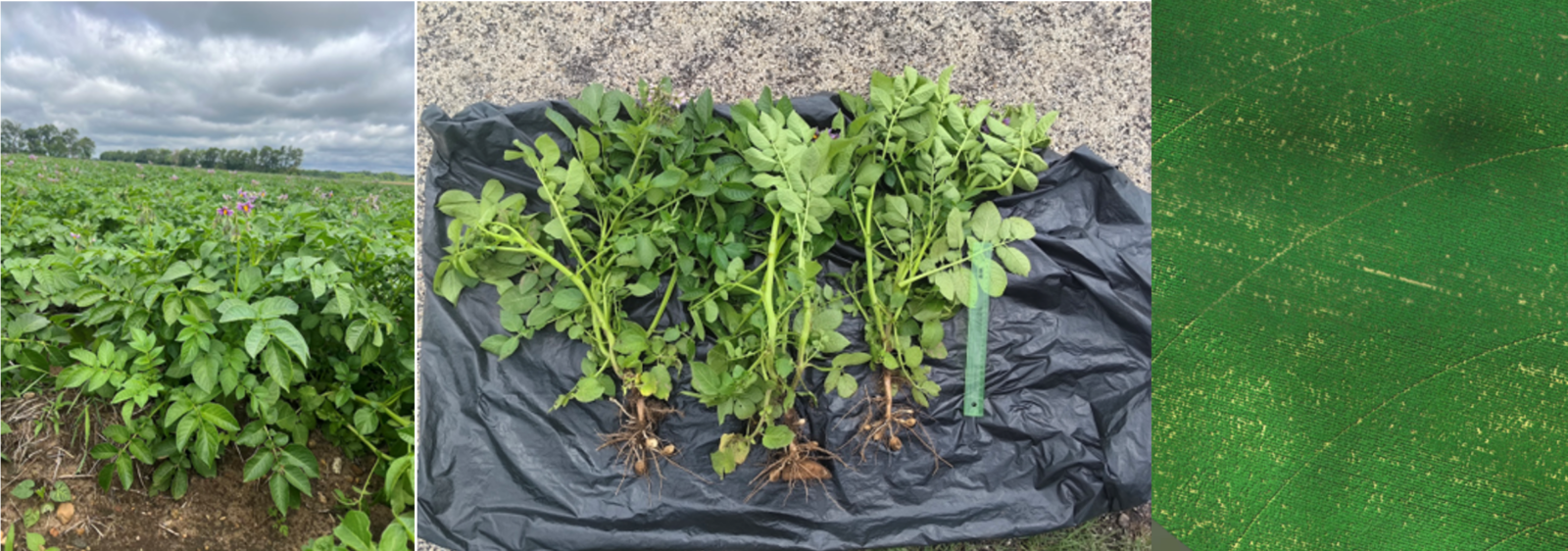
According to the UW–Madison Extension weather report, it has been a cooler-than-normal week across the state. Temperatures were mostly 4-8°F below average. Most of the state received at least 0.5’’ of rain, and totals of 1-2’’ were common. Satellite-based soil moisture estimates indicate that most of the state has near-normal moisture in the top 40’’ of soil. Minimal drought is observed. Rain chances over the next 7 days are higher in the northwest, north central, and west central counties. Outlook for early July suggests that temperatures might be above normal, and late summer through early fall (July – September) might be cooler-than-normal in southern and central counties, with rainfall amounts leaning towards below normal for most parts of Wisconsin. We checked on a couple of Reveille plants on Wednesday. They were about knee-high, and the average tuber length was about 1 ¼’’. We saw uneven plant stands in the field, but generally they looked healthy.
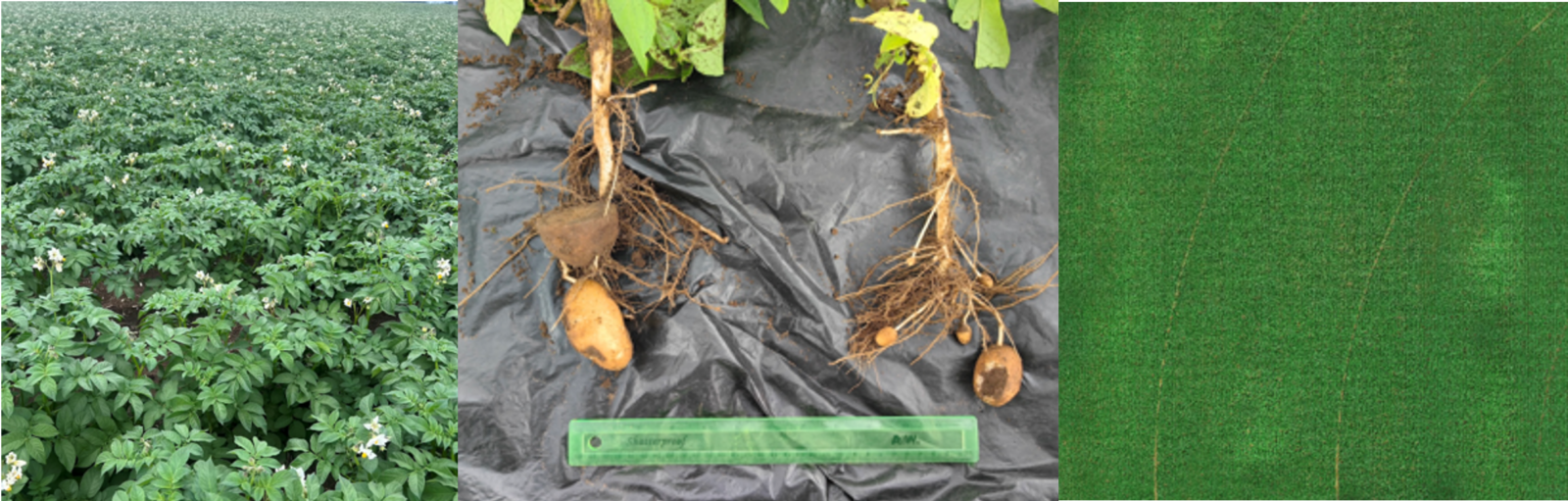
We also checked on some Caribou plants. They were about waist-high. The average tuber length was about 1 ½’’. Plant stands were more consistent in the Caribou field than in the Reveille field.
Amanda Gevens, Professor & Extension Vegetable Pathologist, UW–Madison, Dept. of Plant Pathology, 608-575-3029, gevens@wisc.edu
Current P-Day (Early Blight) and Disease Severity Value (Late Blight) Accumulations
Thanks to Ben Bradford, UW- Madison Entomology for supporting this effort and providing a summary reference table: https://agweather.cals.wisc.edu/thermal-models/potato. A Potato Physiological Day or P-Day value of ≥300 indicates the threshold for early blight risk in potato and triggers preventative fungicide application. A Disease Severity Value or DSV of ≥18 indicates the threshold for late blight risk and triggers preventative fungicide application in potato. Data from the modeling source: https://agweather.cals.wisc.edu/vdifn are used to generate these risk values in the table below. I’ve estimated early, mid-, and late planting dates by region based on communications with stakeholders. These are intended to help in determining optimum times for preventative fungicide applications to limit early and late blight in Wisconsin.
| Location | Planting Date Dates in future are anticipated or not yet listed (To Be Determined or TBD) | 50% Emergence Date | Disease Severity Values (DSVs) through 6/20/26 | Potato Physiological Days (P-Days) through 6/20/26 | |
| Spring Green | Early | Apr 10 | May 7 | 13 | 386 |
| Mid | May 5 | May 20 | 11 | 315 | |
| Late | May 16 | June 2 | 11 | 218 | |
| Arlington | Early | Apr 12 | May 8 | 11 | 377 |
| Mid | May 6 | May 23 | 11 | 302 | |
| Late | May 20 | June 4 | 11 | 205 | |
| Grand Marsh | Early | Apr 13 | May 9 | 13 | 350 |
| Mid | May 6 | May 22 | 13 | 291 | |
| Late | May 21 | June 5 | 13 | 186 | |
| Hancock | Early | Apr 14 | May 11 | 13 | 346 |
| Mid | May 10 | May 30 | 12 | 231 | |
| Late | May 23 | June 6 | 11 | 208 | |
| Plover | Early | Apr 15 | May 12 | 13 | 342 |
| Mid | May 10 | May 30 | 11 | 234 | |
| Late | May 25 | June 6 | 10 | 178 | |
| Antigo | Early | May 12 | May 29 | 10 | 216 |
| Mid | May 25 | June 5 | 10 | 171 | |
| Late | June 8 | June 20 | 1 | 58 | |
| Rhinelander | Early | May 15 | June 6 | 10 | 151 |
| Mid | May 28 | June 10 | 8 | 115 | |
| Late | June 9 | June 25 | 0 | 21 | |
Late blight of potato/tomato
Early and mid-planted potatoes of Wisconsin have accumulated up to 13 Disease Severity Values or DSVs as of 6/27 – this is just 0-2 more DSVs since last week. This indicates that late blight favorable weather has occurred, since ~50% crop emergence. However, we have not yet accumulated enough late blight-favorable weather to warrant a preventative fungicide application to target this disease. https://vegpath.plantpath.wisc.edu/diseases/potato-late-blight/
Early blight of potato
Once we see potato crops at 50% emergence, P-Days accumulate. P-Day values will continue to amass and indicate optimum conditions for early blight disease caused by the debris-borne fungus Alternaria solani. This disease can impact potato, tomato, and other solanaceous crops. Fungicides can provide good control of early blight in vegetables when applied early on in infection. Multiple applications of are recommended for optimum disease control through the season to vine-kill. Earliest emerging fields in Plover and Southward have surpassed the treatment threshold of 300 P-Days. Currently, preventative fungicide applications are warranted for such fields. In our UW Hancock Agricultural Research Station potato early blight research plots, early blight lesions are now present in the lower canopies of cultivars including Russet Burbank, Snowden, Atlantic, Dark Red Norland, Yukon Gold, and Colomba.
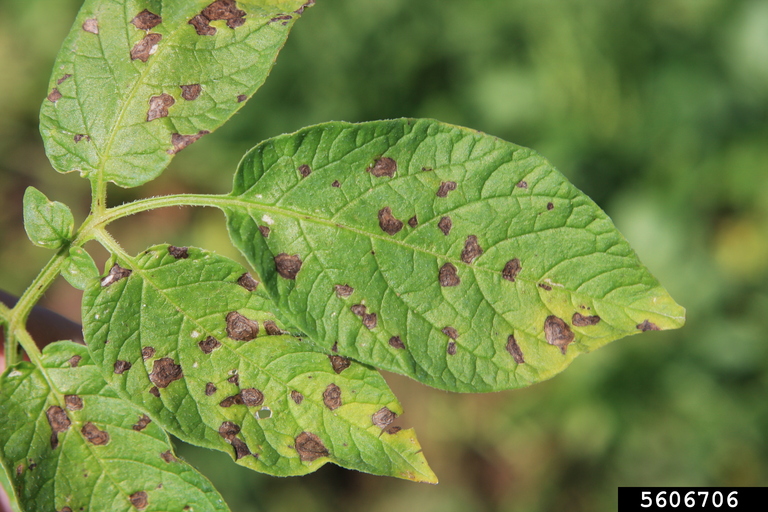
Potato early blight management is most successful when addressed preventatively. Cultivars vary in their susceptibility to this primarily foliar fungal disease caused by Alternaria solani, but all are susceptible. When the weather remains relatively warm and dry, early blight onset is slowed and progress is hampered. Irrigation timing, when feasible to manage, can help to manage the length of leaf wetness. A list of fungicides for consideration once a foliar fungicide program is initiated (based on disease model tool of P-Day 300 or other indicator) is provided, below, and per the potato early blight management sections of the A3422. Please note that this list is not comprehensive nor does it provide a specific recommendation. We do have substantial resistance in our Alternaria population in Wisconsin to QoI fungicides including azoxystrobin. Early season treatments with azoxystrobin, however, have demonstrated management of other diseases including Rhizoctonia (in-furrow application) and black dot (in-furrow, at-first-hilling, and row-touch applications.
Fungicide options for disease management
See also: Commercial Vegetable Production in Wisconsin (A3422)
Early blight (Alternaria solani) and brown spot (Alternaria alternata)
| Active ingredient | Rate and fungicide name | Days to harvest | Comments |
| azoxystrobin | 6.0-15.5 fl oz Aframe, Equation, Quadris, Satori, Willowood Azoxy 2SC | 14 | Group 11 fungicide. Follow resistance management guidelines. Note that much of the pathogen populations in Alternaria genus have resistance to Group 11 fungicides. |
| azoxystrobin + difenoconazole | 8-14 fl oz Quadris Top | 14 | Follow resistance management guidelines. |
| azoxystrobin +Reynoutria sachalinensis extract | 7.4-18.4 fl oz AzterKnot | 14 | Group 11 fungicide. Follow resistance management guidelines. |
| boscalid | 2.5-4.5 Endura WDG | 10 | For control of early blight only. Endura belongs to Group 7 fungicide category. Do not exceed 2 sequential applications before alternating to a different mode of action. Do not exceed 20.5 oz/a/season. |
| boscalid + mefentrifluconazole | 18.5-20 fl oz Endura Pro | 10 | FRAC Group 3 mefentrifluconazole is unique from other Group 3 fungicides. Follow resistance management guidelines. |
| cyprodinil + fludioxonil | 11-14 oz Alterity, Xuvia | 14 | Follow resistance management guidelines. |
| difenoconazole | 5.5-7 fl oz Top MP | 14 | Follow resistance management guidelines. |
| difenoconazole + tea tree oil | 4-8.5 fl oz Regev | 14 | Follow resistance management guidelines. |
| fluazinam + difenoconazole | 12.5-14.5 fl oz Orbus | 14 | See label for fungicide resistance management guidelines. |
| fluopyram | 6.5 fl oz Velum Prime | 7 | Use preventatively. Do not apply more than 43.6 fl oz/a/season. Do not make more than 2 sequential applications of any Group 7 or 9 fungicide before rotating with another mode of action. |
| fluopyram + penflufen | 13 fl oz Velum Rise | In furrow; one application per year | |
| fluopyram + prothioconazole | 10 fl oz Luna Pro | 14 | |
| fluopyram + pyrimethanil | Early blight: 11.2 fl oz Luna Tranquility | 7 | |
| fluxapyroxad + pyraclostrobin | 4-8 fl oz Priaxor | 7 | Make no more than 3 applications/a/season. Apply no more than 24 fl oz/a/season. |
| iprodione | 1-2 pt Meteor, Nevado 4F, Rovral | 14 | Use high specified rate under high disease pressure circumstances. Do not apply in less than 10 gal carrier water/acre. |
| mefentrifluconazole | 3-5 fl oz Provysol | 7 | Do not apply more than 5 fl oz (0.13 lb) per acre/application. Do not make more than 3 applications at 5 fl oz or 5 applications at 3 fl oz per acre/year. |
| metconazole | 2.5-4 oz Quash | 1 | Do not make more than 4 applications/season. Do not make more than 2 sequential applications. Do not apply more than 15 oz/a/season. |
| picoxystrobin | 6-12 fl oz Approach | 3 | Follow label for resistance management. Also for white mold. |
| penthiopyrad | 10-24 fl oz Vertisan | 7 | Do not exceed 72 fl oz/a/year. Make no more than 2 sequential applications before switching to different mode of action. |
| pydiflumetofofen + fludioxonil | 9.2-11.4 fl oz Miravis Prime | 14 | Do not apply more than 2 applications/year by air. Do not apply more than 34.2 fl oz/acre/year. |
| pyrimethanil | 7 fl oz Scala SC | 7 | Follow resistance management guidelines. |
Early blight and late blight (Phytophthora infestans)
| Active ingredient | Rate and fungicide name | Days to harvest | Comments |
| azoxystrobin | 6-15.5 fl oz Aframe, Satori, Quadris, Equation | 14 | Evito, Gem, Headline, Quadris, Reason, and Tanos are Group 11 fungicides. Adhere to fungicide resistance mitigation requirements when using. Note: Group 11 fungicides are no longer optimal for early blight control due to high levels of pathogen resistance in the populations. Group 11 fungicides are good late blight preventatives when pressure is low. |
| azoxystrobin + chlorothalonil | 1.6 pt Quadris Opti | 14 | |
| azoxystrobin + difenoconzole | 8-14 fl oz Quadris Top | 14 | |
| cymoxanil + famoxodone | early blight: 6 oz Tanos 50DFlate blight: 6-8 oz Tanos 50DF | 14 | |
| fenamidone | 5.5-8.2 fl oz Reason 50 SC | 14 | |
| fluoxastrobin | 2-3.8 fl oz Aftershock, Evito 480 SC | 7 | |
| pyraclostrobin | early blight: 6-9 fl oz Headline SC, EClate blight: 6-12 fl oz headline SC, EC | 3 | |
| pyraclostrobin + metiram | 2.9 lb Cabrio Plus | 3 | |
| Bacillus mycoides isolate J | 1-4.5 oz LifeGard WG | 0 | Maximum level of protection is induced within the plant at 3-5 days post application. Protection can last up to 18 days. |
| chlorothalonil | 1-1.5 pt Bravo Weather Stik, Echo 720, Equus 7201.5-2.25 pt Bravo Zn, Equus 500 Zn0.875-1.25 lb Echo 90DF, Echo Zn0.9-1.36 lb Bravo Ultrex 82.5WDG, Equus DF | 7 | Note seasonal use limitations on label and in WI DATCP Special Registrations for only Bravo products. |
| chlorothalonil + cymoxanil | 2 pt Ariston | 14 | Apply preventatively when triggered by disease modeling tools. |
| copper hydroxide | 0.66-2.66 pt ChampFormula 20.67-2.67 pt Kocide 4.5LF1.3-5.3 pt Kocide LF0.5-1.75 Kocide 30000.75-3 lb Kocide 2000DF1-4 lb Champion 77WP, Kocide 101, DF | 0 | Gives fair control of early blight and good control of late blight when applied preventatively. |
| cymoxanil | 3.2 oz Curzate 60DF | 14 | Do not use Curzate alone. Always mix with another registered fungicide such as mancozeb or chlorothalonil. Do not apply more than 7 sprays/season. After 3 to four applications of Curzate, switch to another mode of action before applying any additional Curzate. High heat can reduce length of curative fungicide activity period from 3 days to 1 day. |
| mancozeb | 0.4-1.6 qt Dithane F45 4F0.5-2.0 lb Dithane M4, Penncozeb 80WP, Penncozeb 75DF1-2 lb Dithane 75DF Rainshield NT, Koverall, Manzate 200 75DF | 3 | Do not exceed total of 11.2 lb/ai/a of EBDC per growing season. EBDCs include maneb, mancozeb, and metiram. |
| mancozeb + chlorothalonil | 1.2-1.8 lb Elixir | 7 | Also controls black dot. Do not apply more than 18 lb product/acre/crop. |
| mancozeb + mefenoxam | 2.5 lb Ridomil Gold MZ WG | 3 | Do not make more than 4 applications per year. Mefenoxam component can manage late blight and oomycete water rots when pathogen is susceptible. Generally, most US-23 clonal lineage types are still controllable with mefenoxam. |
| mandipropamid + difenoconazole | 5.5-7 fl oz Revus Top | 14 | Make no more than 2 consecutive applications before switching to a non-Group 40/3 fungicide. Do not exceed 28 fl oz/a Revus Top per season. The addition of a spreading or penetrating type adjuvant such as a non-ionic surfactant is recommended. |
| mefentrifluconazole + pyraclostrobin | 5-10 fl oz Veltyma | 7 | Follow label for resistance management strategies. Also registered for black dot. |
| metiram | 1.5-2 lb Polyram 80DF | 14 | Do not exceed 14 lb/a Polyram 80DF per season. |
| trifloxystrobin | early blight: 2.9-3.8 fl oz Gem 500 SClate blight: 3.8 fl oz Gem 500 SCtank mixed with protectant fungicide | 7 | Follow resistance management strategies on fungicide label. |
| triphenyltin hydroxide (TPTH) plus mancozeb or metiram | 3 fl oz Super Tin 4L (restricted use fungicide)1.87 oz Super Tin 80WP (restricted use fungicide)Plus one of the following:1.5 lb Dithane M45 80WP, 75DF, WSP, or 1.2 qt Manex F4 or 1.5 lb Penncozeb 80WP, 75DF or 1.5 lb Polyram 80DF | 7 | Combining TPTH with maneb, mancozeb, or metiram reduces foliage injury while providing improved control of early blight. Following use allowances for EBDCs previously outlined. |
| zoxamide + chlorothalonil | 32-34 fl oz Zing! | 7 | Do not make more than 2 sequential applications before alternating to another mode of action. |
| zoxamide + mancozeb | 1.5-2 lb Gavel 75DF | 3 | Begin treatment before the onset of late blight. This product contains mancozeb, an EBDC. Follow allowances previously outlined. Do not make more than 6 applications per season or exceed 12.0 lb/acre of Gavel 75DF. |
Tar spot of sweet corn
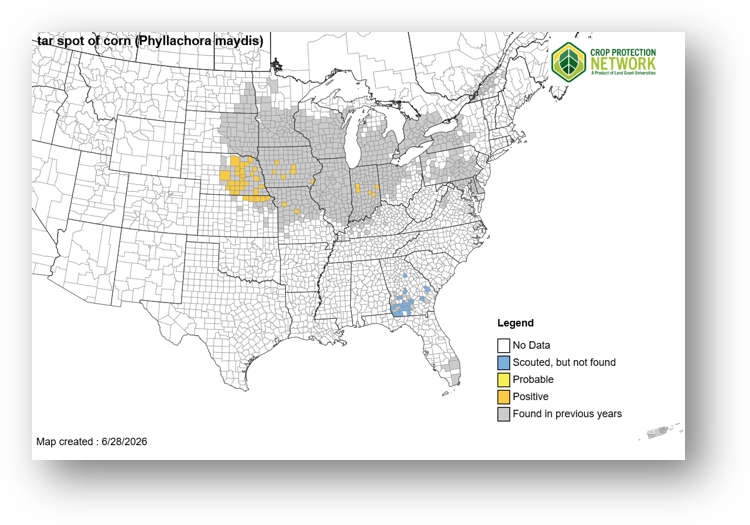
At this time, there have been no confirmations of corn tar spot in Wisconsin on field or sweet corn, but the weather has been very favorable for the disease. Tar spot has been confirmed in several Midwestern states to the south of Wisconsin (map below generated 6/28). In these states, the disease has so far been of low incidence and confined to lower canopy leaves. There is no indication of widespread damaging epidemics at this time. It is important to be aware of this disease and be on the lookout for early symptoms, but treatment is not yet recommended. Management recommendation depends heavily on incidence of the disease, and the crop stage. The pathogen is present in our growing environment as it overwinters on crop debris.
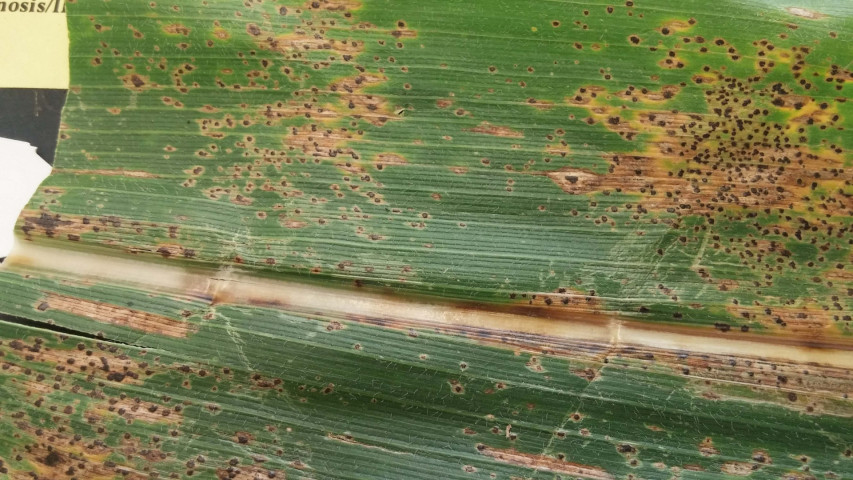
In sum, management recommendations for sweet corn tar spot: i) scout carefully, ii) utilize information at the Crop Protection Network and other info networks like this newsletter to assist in assessing risk, iii) if fungicides are necessary, given that the hybrid is susceptible, the field and region has a history of tar spot, weather remains favorable, and lesions are being detected locally, do not utilize prior to V10 growth stage, iv) VT-R3 applications typically result in the highest return on investment, v) utilize fungicides with multiple modes of action (QoI and DMI, or QoI and SDHI) for best management response. Fresh market and processing sweet corn hybrids tend to have a shorter season than field corn. Fungicide decisions should also be considered as relative to days to harvest, as well as crop stage. Late infections occurring only 10-14 days before harvest have less economic impact than comparable infections in grain corn.
A bit more about Tar spot if it’s new on your radar, from https://connect.doit.wisc.edu/cpn-risk-tool/. Tar spot is caused by the fungus Phyllachora maydis and can cause severe yield loss on susceptible hybrids when conditions are favorable for disease. Tar spot appears as small, raised, black spots scattered across the upper and lower leaf surfaces. These spots are stromata (fungal fruiting structures). If viewed under the microscope, hundreds of sausage-shaped asci (spore cases) filled with spores are visible. When severe, stromata can even appear on husks and leaf sheaths. Tan to brown lesions with dark borders surrounding stromata can also develop. These are known as “fisheye” lesions. At the end of the growing season, common and southern rust pustules can be mistaken for tar spot stromata as these rusts switch from producing orange-red spores (urediniospores) to black spores (teliospores). However, rust spores burst through the epidermis and the spores can be scraped away from the pustules with a fingernail while tar spots cannot be scraped off the leaf tissue. The pathogen that causes tar spot overwinters on infested corn residue on the soil surface, and it is thought that high relative humidity and prolonged leaf wetness favor disease development. Residue management, rotation, and avoiding susceptible hybrids may reduce tar spot development and severity. Some fungicides may also reduce tar spot, although little data exists regarding application timing for efficacy and economic response in sweet corn.
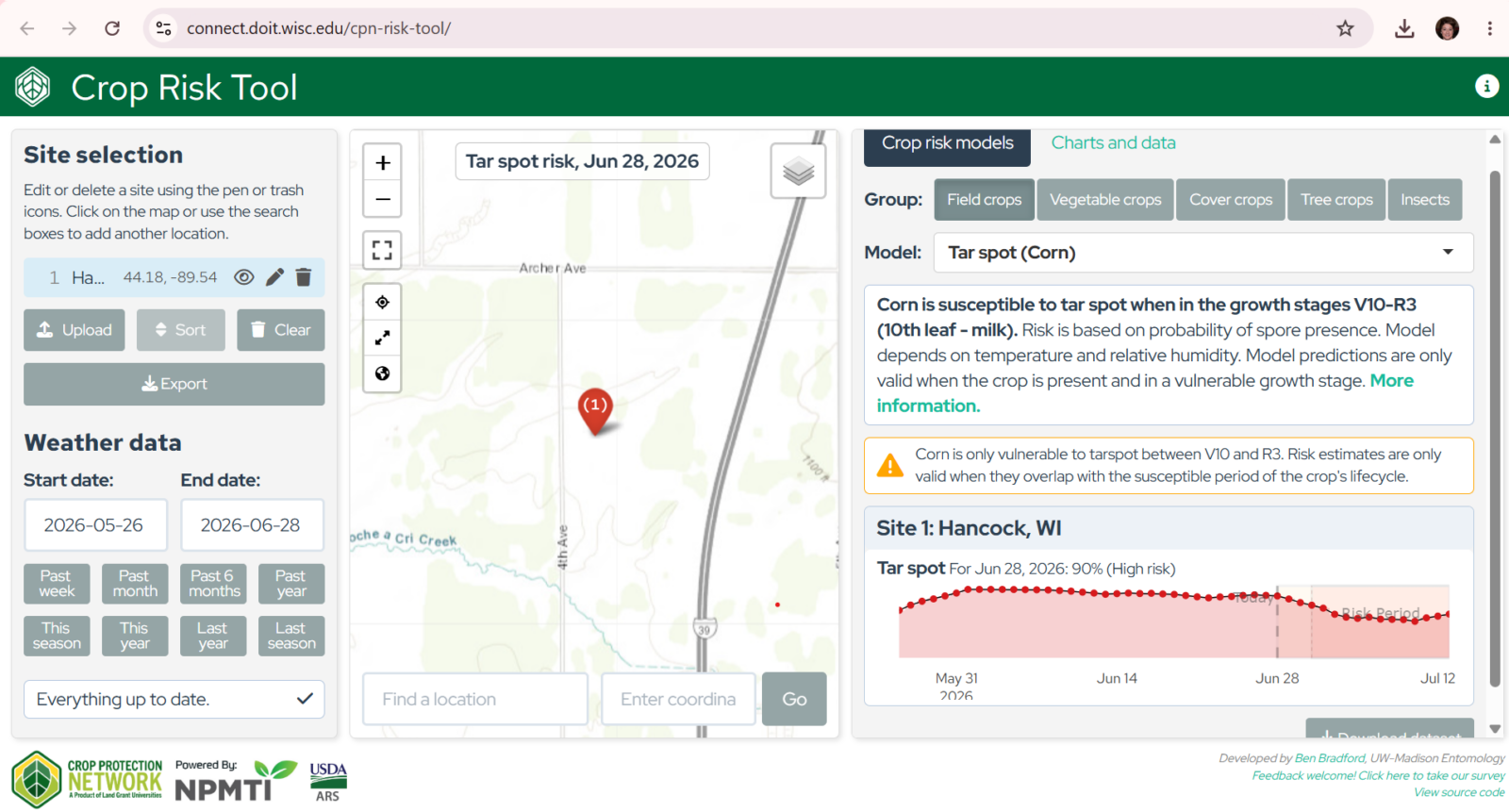
The tar spot model accessible at https://cropprotectionnetwork.org/crop-disease-forecasting is based on logistic equations described by Webster et al 2023 which calculate the probability of spore presence. Risk scores are assigned based on these probabilities. The screenshot, below, indicates current risk level of tar spot in corn in Hancock, WI. While the weather governs the current risk, the pathogen has not yet been active at creating disease.
More information: Webster et al 2023: Uncovering the environmental conditions required for Phyllachora maydis infection and tar spot development on corn in the United States for use as predictive models for future epidemics https://doi.org/10.1038/s41598-023-44338-6 & Crop protection network: https://cropprotectionnetwork.org/encyclopedia/tar-spot-of-corn
Vegetable Insect Update – Russell L. Groves, Professor and Associate Department Chairperson, UW–Madison, Department of Entomology, 608-262-3229 (office), (608) 698-2434 (cell), e-mail: rgroves@wisc.edu
Vegetable Entomology Webpage: https://vegento.russell.wisc.edu/
Corn earworm – (https://vegento.russell.wisc.edu/pests/corn-earworm/)
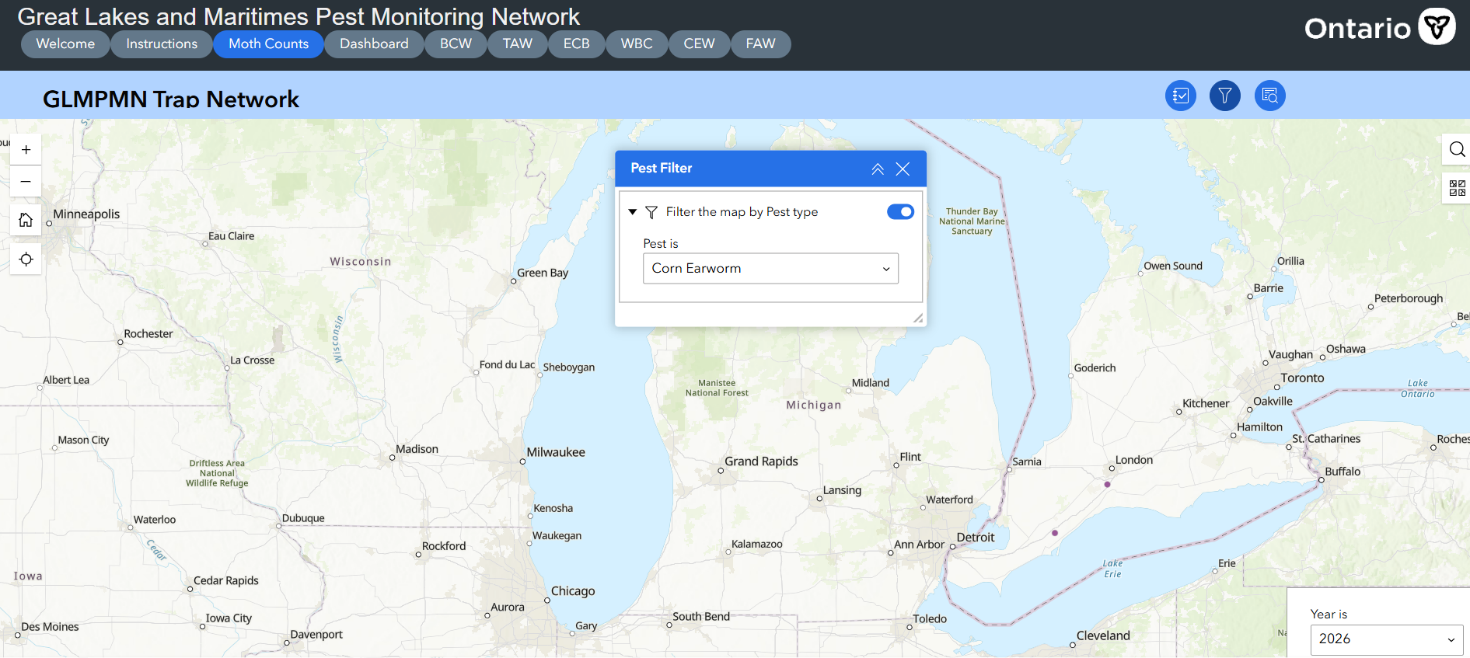
Few corn earworms have been detected through the Great Lakes and Maritimes Pest Monitoring Network in 2026. The site enumerates pheromone captures over much of the Midwest and Northeastern region and trap captures from the Wisconsin Department of Agriculture, Trade and Consumer Protection’s, Crop Pest Trap Networks are included here. Our historical understanding is that corn earworm will not survive winter in Wisconsin. Instead, they overwinter as pupae in the soil in the mid-South and Gulf States. In early spring, the pupae complete their development and emerge as moths in early May and it is anticipated that some of these moths migrate northward. Over the winter of 2024 – 25, the conditions across southern Wisconsin were conducive to survivorship of corn earworm moth pupae and we observed adult moths far earlier than normal. Last year, adult moths were captured in significant numbers as soon as the trapping began in late June. This season captures in regional pheromone traps and blacklight traps do not suggest larger populations in the state at this time.
The best technique for monitoring earworms is through the use of pheromone traps. These traps use a special scent to attract male moths. Knowing when moths are present helps to determine when to treat fields. If a producer obtains a pheromone trap, it is best to secure it 4 to 6 feet above the ground on the south or west side of fields when corn is in the green silk stage. Pheromones should be changed every 2 weeks with the unused lures kept frozen until needed. Hercon pheromone lures have been very effective at attracting earworm moths. For accurate counts, be sure to remove used lures from the trap area.
Another technique for monitoring earworms uses a black light to lure night-flying insects. However, black light traps are more expensive, less effective, and more difficult than pheromone traps to monitor. Counts in blacklight traps are consistently lower than those in pheromone traps in adjacent fields. Pheromone trap catches of 5 to 10 moths or blacklight trap captures of 3 to 5 moths per night for three consecutive nights indicate that moths are probably laying enough eggs to warrant treatment of fields that are in the vulnerable stage between brush and silk browning. To add precision to your scouting, check silks for the small, spherical corn earworm eggs before beginning a spray program.
The females lay eggs singly on fresh corn silks and on foliage. Fertilized females deposit up to 1000 eggs each. They are particularly attracted to sweet corn in the late tassel through early silking stages. The eggs hatch within 1 to 8 days and the larvae immediately crawl into the silk channels at the ear tip to feed. Corn earworm larvae are cannibalistic; if one earworm encounters another, they will fight to the death. For this reason, only one larva is typically found per ear. During the entire larval stage, earworms move very little and feeding is confined to the ear tip. After 2 weeks later, it emerges as a moth and works its way to the soil surface. Development from egg to adult takes about 30 days in midsummer.
Diamondback moth – (https://vegento.russell.wisc.edu/pests/caterpillar-pests-of-cole-crops/)
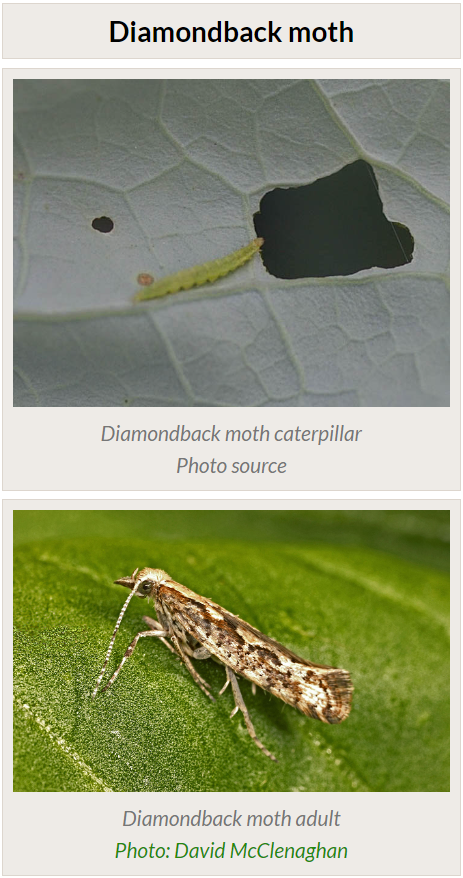
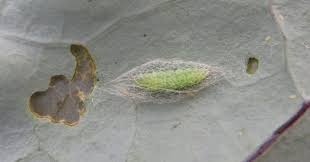
A full generation of Diamondback moth (DBM: Plutella xylostella) has just been completed in southern Wisconsin. Continue to scout fields weekly throughout the remainder of the season for early season damage. Check plants carefully, even if no feeding damage is apparent, and examine the underside of leaves for small larvae and eggs that will hatch into small caterpillars in several days. Examine the lower leaves of the plant for the larvae of DBM and especially look for the characteristic ‘window-paning’ damage.
Late-stage caterpillars of DBM are nearing completion of the 1st full generation at the Arlington Agricultural Research Station. They have completed their larval stages as we are observing the woven pupae on the undersurface of leaves now. While scouting, you will often observe the feeding damage associated with larval DBM feeding and immediately adjacent will be the pupa within a silken cocoon.
Treatment thresholds are well established and based on the percent of infestation by any lepidopteran species. Economic thresholds (ETs) vary based on the stage of crop development. Cabbage, broccoli and cauliflower in the seedbed are particularly susceptible to damage. Therefore, control measures are warranted when 10% of the plants are affected. Between transplant and cupping, the ET is raised to 30%, from the time plants begin to cup until early heading, if more than 20% of plants are infested, treatment is warranted. From early heading until harvest, the threshold again drops to 10% to protect market quality of the produce. Use pest-specific insecticides in early to mid-season when diamondback moths and cabbageworms are prevalent. Spinosyns (e.g. Entrust, Conserve, Radiant) represent a reduced-risk insecticide option for use against DBM and also products containing Bacillus thuringiensis subsp. kurstaki (e.g. Dipel). Both options are biologically based materials that are quite selectively active on caterpillar pests but are safe to beneficials.
Japanese beetles – (https://vegento.russell.wisc.edu/pests/japanese-beetle/)
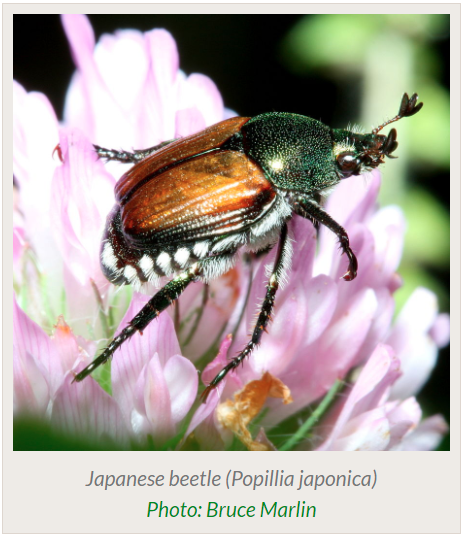
Japanese beetles have only one generation per year. In late-June and in early July (or around 1000 growing degree days), adults begin emerging from the soil. Adult emergence is just underway across much of southern Wisconsin, but the bulk of the adult emergence is just beginning and will continue through early July.
Immediately thereafter, females mate with males and begin laying eggs. Adult beetles are most active in the afternoon in full-sun. Females leave ornamental plants where they feed and mate, and burrow two to four inches into the soil (under the turf and in mulched areas) in a suitable area to lay their eggs. Eggs hatch in about two weeks, after which grubs begin feeding on the roots of turfgrass and ornamental plants.
Mid-summer rainfall and adequate soil moisture are needed to prevent eggs and newly-hatched grubs from drying out. Adult females instinctively lay their eggs in areas with higher soil moisture content to ensure survival of their offspring. Older grubs are more drought-tolerant and will move deeper into the soil if conditions become dry. Grubs can also withstand elevated levels of soil moisture, so excessive rainfall or irrigation will not affect them.
Cucumber beetles – (https://vegento.russell.wisc.edu/pests/cucumber-beetles/)
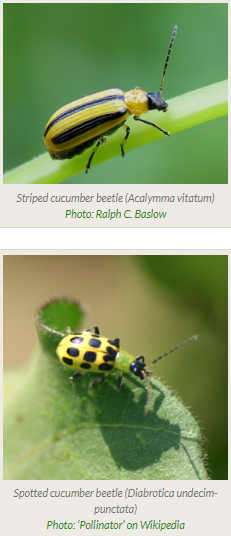
Striped and spotted cucumber beetles will now begin to infest many of our cucurbit crops as strong flowering is underway. Spotted cucumber beetle (aka southern corn rootworm) can cause damage in vine crops, but the striped beetle is more common and damaging in Wisconsin. Feeding from larvae and adults causes direct damage to roots, leaves, flowers, and fruits.
Adult striped cucumber beetle can vector the bacteria, Erwinia tracheiphila. Cucumbers and melons are particularly susceptible to bacterial wilt, and damage from this can be severe. Only the striped cucumber beetle overwinters in Wisconsin. They emerge in mid- to late May and lay eggs in the soil at the base of cucurbits. Spotted cucumber beetles migrate to northern locations in early to mid-July. This late arrival seldom makes them a serious problem.
Plants infected with bacterial wilt will not recover. Therefore, it is important to control beetles early in the season to prevent the spread of the disease. Scout fields for adult beetles 2-3 times per week early in the season and weekly thereafter. Particular attention is needed in field edges where beetles congregate. The treatment threshold for cucumber beetles is 1 beetle per plant in melons, cucumber, Hubbard and Butternut squash, and younger pumpkins and 5 adults per plant in watermelon, other varieties of squash and older pumpkins. Beetle populations in excess of 20 per plant may transmit the bacterial wilt before insecticides have a chance to control the beetles.
Non-chemical control is possible in small plantings by covering the plants with floating row covers. Be sure to uncover flowering plants to allow bees to enter and pollinate the plants. Rotating crops with grain, tomatoes, or a cover crop or using perimeter trap crops can delay infestations. If a trap crop is used, exercise care that the trap crop will not function as a reservoir for bacterial wilt. If bacterial wilt infections have already occurred, remove the diseased plants immediately to prevent the spread of the disease while insects are present.
Colorado potato beetle – (https://vegento.russell.wisc.edu/pests/colorado-potato-beetle/)
Overwintered adult Colorado potato beetle (CPB) are disappearing from southern and central Wisconsin potato fields. North of Hwy 10, adults are still prevalent and egg masses are still being laid throughout fields in northern Wisconsin. Later larval stages (3rd and 4th instar) are now common in central production fields. Northern production areas are seeing egg hatch and early larvae that will soon be abundant in fields with the warm forecast temperatures anticipated for the coming week. Potato producers and scouts need to continue checking potato fields for colonizing Colorado potato beetle (CPB) adults and large numbers of egg masses, especially in northern Wisconsin. The newly registered isocycloseram (Zivalgo®) is an excellent option for use against early larval populations. This active ingredient represents a new mode of action class (Group 30 meta diamide) and this product has very good to excellent performance against adults, eggs and feeding larval stages. Although the new Zivalgo® possesses a broad spectrum of activity against a variety of insects, it will NOT be an effective option against potato-colonizing aphids that can transmit PVY. Important to mention, no potato-colonizing aphid species were reported over the past week in seed producing regions of northern Wisconsin. Remain diligent, however, as these populations are likely to increase with the forecast temperatures.