Vegetable Crop Update – Jun 14, 2026

In this issue:
- Potato early and late blight disease risk model updates
- Cabbage black rot – be on the watch
- Wisconet: we are ahead on growing degree days in WI
- Squash vine borer updates and management
- Colorado potato beetle updates and management
Amanda Gevens, Professor & Extension Vegetable Pathologist, UW–Madison, Dept. of Plant Pathology, 608-575-3029, gevens@wisc.edu, Lab Website: https://vegpath.plantpath.wisc.edu/.
Current P-Day (Early Blight) and Disease Severity Value (Late Blight) Accumulations
Thanks to Ben Bradford, UW- Madison Entomology for supporting this effort and providing a summary reference table: https://agweather.cals.wisc.edu/thermal-models/potato. A Potato Physiological Day or P-Day value of ≥300 indicates the threshold for early blight risk in potato and triggers preventative fungicide application. A Disease Severity Value or DSV of ≥18 indicates the threshold for late blight risk and triggers preventative fungicide application in potato. Data from the modeling source: https://agweather.cals.wisc.edu/vdifn are used to generate these risk values in the table below. I’ve estimated early, mid-, and late planting dates by region based on communications with stakeholders. These are intended to help in determining optimum times for preventative fungicide applications to limit early and late blight in Wisconsin.
| Location | Planting Date Dates in future are anticipated or not yet listed (To Be Determined or TBD) | 50% Emergence Date | Disease Severity Values (DSVs) through 6/13/26 | Potato Physiological Days (P-Days) through 6/13/26 | |
| Spring Green | Early | Apr 10 | May 7 | 9 | 271 |
| Mid | May 5 | May 20 | 7 | 199 | |
| Late | May 16 | June 2 | 7 | 103 | |
| Arlington | Early | Apr 12 | May 8 | 8 | 263 |
| Mid | May 6 | May 23 | 8 | 188 | |
| Late | May 20 | June 4 | 8 | 91 | |
| Grand Marsh | Early | Apr 13 | May 9 | 10 | 247 |
| Mid | May 6 | May 22 | 10 | 188 | |
| Late | May 21 | June 5 | 10 | 82 | |
| Hancock | Early | Apr 14 | May 11 | 8 | 241 |
| Mid | May 10 | May 30 | 7 | 126 | |
| Late | May 23 | June 6 | 6 | 73 | |
| Plover | Early | Apr 15 | May 12 | 9 | 238 |
| Mid | May 10 | May 30 | 9 | 126 | |
| Late | May 25 | June 6 | 7 | 73 | |
| Antigo | Early | May 12 | May 29 | 8 | 126 |
| Mid | May 25 | June 5 | 8 | 81 | |
| Late | June 8 | TBD | TBD | TBD | |
| Rhinelander | Early | May 15 | June 6 | 7 | 72 |
| Mid | May 28 | June 10 | 5 | 35 | |
| Late | June 9 | TBD | TBD | TBD | |
Late blight of potato/tomato
Early and mid-planted potatoes of Wisconsin have accumulated 5 to 9 Disease Severity Values or DSVs as of 6/13. This indicates that late blight favorable weather has occurred, since ~50% crop emergence. However, we have not yet accumulated enough late blight-favorable weather to warrant a preventative fungicide application to target this disease.
Early blight of potato
Once we see potato crops at 50% emergence, P-Days accumulate. P-Day values will continue to amass and indicate optimum conditions for early blight disease caused by Alternaria solani. Fungicides can provide good control of early blight in vegetables when applied early on in infection. Multiple applications of are recommended for optimum disease control through the season to vine-kill. Earliest emerging fields are very close to reaching the treatment threshold of 300 P-Days. Likely by mid- to late this week this threshold will be met for early fields south of Antigo.
Early Season Watchfulness for Black Rot in Cabbage and Other Cole Crops
As cabbage, broccoli, cauliflower, Brussels sprouts, kale, and other brassica crops continue early-season development across Wisconsin, growers should remain vigilant for black rot, one of the most destructive bacterial diseases of crucifer crops worldwide. Black rot is caused by the bacterium Xanthomonas campestris pv. campestris and can result in significant yield and quality losses when conditions favor disease development.
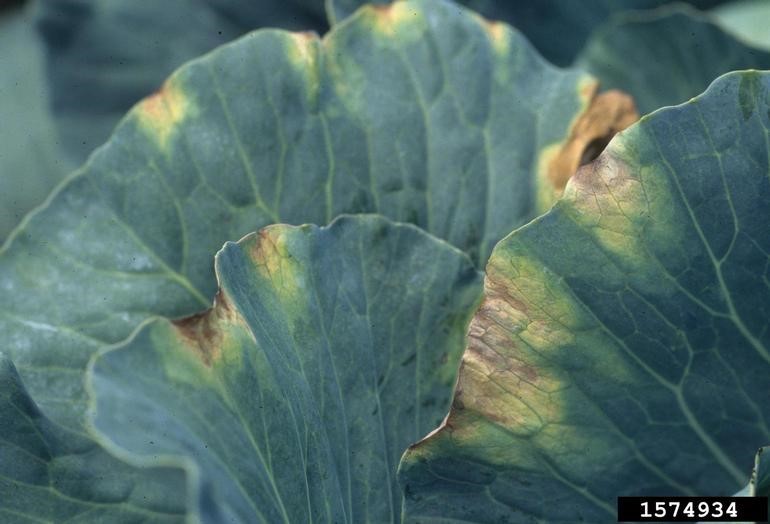
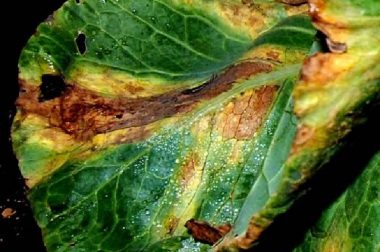
Early symptoms typically appear as yellow, V-shaped lesions that develop along leaf margins, with the point of the “V” directed toward the leaf midrib, as shown above. As the disease progresses, veins within affected tissue often turn dark brown to black, giving the disease its common name. Under favorable conditions, infection can spread throughout the plant vascular system, leading to stunting, wilting, and reduced marketability.
Warm temperatures (75–90°F), rainfall, overhead irrigation, and prolonged leaf wetness favor disease development and spread. The bacterium enters plants through hydathodes at leaf margins and through wounds caused by cultivation, insects, hail, or wind damage.
An important aspect of black rot epidemiology is that the bacterium can be introduced into production systems through contaminated seed or infected transplants. Even low levels of seed contamination may result in infected seedlings that serve as a source of inoculum once plants are established in the field. In greenhouse transplant production systems, warm temperatures, overhead irrigation, high humidity, and close plant spacing can facilitate rapid spread of the pathogen among seedlings, often before symptoms become readily apparent. Consequently, the use of certified disease-free seed, careful inspection of transplants, and strict greenhouse sanitation practices are critical first steps in reducing the risk of black rot outbreaks later in the growing season.
There are no curative treatments once black rot becomes established. Copper containing fungicides can help limit plant to plant spread within a field, but results can vary depending upon disease pressure and susceptibility of the brassica plant type. Management depends on prevention and limiting spread. Growers should scout fields regularly, especially following rain events, and promptly remove heavily infected plants where practical. Avoid working fields when foliage is wet, minimize overhead irrigation when possible, and sanitize equipment that moves between fields. Use certified disease-free seed and transplants, maintain crop rotations of at least 2–3 years away from brassica crops, and control cruciferous weeds that can serve as reservoirs for the pathogen. Early detection and rapid response remain the most effective tools for limiting black rot losses and protecting crop quality throughout the growing season. For more information, please visit: https://vegpath.plantpath.wisc.edu/diseases/brassica-black-rot/.
Vegetable Insect Update – Russell L. Groves, Professor and Associate Department Chairperson, UW–Madison, Department of Entomology, 608-262-3229 (office), (608) 698-2434 (cell), e-mail: rgroves@wisc.edu
Vegetable Entomology Webpage: https://vegento.russell.wisc.edu/
Wisconsin’s Environmental MesoNet (https://wisconet.wisc.edu/tools/agriculture)
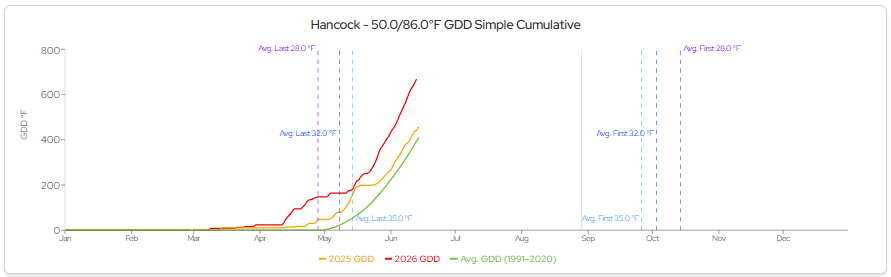
The Wisconsin Environmental MesoNet (Wisconet) is a growing network of weather and soil monitoring stations across Wisconsin, designed to provide research quality data at high spatial and temporal resolutions. There are currently 79 Wisconet stations, each providing more than one dozen measurements every five minutes. A review of Wisconet today tells us, “We are ahead!” The Wisconsin Department of Agriculture, Trade and Consumer Protection confirms these observations suggesting that growing degree day accumulations are running ahead of normal, with many locations showing totals above the 30‑year average for this date. In fact, we are as much as 200 DD base 50 ahead of ‘normal’ climate averages and this translates into a 7-9 day advance development of many insect pests. Using past calendar dates and historical records often fail because insect development varies widely with year‑to‑year temperature fluctuations, making fixed dates poor predictors of emergence or crop infestation. Degree‑day accumulation, by contrast, tracks the actual heat units insects experience, providing a biologically grounded and far more precise estimate of when vulnerable life stages will occur.
Squash vine borer – (https://vegento.russell.wisc.edu/pests/squash-vine-borer/)
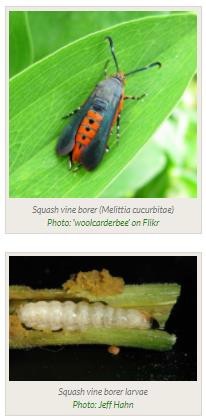
The squash vine borer is an example of a predictable caterpillar pest where the risk of infestation into susceptible squash and pumpkin is best predicted by accumulating degree days. Over recent years, we would suggest that adult vine borers would emerge from the soil in late June and early July. Not this year! The risk of early infestation into susceptible squash and pumpkin is underway in the southern tier of counties in Wisconsin.
In the Midwest the pest typically emerges after approximately 1K growing degree-days (base 50°C) have been reached. Often, this degree day threshold will closely coincide with full bloom of the common roadside weed chicory and this species was initiating bloom through southern Wisconsin just last week.
Newly emerged female moths quickly seek suitable hosts and begin laying small, brown eggs singly at the base of susceptible plants. Each female is capable of laying between 150-200 eggs. Depending upon temperature, eggs will hatch within 10-15 days of being laid. Newly hatched larvae quickly bore into the vine stems to feed for four to six weeks. As the larvae feed, they leave behind characteristic light brown frass (insect feces) that resembles sawdust. Larvae typically feed at the center of host plant stems this internal feeding greatly restricts the plant’s ability to move water and nutrients. Fully-grown borers exit the stems and burrow into the soil to pupate. Squash vine borers produce one generation per year in Wisconsin. sporadic pest of pumpkin and squash (e.g. cucurbits).
Resulting damage can be difficult to diagnose prior to the time after which significant harm to the plant has already occurred. In years of heavy infestation squash vine borer can become a significant economic pest in some cucurbit crops. Initial signs of infestation are very difficult to detect. Scouting early often involves searching for entrance holes and frass at the base of vine crop stems.
Advanced symptoms of squash vine borer infestation are quickly wilting plants in the heat of the day. Since wilting may be confused with other pests of vine crops (e.g. bacterial or Fusarium wilts) scouting remains critical. Infested plants may be diagnosed by splitting the base stems of the plant to confirm the presence of the larvae. Fields that have been damaged in past seasons have a good chance for recurring squash vine borer infestations annually.
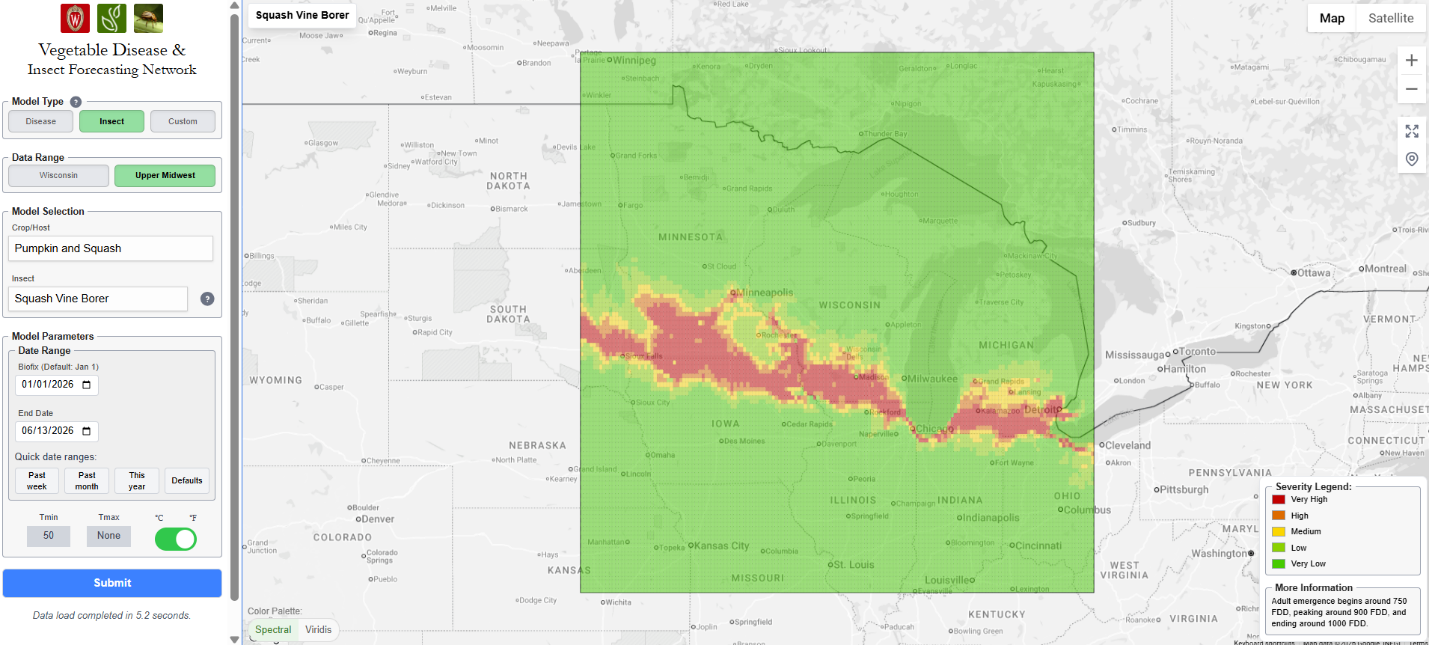
Susceptibility to squash vine borer is variable among species of cucurbits. Varieties known to be suitable hosts are pumpkins and squashes. Commonly infested cultivars are pumpkin (standard and giant), zucchini, as well as crookneck, straight neck, acorn, patty pan, summer, banana, buttercup, and Hubbard squashes. Squash vine borer is very difficult to manage with chemical insecticides since older larvae are protected within the plant stem. The target life-stage for conventional chemical management is newly hatched larvae that have not yet entered the stem. Effective control requires insecticide residue to be in place before and during the egg laying period (1,000 DD50). Two to three successive applications of insecticide 5-7 days apart will adequately control most of the larval borers before entering the vines, and products containing spinosad (Entrust® SC), spinetoram (Radiant® SC) or Bacillus thuringiensis subsp. kurstaki (DiPel® DF) are all good options to direct onto vines at the time of oviposition.
Colorado potato beetle – (https://vegento.russell.wisc.edu/pests/colorado-potato-beetle/)
Potato producers and scouts need to continue checking potato fields for colonizing Colorado potato beetle (CPB) adults and large numbers of egg masses, especially in northern Wisconsin. In the seed growing region of Wisconsin, adult colonization and initial egg deposition is underway and early detection of these initial infestations can be especially critical to initiate applications at the correct time to be most successful.
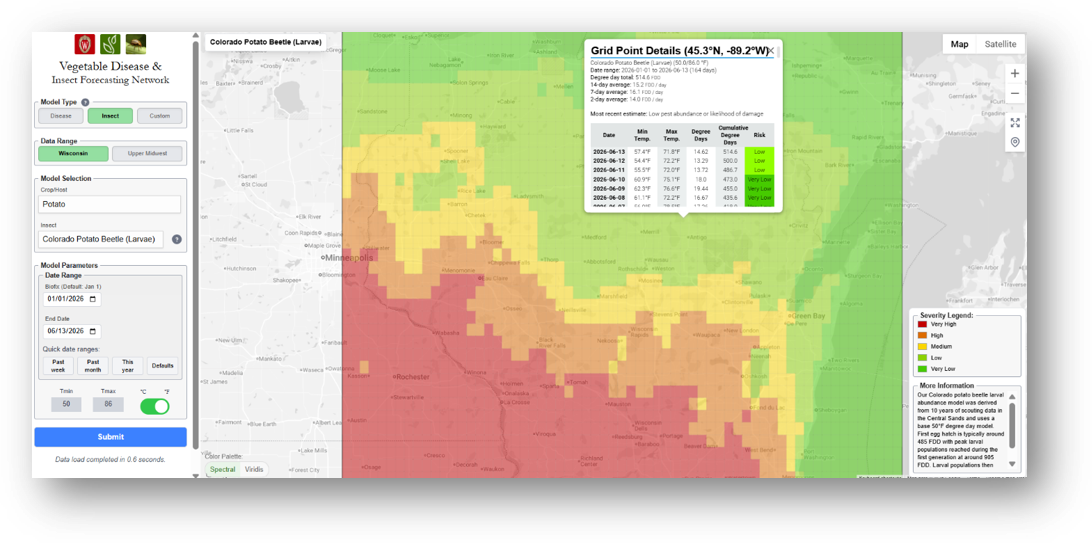
One option can be the use of perimeter or edge applications in fields where aggregates of adults are present. Very targeted applications of indoxacarb (Avaunt® eVo) plus piperonyl butoxide (insecticide synergist) can be directed onto these colonizing adults as well as oxamyl (Imidan® 70-W) and the newly registered isocycloseram (Zivalgo®).
At this early stage of crop development, novel and low-volume delivery systems can work very well to contact these early colonists. Drone and aerial applications on small plants and architecturally simple canopies can be very effective at this time to direct sprays onto edges where early colonists are present.
Caution should taken when applying early season insecticides in tank mix combinations. Complex pesticide tank mixes can reduce insecticide efficacy because multiple active ingredients and adjuvants can chemically, physically, or biologically interfere with one another. These interactions can change how much insecticide reaches the target insect, how long it persists, or how well it penetrates the cuticle—ultimately lowering performance even when each product works well on its own.