Vegetable Crop Update – Jun 7, 2026

In this issue:
- Potato productivity and weather updates
- Potato early and late blight disease risk model updates
- Cucurbit downy mildew spores found in MI
- Onion thrips updates and management
- Colorado potato beetle updates and management
Yi Wang, Associate Professor & Extension Potato and Vegetable Production Specialist, UW–Madison, Dept. of Plant and Agroecosystem Sciences, 608-265-4781, Email: wang52@wisc.edu
According to the UW–Madison Extension 2026 Weather Outlook, temperatures were unseasonably warm last week, with many locations showing 4-8°F above normal for late May. Portions of central Wisconsin received up to 1.5’’ of rainfall last week, but most parts of the state received 0.25’’ or less. Over the past month, most of the state has received 50% or less of normal precipitation. Therefore, drought has returned to Wisconsin, with southeastern and west-central counties in moderate drought conditions. Soil moisture content at 4’’ depth across the Wisconet research farm stations decreased from last week’s levels, in some cases down to zero inches of plant available water.
Looking forward:
- Rain chances over next week are highest in the southern and southwestern parts of the state;
- Most of Wisconsin will likely see above normal temperatures (50-70% chance);
- The June outlook indicates a lean towards above-normal temps (40-50% chance) and below-normal precip (about 40% chance);
- The warm temps will boost growing degree days;
- Efficient irrigation management in those drought-stressed fields, especially sandy grounds with lack of recent precip.
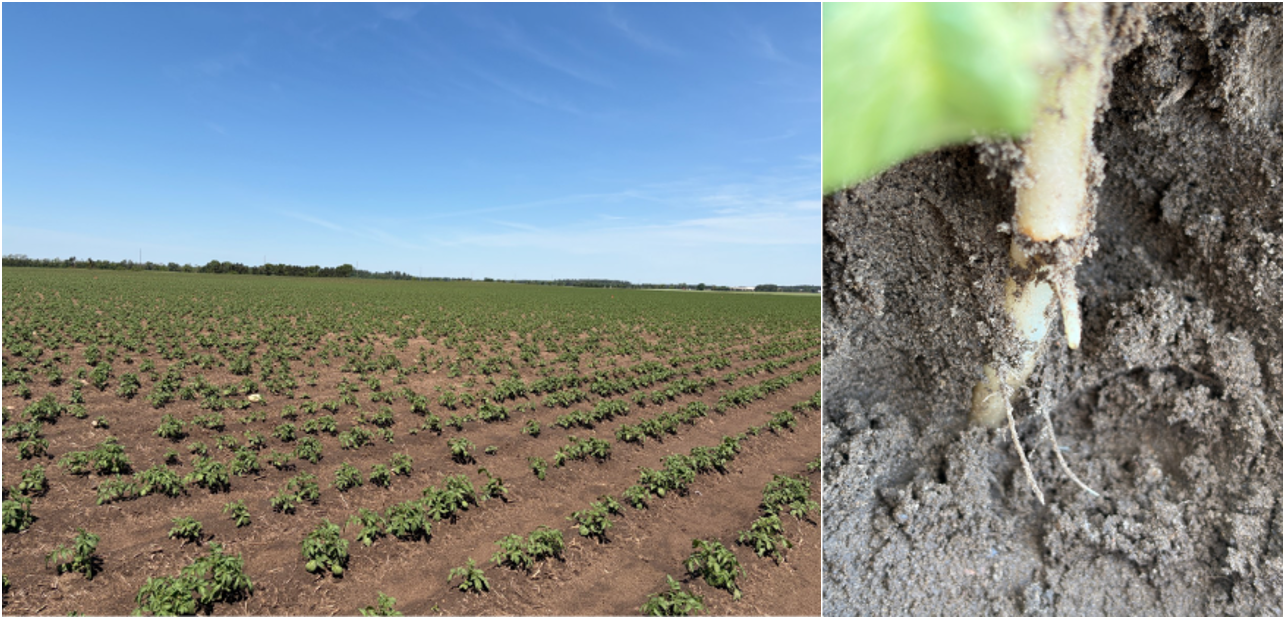
I checked on the growth status of some full-season potato varieties on Wednesday. The plants are about 4’’ tall, and some plants started to hook (pictures below).
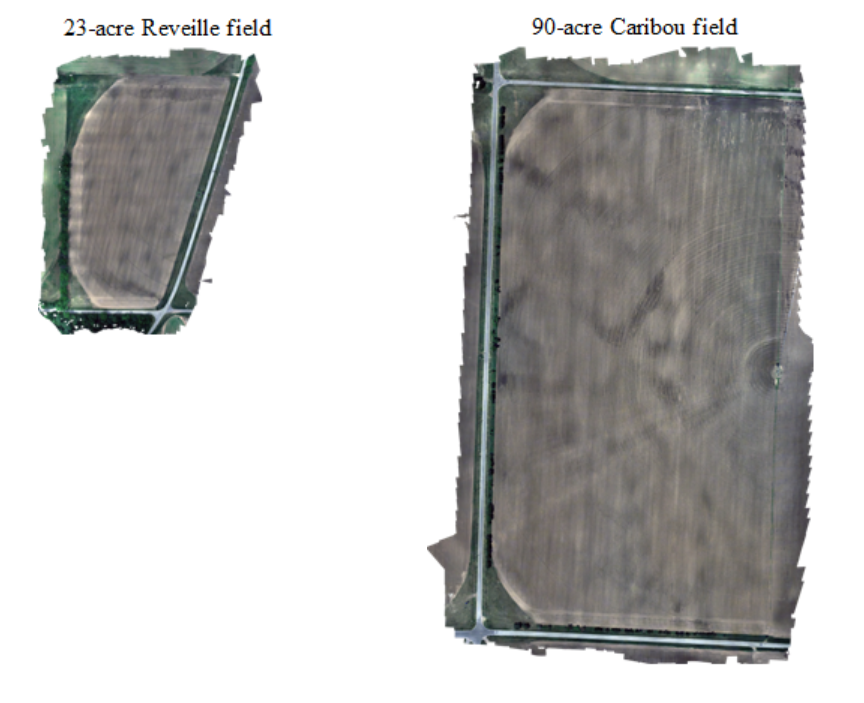
This year, we will work on two commercial fields to continue our petiole nitrate-N prediction research using multispectral and hyperspectral imagery. We selected a 23-acre field that grows Reveille and a 90-acre field that grows Caribou (half of a pivot). We used a DJI Phantom 4 Pro V2.0 drone for the flight. It took us about one hour to finish the Reveille field, but more than 3 hours to finish the Caribou field. We flew at 200 feet high and at 25 mph. The biggest problem we ran into when flying the big Caribou field was that the drone’s batteries and sensors overheated during the long flight (air temperature was 82F). The software controlling the drone then crashed, so we had to repeatedly restart the whole system. A good thing about a small drone like the one we used is that it is lightweight, and the battery has a relatively long life. The long flight time could be due to the low altitude at which we flew and the high resolution required for research. Commercially used drones could fly higher and cover larger fields without long-flight-time issues.
Amanda Gevens, Professor & Extension Vegetable Pathologist, UW–Madison, Dept. of Plant Pathology, 608-575-3029, gevens@wisc.edu, Lab Website:https://vegpath.plantpath.wisc.edu/.
Current P-Day (Early Blight) and Disease Severity Value (Late Blight) Accumulations will be posted at our website and available in the weekly newsletters. Thanks to Ben Bradford, UW- Madison Entomology for supporting this effort and providing a summary reference table: https://agweather.cals.wisc.edu/thermal-models/potato. A Potato Physiological Day or P-Day value of ≥300 indicates the threshold for early blight risk in potato and triggers preventative fungicide application. A Disease Severity Value or DSV of ≥18 indicates the threshold for late blight risk and triggers preventative fungicide application in potato. Data from the modeling source: https://agweather.cals.wisc.edu/vdifn are used to generate these risk values in the table below. I’ve estimated early, mid-, and late planting dates by region based on communications with stakeholders. These are intended to help in determining optimum times for preventative fungicide applications to limit early and late blight in Wisconsin.
| Location | Planting Date Dates in future are anticipated or not yet listed (To Be Determined or TBD) | 50% Emergence Date | Disease Severity Values (DSVs) through 6/6/26 | Potato Physiological Days (P-Days) through 6/6/26 | |
| Spring Green | Early | Apr 10 | May 7 | 3 | 209 |
| Mid | May 5 | May 20 | 1 | 137 | |
| Late | May 16 | June 2 | 1 | 41 | |
| Arlington | Early | Apr 12 | May 8 | 0 | 199 |
| Mid | May 6 | May 23 | 0 | 124 | |
| Late | May 20 | June 4 | 0 | 27 | |
| Grand Marsh | Early | Apr 13 | May 9 | 1 | 183 |
| Mid | May 6 | May 22 | 1 | 123 | |
| Late | May 21 | June 5 | 1 | 18 | |
| Hancock | Early | Apr 14 | May 11 | 2 | 177 |
| Mid | May 10 | May 30 | 1 | 62 | |
| Late | May 23 | June 6 | 0 | 9 | |
| Plover | Early | Apr 15 | May 12 | 3 | 177 |
| Mid | May 10 | May 30 | 3 | 63 | |
| Late | May 25 | June 6 | 0 | 9 | |
| Antigo | Early | May 12 | May 29 | 2 | 63 |
| Mid | May 25 | June 5 | 2 | 18 | |
| Late | TBD | TBD | TBD | TBD | |
| Rhinelander | Early | May 15 | June 6 | 0 | 9 |
| Mid | May 28 | TBD | TBD | TBD | |
| Late | TBD | TBD | TBD | TBD | |
Late blight of potato/tomato. The southern locations of early-planted potatoes have accumulated up to just 3 Disease Severity Values or DSVs as of 6/6. This indicates that late blight favorable weather has occurred, since ~50% crop emergence. However, we have not yet accumulated enough late blight-favorable weather to warrant a preventative fungicide application to target this disease.
Early blight of potato. Once we see potato crops at 50% emergence, P-Days accumulate. P-Day values will continue to amass and indicate optimum conditions for early blight disease caused by Alternaria solani. Fungicides can provide good control of early blight in vegetables when applied early on in infection. Multiple applications of are recommended for optimum disease control through the season to vine-kill. Earliest emerging fields are at roughly 200 P-Days.
Cucurbit downy mildew spores found in Michigan. https://www.canr.msu.edu/news/statewide-monitoring-network-for-cucurbit-downy-mildew-verifies-the-2026-arrival-of-spores-in-four-michigan-counties Dr. Mary Hausbeck, vegetable pathologist at Michigan State University, has reported the confirmation of cucurbit downy mildew spores (Pseudoperonospora cubensis) in air sampling traps around Michigan during the last week of May. From Dr. Hausbeck’s newsletter: “Cucurbit downy mildew spores have been verified in air samples from Berrien, Bay, Allegan and Muskegon counties from samples collected from May 19 to May 26. During this period, Berrien and Muskegon had 6 days with a positive detection; Allegan had 3 days that were positive for downy mildew, and Bay had 2 days that were positive. Our lab uses a Burkard volumetric spore trap coupled with qPCR molecular analysis of the spore trap tape, and any early positive samples are verified with microscopy to ensure there are no false positives. Berrien, Allegan and Muskegon counties are on the state’s west side that hosts significant cucumber, pumpkin, zucchini and squash acreage. Bay County is located on the east side of the state in the Thumb region and hosts cucurbit production for the fresh and processing markets. These positive air samples confirm that airborne downy mildew spores have arrived in the state this growing season. The cucurbit downy mildew spores detected in the air may have originated from local/regional cucumber production greenhouses or from early field plantings of cucumbers and melons being grown in low/high tunnels. Elsewhere in the U.S., cucurbit downy mildew outbreaks in the field have been reported in Florida. A cucurbit downy mildew disease outbreak in the field on cucumbers or other cucurbits has not been reported in Michigan.” No reports of downy mildew on cucurbits in Wisconsin at this time. For more information on cucurbit downy mildew symptoms and management, please visit: https://vegpath.plantpath.wisc.edu/diseases/cucurbit-downy-mildew/
Vegetable Insect Update – Russell L. Groves, Professor and Associate Department Chairperson, UW–Madison, Department of Entomology, 608-262-3229 (office), (608) 698-2434 (cell), e-mail: rgroves@wisc.edu
Vegetable Entomology Webpage: https://vegento.russell.wisc.edu/
Onion thrips – https://vegento.russell.wisc.edu/pests/onion-thrips/
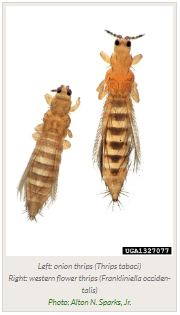
Recent precipitation across much of Wisconsin brought some relief to developing drought conditions throughout the southern half of Wisconsin. Along with warm temperatures, this set of environmental conditions has led to the potential for populations of onion thrips to build in early transplant and direct seeded onions.
Onion thrips overwinter in legume and grain fields and along weedy field edges. Females can reproduce without mating and lay eggs beneath the leaf’s surface. Eggs hatch after 5-10 days, and nymphs are full grown within 15-30 days. Development of the last two nymphal stages occurs in the soil, without feeding. After the fourth molt, adult female thrips return to the plant. Thrips produce 5-8 generations per year, and outbreaks are most likely to occur in hot, dry weather.
Mass immigration to onion fields can occur any time throughout the summer but is likely coincident with harvest of infested legume and grain fields. Feeding damage causes whitish blotches and dry, yellow areas on leaves, decreased pollen set, and, under heavy infestations, brown leaf tips and distorted or undersized bulbs. Both adults and larvae can cause silvery streaking on leaves, which becomes dry and yellow. Immature thrips prefer to feed on the youngest leaves.
Begin to monitor plants weekly, and scout plants on field edges as thrips are more common at borders in the early part of the season. Depending upon the cultivar planted, action thresholds can vary from 1-3 thrips per onion leaf. For example, if onions currently have 8 leaves, and the mean number of thrips per plant now has exceeded 24 immature thrips per plant, it is appropriate to initiate controls. Control using insecticides can be a struggle because of thrips’ protected location in plants. Applications should be directed over plants in beds where possible and delivery should be provided in sufficient application volume (e.g., 20+ gallons per acre). Many of the registered insecticides used for onion thrips control require an appropriate adjuvant to penetrate the leaf cuticle, so always read the label and choose an appropriate adjuvant for the specific insecticide used. Cornell University has published a very useful guide for pesticide selection and product rotation to achieve season-long success with onion thrips management. Remember to alternate chemical modes of action to minimize the potential for resistance development in this pest.
Colorado potato beetle – https://vegento.russell.wisc.edu/pests/colorado-potato-beetle/
Potato producers and scouts need to continue checking potato fields for colonizing Colorado potato beetle (CPB) adults and large numbers of egg masses. In much of southern Wisconsin, larval populations are well into mid- and later stages of larval development, whereas only early larval stages are present in most fields within central Wisconsin. Mentioned last week, early detection of these initial infestations can be especially critical to initiate applications at the correct time to be most successful.
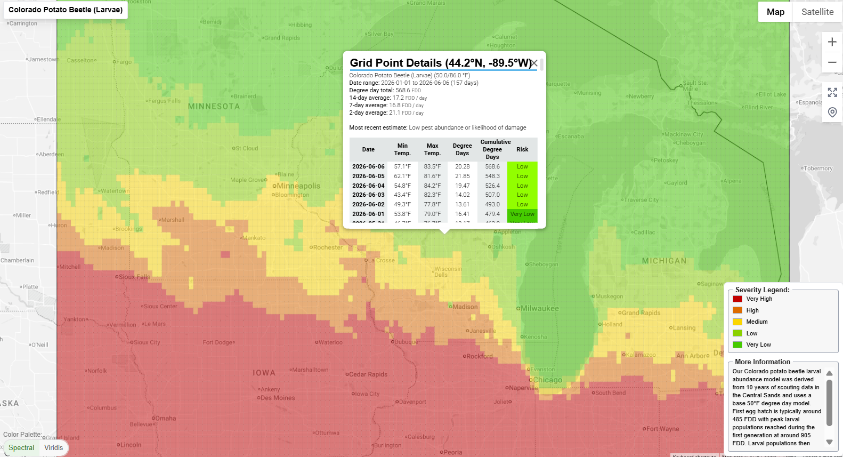
There are several 1st generation larvicides that can be very effective in controlling this generation of developing CPB, and suggested materials are listed in the attached supplement to this week’s newsletter. In central Wisconsin, it is appropriate to initial applications of novaluron (Rimon® 0.83EC) or ledprona (Calantha®) this week as we have reached and recently exceeded 10% egg hatch. In the earliest planted fields, it is possible that 2nd instar larvae are present and producers could consider other foliar products for the control of larval populations (e.g., Blackhawk® 36WDG, Delegate® WG, Agri-Mek® SC)
Producers should develop an annual plan of control for the CPB and make efforts to try to limit consecutive exposures of similar mode of action (MoA) insecticide classes across generations as defined by IRAC (iraconline.org). Specifically, pest management practitioners should consider the specific MoA of each insecticide used at different points throughout the production season (see our Colorado potato beetle management recommendations). In the attached example, be certain that the compound used for each of the following time points, i) at-plant systemic, ii) perimeter, contact adulticide, iii) 1st generation, foliar larvicide(s), iv) 1st generation rescue, v) 2nd generation, foliar insecticide, are classified as unique MoA to implement the best overall insecticide resistance management plan.