Vegetable Crop Update – May 25, 2026

In this issue:
- Imported cabbageworm updates and management
- Colorado potato beetle updates and management
- Potato disease model updates (Late blight and Early blight)
- Potato early blight fungicides
Vegetable Insect Update – Russell L. Groves, Professor and Associate Department Chairperson, UW–Madison, Department of Entomology, 608-262-3229 (office), (608) 698-2434 (cell), e-mail: rgroves@wisc.edu, Vegetable Entomology Webpage: https://vegento.russell.wisc.edu/
Imported cabbageworm – Pieris rapae
https://vegento.russell.wisc.edu/pests/cabbage-maggot/
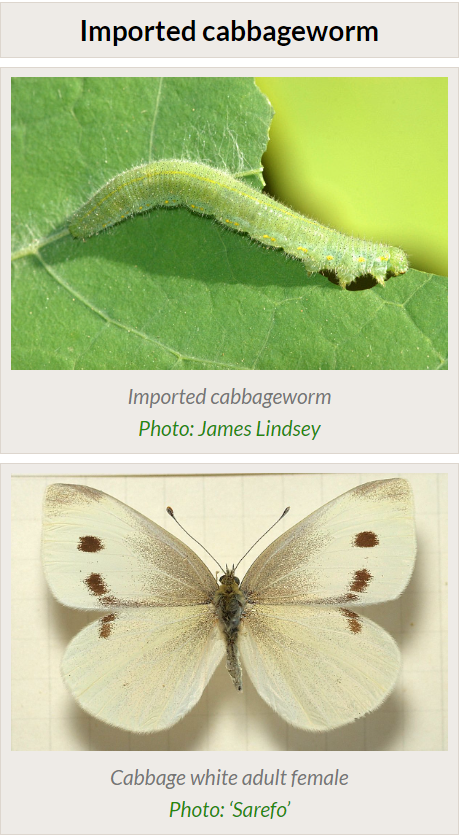
Also known as cabbage whites or small whites, cabbage loopers and diamondback moths are the three most significant caterpillar pests of Wisconsin cole crops, with the imported cabbage worm being the most significant.
Identification. Imported cabbageworm adults, commonly referred to as the white cabbage butterfly or cabbage whites, are white butterflies with black markings on the wing tips. Female butterflies have 2 black dots on each fore wing; males, which are smaller, have 1 dot per wing. Eggs are yellow and conical, laid individually on the leaf surface and occasionally on the stem. An adult butterfly can lay 300 to 400 eggs in her lifetime. Larvae appear as velvety green worms up to 1 inch long with a faint yellow stripe running down the back. The caterpillar is commonly found along the veins of leaves and easily blends into the foliage.
Life cycle. This insect overwinters as pupa on plant debris and usually produces 3-6 generations in a season. Adult butterflies have now emerged in southern Wisconsin and are underway with emergence across much of central Wisconsin. Adults have begun laying single, small, yellow-orange eggs on any plant part that is above ground. The eggs hatch in about 5 days. The larvae develop on cruciferous weeds and cole crops that are early planted. The caterpillar feeds and develops for approximately 11 to 20 days before forming a pupa from which the adult butterfly emerges after 6 to 11 days. Second generation butterflies emerge in late June and early July and larvae develop almost entirely on cultivated cole crops. This generation causes the most damage.
Management. Drench, in-furrow and banded applications using cyantraniliprole (Verimark®) can provide 45-60 days of early protection. Broadcast foliar applications targeting Imported cabbageworm, or any caterpillar pest in cole crops, are not recommended this early in the season and are often unnecessary as population densities have not yet reached damaging levels.
Colorado potato beetle – Leptinotarsa decemlineata
https://vegento.russell.wisc.edu/pests/colorado-potato-beetle/
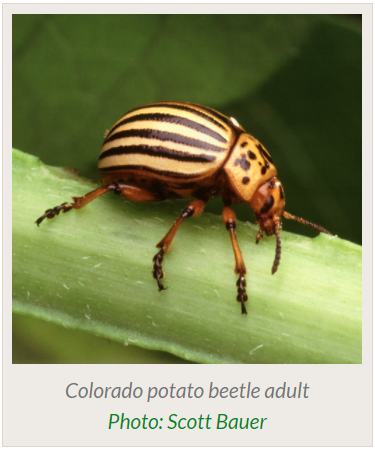
Commercial potato producers should begin checking for Colorado potato beetle (CPB) adults in outside rows of emerging potatoes beginning this week and into late May. Mentioned last week, early detection of these initial infestations can be especially critical to implement perimeter sprays. Adulticide compounds mentioned last week include the active ingredients indoxacarb (Avaunt® eVo), phosmet (Imidan 70-W) which can be applied to outer rows. If using Avaunt eVo, producers should consider using full rates (6.0 fl oz/ac) together with a tank mix containing piperonyl butoxide (e.g., Exponent® insecticide synergist; PBO) at a rate of 6.5-8.0 fl oz/ac to enhance the performance of indoxacarb when targeting CPB. Scout field edges adjacent to prior year’s potato crops and carefully examine lower leaf surfaces of plants for clusters of bright yellow-orange, waxy eggs. These have the greatest probability for early infestation by adult CPB and greater densities egg masses. The risk for early larvae is only just beginning in southern Wisconsin, and producers in this region should consider initial applications of novaluron (Rimon® 0.83EC) or ledprona (Calantha®).
Amanda Gevens, Professor & Extension Vegetable Pathologist, UW–Madison, Dept. of Plant Pathology, 608-575-3029, gevens@wisc.edu
Current P-Day (Early Blight) and Disease Severity Value (Late Blight) Accumulations will be posted at our website and available in the weekly newsletters
Thanks to Ben Bradford, UW- Madison Entomology for supporting this effort and providing a summary reference table: https://agweather.cals.wisc.edu/thermal-models/potato. A Potato Physiological Day or P-Day value of ≥300 indicates the threshold for early blight risk in potato and triggers preventative fungicide application. A Disease Severity Value or DSV of ≥18 indicates the threshold for late blight risk and triggers preventative fungicide application in potato. Data from the modeling source: https://agweather.cals.wisc.edu/vdifn are used to generate these risk values in the table below. I’ve estimated early, mid-, and late planting dates by region based on communications with stakeholders. These are intended to help in determining optimum times for preventative fungicide applications to limit early and late blight in Wisconsin.
| Location | Planting Date Dates in future are anticipated or not yet listed (To Be Determined or TBD) | 50% Emergence Date | Disease Severity Values (DSVs) through 5/24/26 | Potato Physiological Days (P-Days) through 5/24/26 | |
| Spring Green | Early | Apr 10 | May 7 | 2 | 100 |
| Mid | May 5 | May 20 | 0 | 29 | |
| Late | May 16 | TBD | TBD | TBD | |
| Arlington | Early | Apr 12 | May 8 | 0 | 92 |
| Mid | May 6 | May 23 | 0 | 16 | |
| Late | May 20 | TBD | TBD | TBD | |
| Grand Marsh | Early | Apr 13 | May 9 | 0 | 80 |
| Mid | May 6 | May 22 | 0 | 21 | |
| Late | May 21 | TBD | TBD | TBD | |
| Hancock | Early | Apr 14 | May 11 | 1 | 75 |
| Mid | May 10 | TBD | TBD | TBD | |
| Late | May 23 | TBD | TBD | TBD | |
| Plover | Early | Apr 15 | May 12 | 1 | 72 |
| Mid | May 10 | TBD | TBD | TBD | |
| Late | May 25 | TBD | TBD | TBD | |
| Antigo | Early | May 12 | TBD | TBD | TBD |
| Mid | May 25 | TBD | TBD | TBD | |
| Late | TBD | TBD | TBD | TBD | |
| Rhinelander | Early | May 15 | TBD | TBD | TBD |
| Mid | TBD | TBD | TBD | TBD | |
| Late | TBD | TBD | TBD | TBD | |
Late blight of potato/tomato
There was some accumulation of Disease Severity Values (DSVs) which indicate risk of late blight development – but no thresholds have been met. Earliest planted potato fields with emergence earlier this month have accumulated 1-2 DSVs (noted above). Further information on potato late blight: https://vegpath.plantpath.wisc.edu/diseases/potato-late-blight/. An updated list of fungicides for management potato late blight in Wisconsin 2026 is provided here: https://vegpath.plantpath.wisc.edu/resources/late-blight-fungicides/
Early blight of potato
Once we see potato crops at 50% emergence, P-Days will begin to accumulate to aid in anticipating early blight. P-Day values will continue to amass and develop conditions optimum for early blight disease caused by Alternaria solani. Fungicides can provide good control of early blight in vegetables when applied early in infection. Multiple applications of fungicide are often necessary to sustain disease management to time of harvest due to the typically high abundance of inoculum and susceptibility of most common cultivars. For Wisconsin-specific fungicide information, refer to the list below, or the Commercial Vegetable Production in Wisconsin (A3422), a guide available through the UW Vegetable Pathology website which is annually updated and linked here: https://vegpath.plantpath.wisc.edu/resources/a3422/. For home garden fungicide recommendations, see Home Vegetable Garden Fungicides (D0062), a fact sheet available through the UW Plant Disease Diagnostic Clinic website or here: https://hort.extension.wisc.edu/articles/home-vegetable-garden-fungicides/. Always follow label directions carefully. For custom values, please explore the UW Vegetable Disease and Insect Forecasting Network tool for P-Days and DSVs across the state (https://agweather.cals.wisc.edu/vdifn).
As crop canopies expand, growers should begin preparing for early foliar disease management programs, particularly for potato early blight. Early blight risk increases with periods of leaf wetness, high humidity, and fluctuating temperatures conducive to Alternaria solani development. Inoculum establishment often begins early in the season, particularly in fields with potato debris, stressed plants, or reduced crop rotation intervals. Protectant fungicide programs should be initiated according to crop growth stage (row touch or P-Day 300), weather conditions, irrigation frequency, and field disease history. Maintaining healthy crop vigor through balanced fertility and irrigation management remains important in reducing plant stress and minimizing susceptibility. The table below includes fungicides registered for potato early blight in WI.
Fungicide Options for Potato Early Blight Management in Wisconsin (2026)
| Trade Name (examples not comprehensive) | Active Ingredient(s) | FRAC Group | Activity Type |
| Bravo / Echo formulations | chlorothalonil | M5 | Protectant |
| Dithane / Manzate / Penncozeb | mancozeb | M3 | Protectant |
| Elixir | chlorothalonil + mancozeb | M5 + M3 | Protectant |
| Polyram | metiram | M3 | Contact protectant |
| Kocide / Champ / Champion | copper hydroxide | M1 | Protectant |
| Quadris | azoxystrobin | 11 | Locally systemic |
| Quadris Opti | azoxystrobin + chlorothalonil | 11 + M5 | Locally systemic + protectant |
| Quadris Top | azoxystrobin + difenoconazole | 11 + 3 | Locally systemic + systemic |
| AzterKnot | Azoxystrobin + extract of Reynoutria sachalinensis | 11 + biological | Locally systemic and upregulator of resistance |
| Aproach | picoxystrobin | 11 | Locally systemic |
| Headline | pyraclostrobin | 11 | Locally systemic |
| Aftershock / Evito | fluoxastrobin | 11 | Locally systemic |
| Gem | trifloxystrobin | 11 | Locally systemic |
| Delaro | trifloxystrobin + prothioconazole | 11 + 3 | Locally systemic + systemic |
| Tanos | famoxadone + cymoxanil | 11 + 27 | Locally systemic |
| Endura | boscalid | 7 | Systemic |
| Endura Pro | mefentrifluconazole + boscalid | 3 + 7 | Systemic |
| Veltyma | mefentrifluconazole + pyraclostrobin | 3 + 11 | Systemic + locally systemic |
| Quash | metconazole | 3 | Systemic |
| Top MP | difenoconazole | 3 | Systemic |
| Aprovia Top | difenoconazole + benzovindiflupyr | 3 + 7 | Systemic |
| Miravis Prime | pydiflumetofen + fludioxonil | 7 + 12 | Systemic + protectant |
| Cabrio Plus | pyraclostrobin + metiram | 11 + M3 | Locally systemic + protectant |
| Priaxor | pyraclostrobin + fluxapyroxad | 11 + 7 | Locally systemic + systemic |
| Velum Prime | fluopyram | 7 | Systemic |
| Velum Rise | fluopyram + penflufen | 7 + 7 | Systemic |
| Luna Pro | fluopyram + prothioconazole | 7 + 3 | Systemic |
| Luna Tranquility | fluopyram + pyrimethanil | 7 + 9 | Systemic |
| Vertisan | penthiopyrad | 7 | Systemic |
| Reason | fenamidone | 11 | Locally systemic |
| Scala | pyrimethanil | 9 | Locally systemic |
| Provysol | mefentrifluconazole | 3 | Systemic |
| Agri-Tin / Super Tin | triphenyltin hydroxide | 30 | Contact foliar fungicide |
| Lifegard | Bacillus mycoides | biological | Upregulates resistance in the plant |
Read this newsletter as a PDF.
For diagnostic and management support in Wisconsin, please consider contacting Dr. Amanda Gevens (gevens@wisc.edu) or our Plant Disease Diagnostic Clinic (pddc@wisc.edu).
Last updated: