Vegetable Crop Update – May 17, 2026

In this issue:
- Cabbage Maggot Updates and Management
- Colorado Potato Beetle Updates and Management
- Vegetable Leafminers Updates and Management
- Potato Disease Model Updates (Late blight and Early blight)
Vegetable Insect Update – Russell L. Groves, Professor and Associate Department Chairperson, UW–Madison, Department of Entomology, 608-262-3229 (office), (608) 698-2434 (cell), e-mail: rgroves@wisc.edu. Vegetable Entomology Webpage: https://vegento.russell.wisc.edu/
Cabbage Maggot – https://vegento.russell.wisc.edu/pests/cabbage-maggot/
The risk of cabbage maggot infestation has peaked across much of southern and central Wisconsin, with peak egg laying activity of adult flies underway in these regions. Recall, adult activity is considered an early season pest, and the larvae (maggots) that hatch from newly laid eggs feed on the roots and lower stems of all cruciferous crops and weeds. Wounds produced by this feeding can create entry points for several cole crop diseases. Early season transplants and spring roots crops that have recently been planted can be damaged most severely.
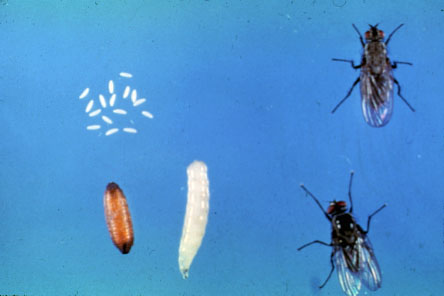
Throughout Wisconsin, populations of cabbage maggots overwinter as pupae in the upper few inches of the soil. With sufficient degree days in the spring, overwintering pupa develop into adult flies, and these are emerging now, coincident with an accumulation of 360 Fahrenheit degree days (FDD). Peak adult emergence occurs around 600 FDD, and this peak adult activity is very prevalent in southern Wisconsin and will progress across the state over the next 7-10 days, especially with warm forecast temperatures in the week to come.
Cabbage maggot treatment is primarily preventative. Plants that already have eggs on them are likely to have damage from infestations. If possible, time planting dates to avoid peak fly emergence. Plantings after mid-June generally suffer less damage than early plantings. In central and northern Wisconsin, the infestation threat will continue for the next two weeks. To avoid damage from this pest, till in cover crops 2-3 weeks before seeding or transplanting, and plant when soil temperatures are adequate (e.g., > 50 F) for quick emergence. Transplants should be planted one week before peak fly emergence. Floating row covers are also effective in protecting plants during flight periods. Do not plant cole crops in fields where animal manure has been freshly applied. Drench, in-furrow and banded applications using cyantraniliprole (Verimark®) and bifenthrin (Capture LFR®) over recently transplanted cole crops can provide some protection. Broadcast applications containing these active ingredients do not provide sufficient control especially in areas with re-occurring infestations.
Colorado potato beetle – https://vegento.russell.wisc.edu/pests/colorado-potato-beetle/
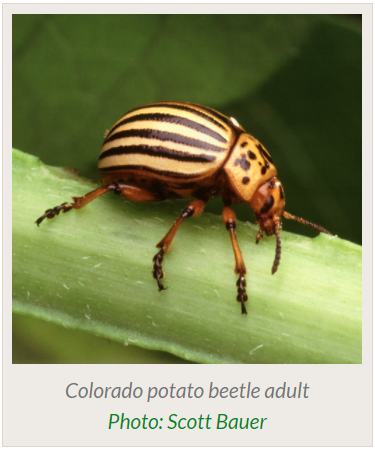
Commercial potato producers should begin checking for Colorado potato beetle (CPB) adults in outside rows of emerging potatoes beginning this week and into late May. Shortly after potato plants emerge, overwintered adult beetles begin to colonize potato plants along the perimeters of newly planted fields. The highest density of adults is often adjacent to previous year’s potato crops. Colonizing adults will usually begin mating and laying eggs in the first 7-10 days after initial colonization, and initial egg masses can be found in the perimeter rows of fields. In central Wisconsin potato producing areas south of Hwy 21, initial perimeter applications may begin as early as May 24. Areas just to the north may begin perimeter applications around 5-7 days thereafter. Potato production in the Lower Wisconsin River Valley may wish to consider initial perimeter applications later this week, and in areas where newly emerged potato has been above ground after hilling for 10 days or longer.
Early detection of these initial infestations can be especially critical where producers wish to use perimeter sprays to limit advancing populations. Early applications containing the adulticide indoxacarb (Avaunt® eVo) can be applied to outer rows to control advancing populations of overwintering adults moving into fields from waterways or hedgerows. If using Avaunt eVo, producers should consider using full rates (6.0 fl oz/ac) together with a tank mix containing piperonyl butoxide (e.g., Exponent® insecticide synergist; PBO) at a rate of 6.5-8.0 fl oz/ac to enhance the performance of indoxacarb when targeting CPB. Formulations of PBO containing greater than 85% active ingredient should be considered. Compounds containing novaluron (Rimon®) can also be initiated in perimeter applications to limit the number of viable eggs laid by adult females.
Scout field edges by quickly scanning plants and surrounding soil for the presence of live adults. Often adult beetles will drop from small plants to the soil as a defensive tactic, typically observing the area surrounding plants will help with early detection. Second, carefully examine lower leaf surfaces of plants for clusters of bright yellow-orange, waxy eggs. Additionally, focus early season scouting on border rows that are adjacent to either previous solanaceous crops or unmanaged non-crop areas. These have the greatest probability for early infestation by adult CPB and greater densities egg masses.
Vegetable leafminers – https://vegento.russell.wisc.edu/pests/vegetable-leafminers/
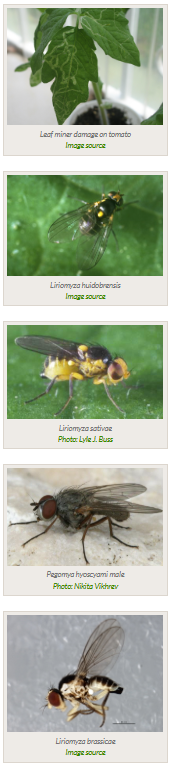
The term leafminer is commonly used to describe flies, moths, sawflies, or beetles in the larval stage. However, leafminers that feed on vegetables most commonly belong to the order Diptera – the true flies. Leafminers feed on the mesophyll tissue between the upper and lower surfaces of leaves. This region of the leaf is where the plant converts light to energy through the process of photosynthesis. Economic crop damage occurs most often in vegetables harvested for edible foliage, such as spinach orchard. There are three primary garden leafminer pests in the state of WI: pea (Liriomyza huidobrensis), vegetable (L. sativae), and spinach (Pegomya hyoscyami) leafminers. Increasingly a fourth species, the serpentine (L. brassicae) leafminer is becoming more common in greenhouse settings. Growers should note that many of these leafminer species do not persist at economically damaging levels in the state and may only be a sporadic and even cosmetic pest on vegetables. Significant problems may arise when transplants are sourced from southern regions. Many regions of the southeastern US have large, persisting leafminer populations with significant insecticide resistance problems. Growers in Wisconsin should take great care to inspect all transplant material sourced from outside the Midwest ensuring plants are healthy and free of leafminer, other arthropod pests and plant pathogens.
It is critical to identify leafminer infestations before the marketability of the crop is affected; this threshold differs greatly among crops. Effective control of leafminer occurs early in the pest’s larval life cycle. Many leafminer species deposit eggs on the lower leaves often avoiding new growth. Focus upon these surfaces when looking for early leafminer damage. Based upon the crop adjust infestation tolerances to the end product. For instance, when growing beets for direct consumption of greens this will necessarily demand a lower threshold for control than beet for roots. Adjustments may also be made based upon the spatial distribution of the pest in the plant. If the majority of leafminers are found in older wrapper leaves of chard, which are commonly discarded, control may not be necessary. Younger plants are generally more susceptible to damage than older ones. On leafy green crops such as spinach, lettuce, and chard, a 5% damage threshold is commonly used. Because leafminers are protected within the plant, foliar insecticidal control is often difficult. Foliar protectants must be applied prior to egg deposition on the crop. The window of activity is a concern and to obtain sufficient control it may be necessary to apply sequential applications Newer reduced risk insecticide groups, such as chlorantraniliprole (Vantacor®), may provide excellent systemic control of the leafminer complex in several crops, especially where insecticide resistance to older chemistries is suspected. Organic control options can include spinosad (Entrust® SC) and pyrethrum/azadirachtin (Azera®).
Amanda Gevens, Professor & Extension Vegetable Pathologist, UW–Madison, Dept. of Plant Pathology, 608-575-3029, gevens@wisc.edu, Lab Website: https://vegpath.plantpath.wisc.edu/
Current P-Day (Early Blight) and Disease Severity Value (Late Blight) Accumulations will be posted at our website and available in the weekly newsletters
Thanks to Ben Bradford, UW- Madison Entomology for supporting this effort and providing a summary reference table: https://agweather.cals.wisc.edu/thermal-models/potato. A Potato Physiological Day or P-Day value of ≥300 indicates the threshold for early blight risk in potato and triggers preventative fungicide application. A Disease Severity Value or DSV of ≥18 indicates the threshold for late blight risk and triggers preventative fungicide application in potato. Data from the modeling source: https://agweather.cals.wisc.edu/vdifn are used to generate these risk values in the table below. I’ve estimated early, mid-, and late planting dates by region based on communications with stakeholders. I welcome your input on these reference dates for your region. These are intended to help in determining optimum times for preventative fungicide applications to limit early and late blight in Wisconsin.
| Location | Planting Date Dates in future are anticipated or not yet listed (To Be Determined or TBD) | 50% Emergence Date | Disease Severity Values (DSVs) through 5/15/26 | Potato Physiological Days (P-Days) through 5/15/26 | |
| Spring Green | Early | Apr 10 | TBD | TBD | TBD |
| Mid | May 5 | TBD | TBD | TBD | |
| Late | May 16 | TBD | TBD | TBD | |
| Arlington | Early | Apr 12 | TBD | TBD | TBD |
| Mid | May 6 | TBD | TBD | TBD | |
| Late | TBD | TBD | TBD | TBD | |
| Grand Marsh | Early | Apr 13 | TBD | TBD | TBD |
| Mid | May 8 | TBD | TBD | TBD | |
| Late | TBD | TBD | TBD | TBD | |
| Hancock | Early | Apr 14 | TBD | TBD | TBD |
| Mid | May 10 | TBD | TBD | TBD | |
| Late | TBD | TBD | TBD | TBD | |
| Plover | Early | Apr 15 | TBD | TBD | TBD |
| Mid | May 10 | TBD | TBD | TBD | |
| Late | TBD | TBD | TBD | TBD | |
| Antigo | Early | May 12 | TBD | TBD | TBD |
| Mid | TBD | TBD | TBD | TBD | |
| Late | TBD | TBD | TBD | TBD | |
| Rhinelander | Early | TBD | TBD | TBD | TBD |
| Mid | TBD | TBD | TBD | TBD | |
| Late | TBD | TBD | TBD | TBD | |
Late blight of potato/tomato
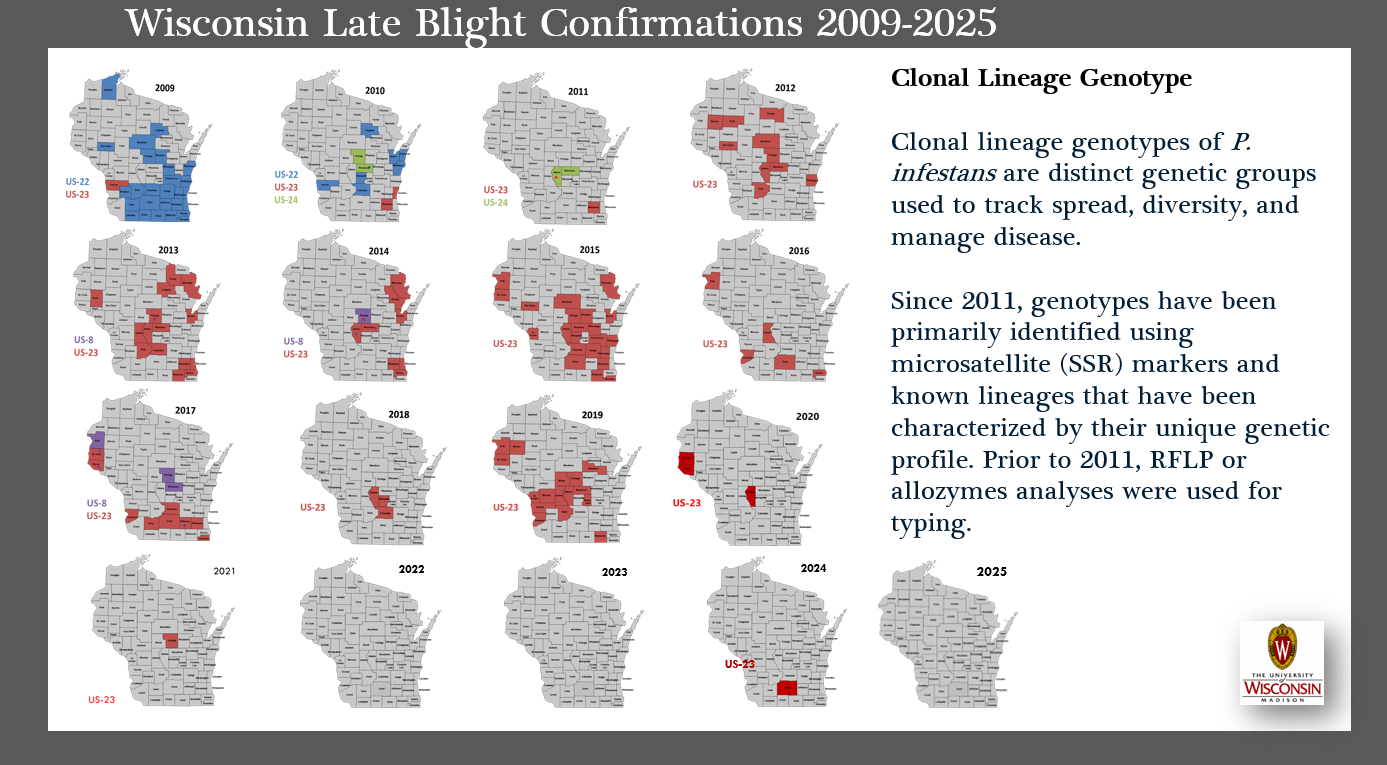
The usablight.org website appears to no longer be working for the collection of late blight confirmations in the US. I will provide information in this newsletter as I learn from other states’ newsletters or reports. The information is useful in anticipating appropriate management especially if genotype/clonal lineage information is provided. Late blight was not confirmed in WI last year (2025) and the disease has been very isolated and sporadic in the past 5 years. Further information on potato late blight: https://vegpath.plantpath.wisc.edu/diseases/potato-late-blight/
An updated list of fungicides for management potato late blight in Wisconsin 2026 is provided here: https://vegpath.plantpath.wisc.edu/resources/late-blight-fungicides/
Early blight of potato
Once we see potato crops at 50% emergence, P-Days will begin to accumulate to aid in anticipating early blight. P-Day values will continue to amass (up to ~10 per day) and develop conditions optimum for early blight disease caused by Alternaria solani. Earliest inoculum typically comes from within a field and from nearby fields. Once established, early blight continues to create new infections due to its polycyclic nature – meaning spores create foliar infection and the resulting lesion on the plant can then produce new spores for ongoing new infections in the field and beyond. Early season management of early blight in potato can mitigate the disease for the rest of the season. https://vegpath.plantpath.wisc.edu/diseases/potato-early-blight/ Fungicides can provide good control of early blight in vegetables when applied early on in infection. Multiple applications of fungicide are often necessary to sustain disease management to time of harvest due to the typically high abundance of inoculum and susceptibility of most common cultivars. For Wisconsin-specific fungicide information, refer to the Commercial Vegetable Production in Wisconsin (A3422), a guide available through the UW Vegetable Pathology website which is annually updated and linked here: https://vegpath.plantpath.wisc.edu/resources/a3422/. Or, for home garden fungicide recommendations, see Home Vegetable Garden Fungicides (D0062), a fact sheet available through the UW Plant Disease Diagnostic Clinic website or here: https://hort.extension.wisc.edu/articles/home-vegetable-garden-fungicides/. Always follow label directions carefully. For custom values, please explore the UW Vegetable Disease and Insect Forecasting Network tool for P-Days and DSVs across the state (https://agweather.cals.wisc.edu/vdifn). This tool utilizes NOAA weather data. In using this tool, be sure to enter your model selections and parameters, then hit the blue submit button at the bottom of the parameter boxes. Once thresholds are met for risk of early blight and/or late blight, fungicides are recommended for optimum disease control.