Vegetable Crop Update – Aug 16, 2026
In this issue:
Vegetable Disease Update
Amanda Gevens, Professor & Extension Vegetable Pathologist, UW–Madison, Dept. of Plant Pathology, 608-575-3029, gevens@wisc.edu
Current P-Day (Early Blight) and Disease Severity Value (Late Blight) Accumulations
Thanks to Ben Bradford, UW- Madison Entomology for supporting this effort and providing a summary table: https://agweather.cals.wisc.edu/thermal-models/potato. A Potato Physiological Day or P-Day value of ≥300 indicates the threshold for early blight risk in potato and triggers preventative fungicides. A Disease Severity Value or DSV of ≥18 indicates the threshold for late blight risk and triggers preventative fungicide application in potato. Data from the modeling source: https://agweather.cals.wisc.edu/vdifn are used to generate these risk values. I’ve estimated early, mid-, and late planting dates by region based on communications with stakeholders. These are intended to help in determining optimum times for preventative fungicide applications to limit early and late blight in Wisconsin.
| Location | Planting Date | 50% Emergence Date | Disease Severity Values (DSVs) through 8/15/26 Season total (additional DSVs over past week) | Potato Physiological Days (P-Days) through 8/15/26 Season total (additional P-Days over past week) | |
| Spring Green | Early | Apr 10 | May 7 | 49 (12) | 796 (64) |
| Mid | May 5 | May 20 | 47 (12) | 725 (65) | |
| Late | May 16 | June 2 | 47 (12) | 628 (64) | |
| Arlington | Early | Apr 12 | May 8 | 28 (11) | 796 (66) |
| Mid | May 6 | May 23 | 28 (11) | 721 (66) | |
| Late | May 20 | June 4 | 28 (11) | 624 (66) | |
| Grand Marsh | Early | Apr 13 | May 9 | 47 (13) | 770 (65) |
| Mid | May 6 | May 22 | 47 (13) | 711 (66) | |
| Late | May 21 | June 5 | 47 (13) | 606 (66) | |
| Hancock | Early | Apr 14 | May 11 | 30 (7) | 764 (66) |
| Mid | May 10 | May 30 | 29 (7) | 649 (65) | |
| Late | May 23 | June 6 | 28 (7) | 596 (66) | |
| Plover | Early | Apr 15 | May 12 | 26 (3) | 765 (65) |
| Mid | May 10 | May 30 | 25 (3) | 653 (65) | |
Early blight of potato
All Wisconsin potatoes have surpassed the treatment threshold of 300 P-Days. Continued preventative fungicide applications are warranted for these fields. In the past week regions of the state accumulated between 55 and 66 P-Days, very similar to the previous week. For support in selecting fungicides, please consult the A3422 Commercial Vegetable Production in Wisconsin: https://vegpath.plantpath.wisc.edu/resources/a3422/
Late blight of potato
The discovery of late blight on potato in southwestern MI this past week caused increased vigilance in scouting and preventatively managing late blight in our region, especially for plantings intended for storage. Further information on symptoms and management is provided below.
Wisconsin potato production regions have accumulated 1-13 Disease Severity Values or DSVs over this past week. All locations with the exception of the later plantings in the Rhinelander area, are at or surpassing the action threshold of 18. Fields with ≥18 DSVs should receive preventative fungicide applications to manage for late blight.
A current list of fungicides for management of potato late blight in Wisconsin 2026 is provided here: https://vegpath.plantpath.wisc.edu/resources/late-blight-fungicides/. The table includes protectant materials as well as locally systemic, translaminar, and systemic options. The list also identified FRAC groups, REIs, PHIs, seasonal maximums, and product specific resistance management restrictions. For example, the current table notes that chlorothalonil uses are subject to an 11.2 5 lb active ingredient per acre seasonal maximum in Wisconsin, and that certain products have limits on consecutive applications. P. infestans is a water mold, so products must be selected for activity against oomycetes.
Rotate FRAC groups and avoid repeated sequential applications of the same mode of action unless the label specifically permits it. Tank-mix partners, maximum seasonal use rates, preharvest intervals, retreatment intervals, and other restrictions all matter. Always read and follow the current product label. The label is the law. Tomato late blight fungicides may be different than potato, please see the Tomato Late Blight section of our Commercial Vegetable Production in Wisconsin Guide for 2026 for details https://vegpath.plantpath.wisc.edu/resources/a3422/

Late blight remains one of the most consequential foliar and tuber diseases of potato. Caused by the oomycete pathogen Phytophthora infestans, it can move quickly through a field during cool, wet weather and, without timely management, can result in severe canopy loss, tuber infection, and storage problems. Due to the nature of current contemporary strains of the pathogen, this disease also affects tomato. Further information can be found here: https://vegpath.plantpath.wisc.edu/diseases/tomato-late-blight/
Symptoms to note in your scouting:
Early detection depends on knowing what to look for when scouting. Pictures of symptoms are included below for further reference.
- Leaves: Large, irregular, water-soaked to dark-brown lesions, often with a pale green-to-gray edge. Lesions are not restricted by major leaf veins. Expression can vary based on humidity, cultivar, and fungicide usage.
- Stems and petioles: Dark brown, firm lesions that can expand rapidly.
- Humidity clue: During cool, wet, humid mornings, white, powdery-looking sporulation may be visible on infected tissue, especially around lesion margins. Dry conditions can lead to tan or ‘papery’ lesions.
- Tubers: Brown, reddish, or purplish discoloration beneath the skin. Infected tubers may later become soft as secondary bacterial rots develop.
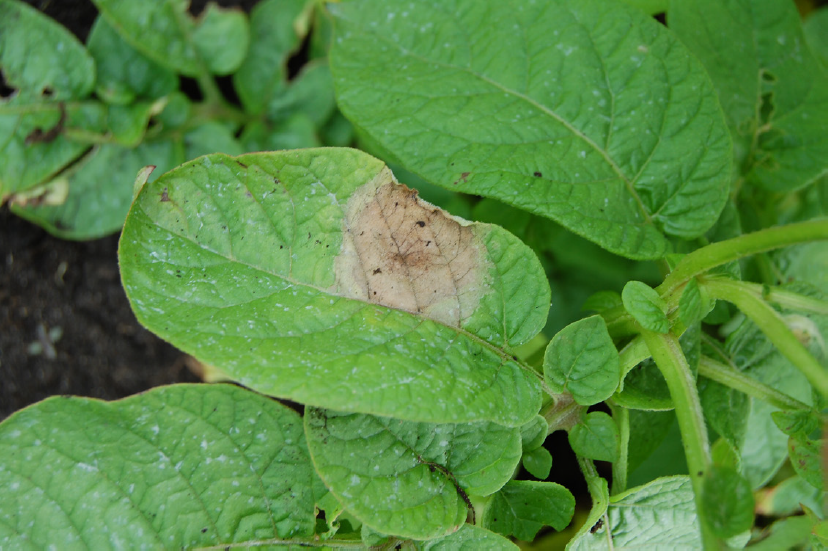
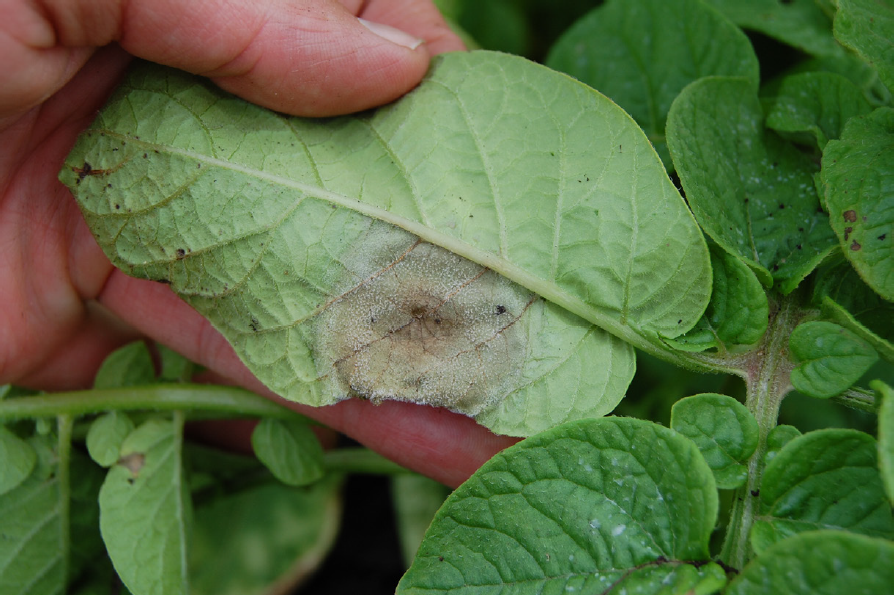
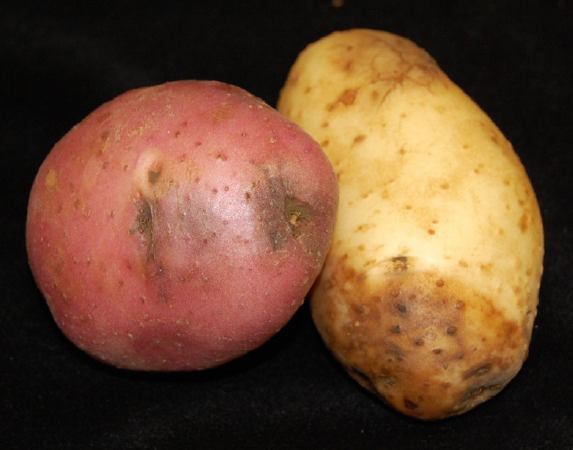
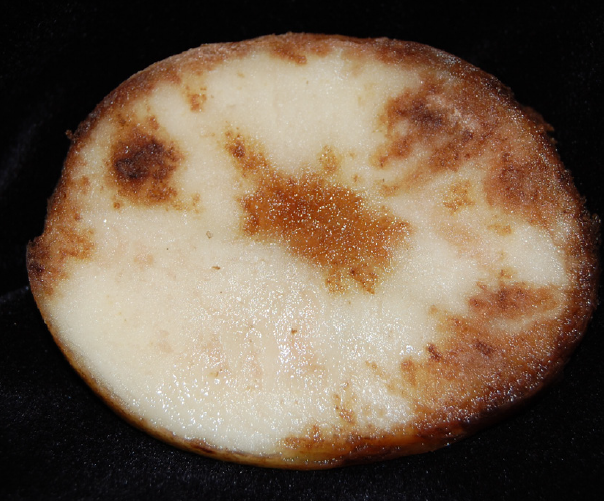
Late blight can resemble other potato problems, including Phytophthora nicotianae blight. It is important to get a confirmed diagnosis if symptoms are questionable. The UW Vegetable Pathology program (gevens@wisc.edu) and the UW Plant Disease Diagnostic Clinic (https://pddc.wisc.edu/) offer cost-free diagnostics for late blight due to the importance of this disease in Wisconsin.
Moist and moderate temperatures (90-100% humidity and 54-75°F) promote the production of sporangia (primary “spores”). Sporangia typically infect at 64-75°F, whereas zoospores are produced and can be infective at 46-64°F. Growers can refer to the disease prediction and weather models available at Vegetable Disease and Insect Forecasting Network (VDIFN) website. Under favorable conditions, lesions can produce abundant sporangia in fewer than five days. These spores can move within fields by rain splash and irrigation and can travel between fields on wind currents.
The disease does not need to begin in a commercial field. Potential local sources include infected seed tubers, potato volunteers, unmanaged cull or waste piles, nearby potato or tomato plantings, windborne inoculum from regional outbreaks. Wisconsin’s emphasis on certified seed, cull-pile destruction, and volunteer management remains central to keeping this disease out of production fields. Wisconsin regulation requires potato cull piles to be destroyed by May 20 each year (wisconsinpotatoes.com & https://docs.legis.wisconsin.gov/code/admin_code/atcp/020/21/14/4/b ).
UW–Madison’s Blitecast potato late blight model featured earlier in this newsletter uses Disease Severity Values (DSVs) to summarize weather favorable for late blight. DSVs accumulate during periods with suitable temperature and humidity. A cumulative total of 18 DSVs or more since crop emergence—or since the last fungicide application is the threshold at which preventive late blight action should be considered. However, DSVs indicate favorable weather only; disease develops only if viable late blight inoculum is present. Blitecast information should be used with your field’s emergence date and fungicide application history, recent rainfall/dew duration/irrigation patterns, regional late blight reports, field scouting results, variety susceptibility and crop stage in making management decisions.
When weather is favorable or regional late blight has been reported, move to more intensive scouting in locations of highest risk including:
- Low areas and fields with extended morning dew
- Shaded borders, tree lines, and areas with poor airflow
- Irrigated fields, especially after frequent irrigation cycles
- Fields near tomato plantings, cull piles, volunteers, or previous potato ground, field entrances, edges, and downwind sides
- Susceptible varieties and late-planted fields with green, dense canopies
For most effective scouting:
- Scout early in the morning before dew dries, when sporulation and water-soaked lesions are easiest to see
- Walk well into the field; do not limit observations to headlands
- Inspect lower and mid-canopy leaves, petioles, and stems
- Flag and photograph suspect locations; record the field, variety, date, growth stage, and GPS point if available
- During active risk periods, increase scouting frequency and revisit known wet or slow-drying areas
- If late blight is suspected, limit unnecessary movement through the area and avoid carrying wet foliage or plant debris into other fields
Lower-risk conditions / no known nearby outbreak: Use a labeled protectant program when Blitecast reaches the preventive-action threshold or when crop and weather conditions justify protection. Maintain coverage as the canopy expands, after rainfall events, and according to label intervals. Note that most commercial crops may be using a protectant with broad spectrum protection for their overall disease management program – not specifically for late blight. This is good general coverage for foliar disease.
Elevated risk / late blight confirmed regionally / symptoms found nearby: Tighten intervals within label limits. Use late-blight-specific materials with appropriate systemic or translaminar activity as part of a resistance-management program. Protect new growth and ensure full canopy coverage.
Confirmed or strongly suspected field infection: Seek a rapid diagnosis immediately. Treat the situation as an area-wide concern, not solely a single-field issue. Work on a containment and fungicide plan that protects adjacent acreage and limits tuber risk. The plan may involve early vine desiccation and/or harvest to remove risk. The plan may also repurpose a field for direct processing rather than storage.
Cucurbit downy mildew
Cucurbit Downy Mildew was reported on commercial cucumber in Branch and St. Joseph Counties in southwestern Michigan this past week. These discoveries follow regional reports from northern IN and OH. There were no field disease confirmations from Wisconsin this past week. The pathogen has been reported in relatively few states this year as noted at the Cucurbit Downy Mildew Forecasting website and network (https://cdm.ipmpipe.org/). Fungicide considerations were discussed in a previous newsletter and can be found here: https://vegpath.plantpath.wisc.edu/2026/07/12/vegetable-crop-update-jul-5-2026/
Vegetable Insect Update
Russell L. Groves, Professor and Associate Department Chairperson, UW–Madison, Department of Entomology, 608-262-3229 (office), (608) 698-2434 (cell), e-mail: rgroves@wisc.edu. Vegetable Entomology Webpage: https://vegento.russell.wisc.edu/
Corn earworm – https://vegento.russell.wisc.edu/pests/corn-earworm/
Captures of adult, male corn earworm (CEW) in pheromone traps increased during the week of Aug 5-12 as reported by the Wisconsin Home Pest Survey, and specifically the Corn Earworm Trap Network. As we expect for mid-August and into mid- to late September, captures of adult male moths have trended upward in the very southern portions of the state indicating the potential for local flights into the region.

From the WI DATCP’s Field Notes Survey for the week, “Migrations of 507 moths were observed in 16 pheromone traps, with greater captures (> 100 moths/trap/week) reported in Walworth County.
In 2026, far fewer adult moths have been captured to date compared with 2025 where only 1,501 (38%) of adult male moths were captured compared with 3,926 moths (2025). Sweet corn producers with susceptible corn (green silk through brown silk stage) should be underway with management options in regions with elevated captures. Treatment schedules are based on nightly corn earworm moth trap catches from the Commercial Vegetable Production in Wisconsin guidelines.
Supported by Northern Illinois University, the Insect Forecast Migration web-page suggested elevated or moderate risk for flights last week from southern regions in the US.

Pheromone trap catches of 5 to 10 moths or blacklight trap captures of 3 to 5 moths per night for three consecutive nights indicate that moths are probably laying enough eggs to warrant treatment of fields that are in the vulnerable stage between brush and silk browning to add precision to your scouting, check silks for the small, spherical corn earworm eggs before beginning a spray program.
Model predictions for risk of infestation of corn earworm over the upper Midwest has encroached into southern and central Wisconsin. Daily pheromone captures in Hartstack traps represent the best, and most actionable tool for control of corn earworm.

Two-spotted spider mites – https://vegento.russell.wisc.edu/pests/#mites
Wisconsin counties in the northern half to one-third of the state are still experiencing moderate to severe drought conditions. In portions of central and southern Wisconsin, drought persists, but recent rains have alleviated some of these conditions.

Populations of two-spotted spider mites (TSSM) in susceptible crops (cucurbits, sweet corn, green bean, dry bean, fruiting vegetables, mint, and potatoes) could increase with temperatures continuing upward in the coming week with limited rain on the forecast.
Populations of TSSM are encouraged with prolonged dry conditions, and these can be especially problematic whenever temperatures are greater than 85°F. These are considered ideal conditions for the TSSM, and populations can increase very rapidly. If spider mites need controlled, consider a selective miticide rather than dimethoate or a synthetic pyrethroid at this time of the year, as these insecticides will eliminate natural enemies and pest resurgence can result. Because aggregations of TSSM populations typically begin along field edges, examine the undersides of leaves where plants have stippling or webbing symptoms.