Vegetable Crop Update – Sep 20, 2026

In this issue:
Vegetable Disease Update
Amanda Gevens, Professor & Extension Vegetable Pathologist, UW–Madison, Dept. of Plant Pathology, 608-575-3029, gevens@wisc.edu
Current P-Day (Early Blight) and Disease Severity Value (Late Blight) Accumulations
Thanks to Ben Bradford, UW- Madison Entomology for supporting this effort and providing a summary table: https://agweather.cals.wisc.edu/thermal-models/potato. A Potato Physiological Day or P-Day value of ≥300 indicates the threshold for early blight risk in potato and triggers preventative fungicides. A Disease Severity Value or DSV of ≥18 indicates the threshold for late blight risk and triggers preventative fungicide application in potato. Data from the modeling source: https://agweather.cals.wisc.edu/vdifn are used to generate these risk values. I’ve estimated early, mid-, and late planting dates by region based on communications with stakeholders. These are intended to help in determining optimum times for preventative fungicide applications to limit early and late blight in Wisconsin.
| Location | Planting Date | 50% Emergence Date | Disease Severity Values (DSVs) through 9/19/26 Season total (additional DSVs over past week) | Potato Physiological Days (P-Days) through 9/19/26 Season total (additional P-Days over past week) | |
| Spring Green | Early | Apr 10 | May 7 | 81 (14) | 1095 (118) |
| Mid | May 5 | May 20 | 79 (14) | 1024 (118) | |
| Late | May 16 | June 2 | 79 (14) | 927 (117) | |
| Arlington | Early | Apr 12 | May 8 | 51 (11) | 1099 (118) |
| Mid | May 6 | May 23 | 51 (11) | 1024 (118) | |
| Late | May 20 | June 4 | 51 (11) | 927 (118) | |
| Grand Marsh | Early | Apr 13 | May 9 | 72 (12) | 1057 (108) |
| Mid | May 6 | May 22 | 72 (12) | 998 (109) | |
| Late | May 21 | June 5 | 72 (12) | 893 (109) | |
| Hancock | Early | Apr 14 | May 11 | 55 (14) | 1051 (107) |
| Mid | May 10 | May 30 | 54 (14) | 937 (108) | |
| Late | May 23 | June 6 | 53 (14) | 883 (108) | |
| Plover | Early | Apr 15 | May 12 | 43 (9) | 1048 (106) |
| Mid | May 10 | May 30 | 42 (9) | 937 (106) | |
| Late | May 25 | June 6 | 41 (9) | 885 (106) | |
| Antigo | Early | May 12 | May 29 | 71 (12) | 908 (100) |
| Mid | May 25 | June 5 | 71 (12) | 865 (100) | |
| Late | June 8 | June 20 | 60 (12) | 753 (100) | |
| Rhinelander | Early | May 15 | June 6 | 41 (7) | 829 (93) |
| Mid | May 28 | June 10 | 39 (7) | 792 (93) | |
| Late | June 9 | June 25 | 34 (7) | 696 (93) | |
Late blight of potato/tomato – Blitecast update and information resources
Wisconsin potato production regions have accumulated moderate to high 7-14 Disease Severity Values or DSVs over this past week. All locations are at or surpassing the comprehensive action threshold of 18. Fields with ≥18 DSVs should receive preventative fungicide applications to manage for late blight. A current list of fungicides for management of potato late blight in Wisconsin 2026 is provided here: https://vegpath.plantpath.wisc.edu/resources/late-blight-fungicides/.
Late blight in the US 2026
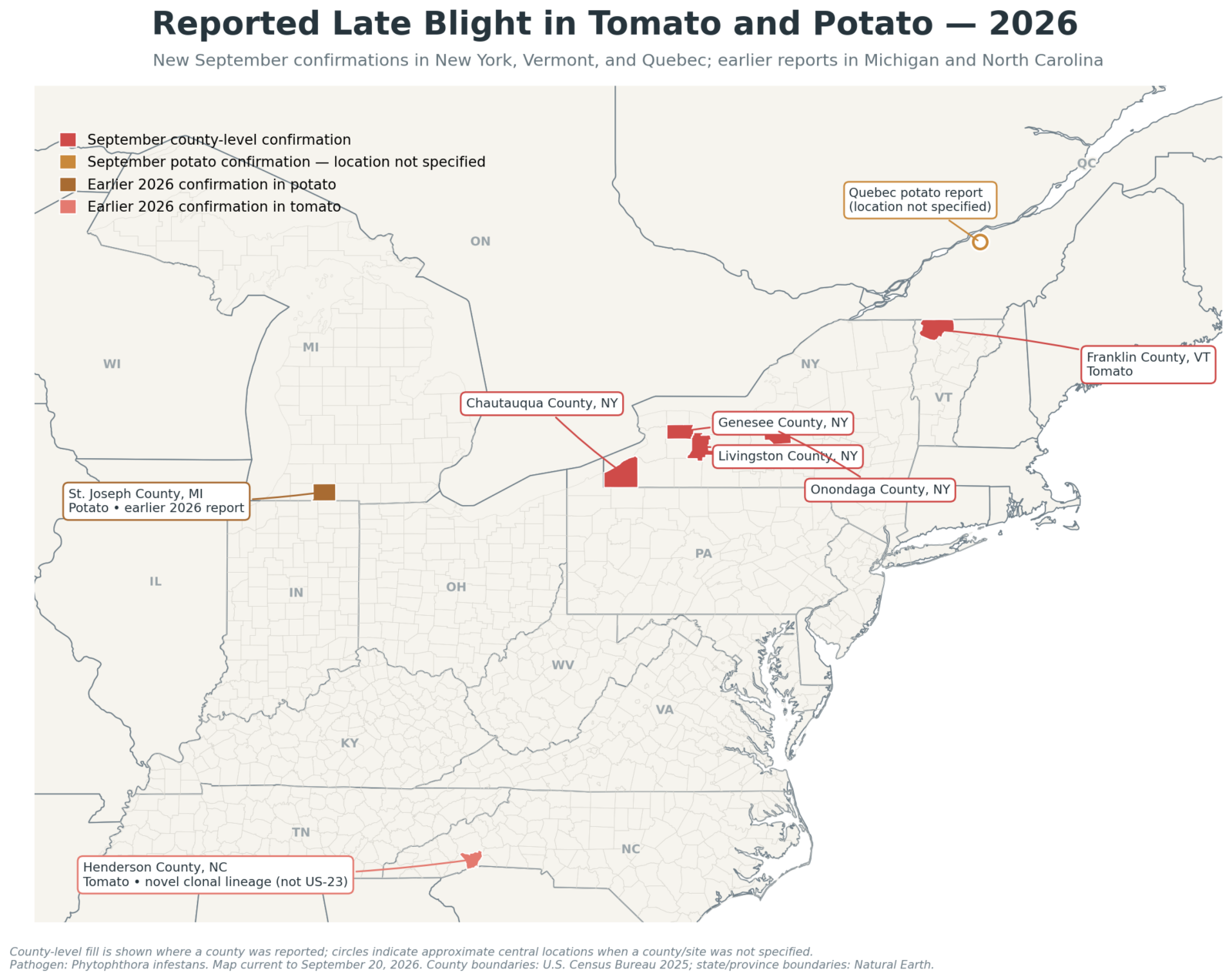
Late blight was confirmed in a few additional mid-Atlantic locations over this past week. A new potato late blight report came from the Quebec area, with tomato reports from Vermont and western New York. Earlier this season, isolated confirmations came from tomato in NC, and potato in MI. Sources of information from researchers and extension specialists out of University of New Hampshire and Penn State University include: https://extension.unh.edu/resource/vegetable-ipm-reports, https://extension.psu.edu/2026-late-blight-updates.
Late Blight Remains Active Regionally as Potato Harvest Advances
New late blight infections continue to be reported in the northeastern US. September reports include late blight on tomato in Franklin County, Vermont, and in at least four New York counties—Chautauqua, Genesee, Livingston, and Onondaga. Late blight was also recently reported on potato in Quebec. Earlier in the 2026 season, the disease was confirmed on potato in St. Joseph County, Michigan, and on tomato in Henderson County, North Carolina. The Michigan pathogen was identified as US-23, whereas the North Carolina pathogen represented a novel clonal lineage that was not US-23. No late blight has been confirmed in Wisconsin this season. However, these regional reports indicate that Phytophthora infestans remains active while Wisconsin potato harvest continues and some tomato crops remain in production. Late-season vigilance is warranted, particularly during periods of cool, wet weather and when storms move into Wisconsin from areas with active disease.
Late blight risk post vine-kill
Tuber risk continues until potatoes are harvested
Vine killing greatly reduces the amount of susceptible foliage within a potato field, but it does not immediately eliminate the risk of tuber infection. Potato tubers remain susceptible while they are in the ground—even after vine kill has occurred. Airborne sporangia produced in an infected field, volunteer potato planting, cull pile, or unmanaged tomato planting can travel into nearby or downwind potato fields. Sporangia deposited on the soil surface or remaining plant material can then be washed downward by rain or irrigation water. Movement is especially likely through soil cracks, around stems, and in areas where tubers are shallow or poorly covered. If viable inoculum reaches susceptible tubers, infection can occur before digging. The period between vine kill and harvest is therefore important. Complete vine death, good soil coverage over tubers, limited soil cracking, and dry harvest conditions all help reduce risk. Fields with surviving green tissue, uneven vine kill, low areas, or a history of late blight deserve additional attention.
Actions to consider now
Growers should continue scouting any potato or tomato fields that retain green foliage. Pay particular attention to field edges, sheltered or low-lying areas, irrigated sections, and locations that remain wet for extended periods. Suspect lesions should be submitted promptly for diagnostic confirmation rather than diagnosed by symptoms alone.
For potatoes approaching harvest:
- Confirm that vines are completely dead and no green regrowth is present.
- Maintain adequate soil coverage over tubers and note areas with soil cracking or exposed tubers.
- Avoid harvesting during or immediately after wet conditions whenever possible.
- Minimize tuber bruising, cuts, and skinning during digging and handling.
- Remove visibly decayed or suspicious tubers before storage.
- Do not place tubers from known late-blight-affected areas into long-term storage without a management plan.
- Provide effective airflow and carefully monitor stored potatoes for developing decay.
Late-blight-infected tubers may show firm, irregular, reddish-brown or granular discoloration extending into the flesh. Symptoms may be subtle at harvest, and affected tubers are highly vulnerable to secondary bacterial soft rot in storage. Storage breakdown can progress rapidly when infected tubers are wet, wounded, or held under conditions that permit condensation.
The recent late blight findings provide a reminder that risk continues as long as susceptible crops and viable inoculum remain in the region. Careful scouting, timely diagnosis, complete vine kill, and thoughtful harvest and storage management remain important through the end of the season.
Cucurbit Downy Mildew
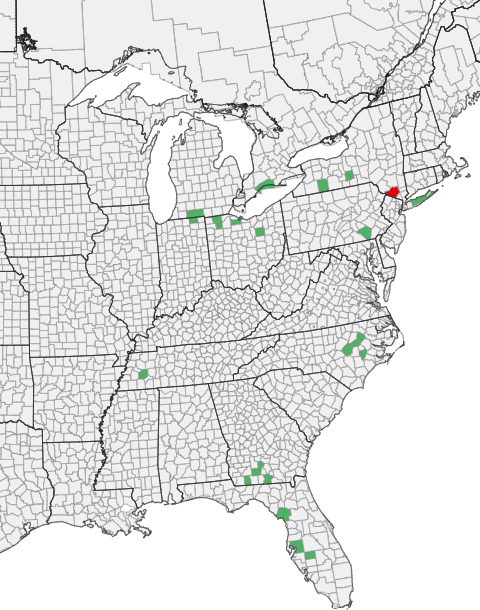
Cucurbit Downy Mildew was reported in new counties of NY this past week (https://cdm.ipmpipe.org/). There were no field disease confirmations from Wisconsin. Fungicide considerations were discussed in a previous newsletter and can be found here: https://vegpath.plantpath.wisc.edu/2026/07/12/vegetable-crop-update-jul-5-2026/
More information on the disease: https://vegpath.plantpath.wisc.edu/diseases/cucurbit-downy-mildew/