Vegetable Crop Update – Sep 21, 2025

In This Issue:
- End of season crop production comments
- Potato tuber heat necrosis and hollow heart
- Late blight updates for potato/tomato
- Cucurbit downy mildew updates
- Pink eye of potato
Yi Wang, Associate Professor & Extension Potato and Vegetable Production Specialist, UW–Madison, Dept. of Plant and Agroecosystem Sciences, 608-265-4781, Email: wang52@wisc.edu.
Since it is close to the end of the field season, growers reported that overall, it is an average year for most vegetable crops. Summertime warmth returned this week, with daily max temps topping 80°F and weekly averages several degrees above normal. Precipitation totals were light for most of the week, with less than 0.5’’ common throughout most parts of the state. Most soil moisture data collected from the UW research farms saw a decline in the top 4’’, with the latest NASS report indicating increases in the percentage of topsoil that is dry to very dry. The next 7 days are expected to be more active for rainfall statewide, with multiple rain chances anticipated during early next week. Climate outlook for late September suggests an increased likelihood (70-80% chance) for warmer-than-normal conditions. However, the outlook for October does not show any strong signs of above or below normal conditions. In recent weeks, I received some growers’ questions about seeing a higher incidence of hollow heart and heat necrosis on some varieties. Both hollow heart and heat necrosis are physiological defects caused by environmental stresses during the growing season. Both can result in significant losses in crop quality and economic returns for growers.
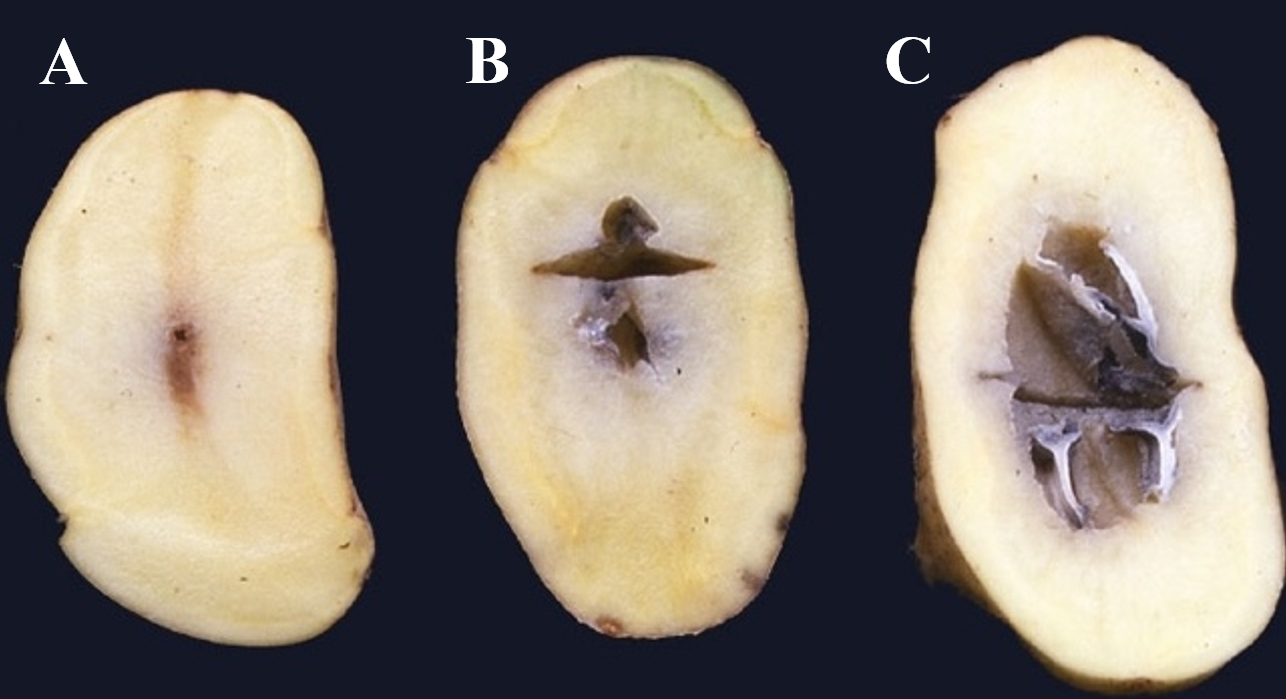
Progression of hollow heart from brown center (A), to early cavity formation (B), to large internal cavity (C).
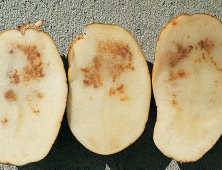
Symptoms of heat necrosis, also called internal brown and internal necrosis, in potato tubers
Amanda Gevens, Professor & Extension Vegetable Pathologist, UW–Madison, Dept. of Plant Pathology, 608-575-3029, gevens@wisc.edu
Late blight of potato/tomato. I’m aware of no new reports of late blight in the US this past week. Findings thus far in potato and tomato have been confirmed as US-23 Phytophthora infestans (still sensitive to mefenoxam/metalaxyl (ie: Ridomil) in western NY and Ontario Canada. Here in Wisconsin, we saw limited accumulations of 2-5 DSVs across WI this past week. https://agweather.cals.wisc.edu/vdifn?model=late-blight Please find a fungicide listing for Wisconsin potato late blight management: https://vegpath.plantpath.wisc.edu/documents/potato-late-blight-fungicides/ For custom values of P-Days (for Early Blight) and DSVs (for Blitecast for Late Blight), please explore the UW Vegetable Disease and Insect Forecasting Network tool for P-Days and DSVs across the state (https://agweather.cals.wisc.edu/vdifn). This tool utilizes NOAA weather data. Be sure to enter your model selections and parameters, then hit the blue submit button at the bottom of the parameter boxes. Once thresholds are met for risk of early blight and/or late blight, fungicides are recommended for optimum disease control. Fungicide details can be found in the 2025 Commercial Veg. Production in WI Extension Document A3422: https://cropsandsoils.extension.wisc.edu/articles/2025-commercial-vegetable-production-in-wisconsin-a3422/ Cucurbit Downy Mildew: No downy mildew was seen on cucurbits this past week at HARS, and none reported through our UW Plant Disease Diagnostic Clinic. There were no new reports of downy mildew on cucurbits through the Cucurbit Downy Mildew ipm PIPE website: https://cdm.ipmpipe.org/. Pink Eye of Potato or Periderm Disorder Syndrome:
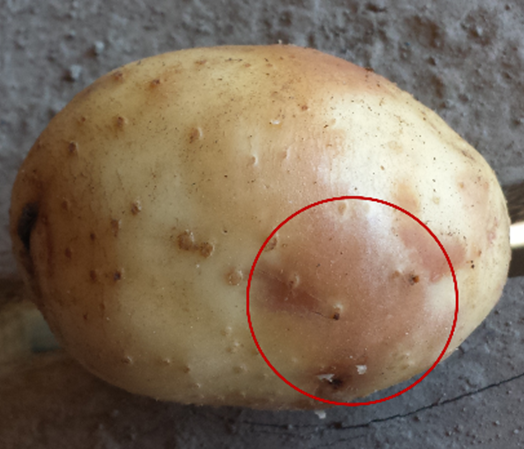
Symptoms of pink eye of potato. This physiological condition is often now referred to as Periderm Disorder Syndrome. Photo Courtesy to Drs. Yi Wang and Amanda Gevens, UW–Madison.
Where does pink eye come from?
Pink eye is a physiological disorder (i.e., an abnormality in plant growth), rather than a true disease that involves a disease-causing microorganism. Pink eye arises during periods of excessive soil moisture and warm temperatures, especially during the later stages of tuber development. Pink eye symptoms typically appear within seven to 10 days after excessive rain. Excessive soil moisture coupled with high soil temperature causes a lack of oxygen around potato tubers, leading to damage of cells in the tuber skin. This cell damage contributes to pink eye development. Environmental conditions that lead to pink eye also promote tuber infections by the pathogens that cause Pythium leak, bacterial soft rot (see UW Plant Disease Facts D0010, Bacterial Soft Rot), pink rot, and Fusarium dry rot (all diseases associated with pink eye in storage).How do I salvage potato tubers affected by pink eye?
Once pink eye symptoms develop, they are permanent. If symptoms are minor, tubers may still be usable. However, when pink eye symptoms are severe, symptomatic tubers will be rejected and discarded.How do I avoid problems with pink eye in the future?
Growers have no control over the extreme precipitation and high temperatures that promote pink eye development. However, growers can practice management strategies that minimize water-saturated soils and reduce warm soil temperatures, thus reducing the severity of pink eye. To minimize water-saturated soils, deep till areas where pink eye has been a problem, areas where water tends to collect for extended periods, and areas where soils may be compacted (e.g., field entrances or head lands). Deep tillage will break up subsoils in these areas that impede proper drainage during wet weather. Proper drainage will limit periods when tubers will be oxygen deprived and thus more prone to pink eye development. Also, avoid any activities that will cause soil compaction such as operation of heavy and large farm tractors and other field equipment when soils are wet. Minimizing water-saturated soils will not only reduce the likelihood of pink eye development but will also help limit development of other tuber diseases. To promote cooler soil temperatures, be sure to manage diseases (e.g., potato early dying) that reduce canopy coverage. Loss of canopy allows soils to warm faster on sunny days, thus leading to higher temperatures that are more favorable for pink eye development. Finally, be sure to scout for pink eye symptoms prior to and during harvest. Knowing the severity of pink eye in a field can help growers make informed decisions about the appropriate duration for tuber storage and the best end use for symptomatic tubers.For more information on pink eye:
Contact the University of Wisconsin Plant Disease Diagnostics Clinic (PDDC) at (608) 262-2863 or pddc@wisc.edu. PDDC fact sheet: https://pddc.wisc.edu/wp-content/blogs.dir/39/files/Fact_Sheets/FC_PDF/Pink_Eye_of_Potato.pdfView this newsletter as a PDF