Vegetable Crop Update – Aug 24, 2025

In This Issue:
- Disease forecasting updates for potato early blight and late blight
- Cucurbit downy mildew updates
- Phytophthora crown and fruit rot in cucurbits and solanaceous crops
- Corn earworm and its management
- PVY and its management
Amanda Gevens, Professor & Extension Vegetable Pathologist, UW–Madison, Dept. of Plant Pathology, 608-575-3029, gevens@wisc.edu, Lab Website: https://vegpath.plantpath.wisc.edu/.
Current P-Day (Early Blight) and Disease Severity Value (Late Blight) Accumulations will be posted at our website and available in the weekly newsletters. Thanks to Ben Bradford, UW–Madison Entomology for supporting this effort and providing a summary reference table: https://agweather.cals.wisc.edu/thermal-models/potato. A Potato Physiological Day or P-Day value of ≥300 indicates the threshold for early blight risk and triggers preventative fungicide application. A Disease Severity Value or DSV of ≥18 indicates the threshold for late blight risk and triggers preventative fungicide application. Data from the modeling source: https://agweather.cals.wisc.edu/vdifn are used to generate these risk values in the table below. I’ve estimated early, mid-, and late planting dates by region based on communications with stakeholders. These are intended to help in determining optimum times for preventative fungicide applications to limit early and late blight in Wisconsin.
| Planting Date | 50% Emergence Date | Disease Severity Values (DSVs) through 8/23/2025 | Potato Physiological Days (P-Days) through 8/23/2025 | ||
| Spring Green | Early | Apr 5 | May 10 | 60 | 844 |
| Mid | Apr 18 | May 14 | 60 | 816 | |
| Late | May 12 | May 26 | 57 | 759 | |
| Arlington | Early | Apr 5 | May 10 | 46 | 846 |
| Mid | Apr 20 | May 15 | 46 | 809 | |
| Late | May 10 | May 24 | 43 | 773 | |
| Grand Marsh | Early | Apr 7 | May 11 | 61 | 826 |
| Mid | Apr 17 | May 14 | 61 | 807 | |
| Late | May 12 | May 27 | 61 | 752 | |
| Hancock | Early | Apr 10 | May 15 | 60 | 795 |
| Mid | Apr 22 | May 21 | 60 | 769 | |
| Late | May 14 | June 2 | 60 | 714 | |
| Plover | Early | Apr 14 | May 18 | 49 | 771 |
| Mid | Apr 24 | May 22 | 49 | 763 | |
| Late | May 19 | June 7 | 49 | 671 | |
| Antigo | Early | May 1 | May 24 | 56 | 730 |
| Mid | May 15 | June 1 | 56 | 695 | |
| Late | June 1 | June 15 | 451 | 609 | |
| Rhinelander | Early | May 7 | May 25 | 38 | 704 |
| Mid | May 18 | June 8 | 38 | 628 | |
| Late | June 2 | June 16 | 34 | 587 | |
Disease profile: Phytophthora Crown and Fruit Rot of Cucurbit and Solanaceous Crops
Phytophthora blight / crown rot is a water mold or oomycete disease of several fruiting vegetable crops including cucurbits (cucumber, melon, squash), solanceous plants (tomato, eggplant, pepper), and to a lesser extent, legumes (snap beans, lima beans) caused by Phytophthora capsici. It causes large, irregular brown spots on leaves, which expand and coalesce in warm and wet conditions. On vines, water-soaked, dark lesions can girdle the stem and cause whole-plant wilt and collapse. Phytophthora capsici also causes damping-off in cucurbits, rotting the crown and root tissues and most often resulting in plant death. Fruit rot often occurs on the side of the fruit touching the soil, beginning as a water-soaked lesion that expands and is covered with white sporulating pathogen growth. Primary Source: Infested soil and infected plant debris Spread: Sporangia spread via very local wind currents and workers/equipment, while swimming zoospores spread via saturated soil and splashing water; the spores (sporangia) cannot travel long distances Favorable Conditions: Warm temperatures and high humidity, high leaf wetness, high precipitation and irrigation, poorly draining soil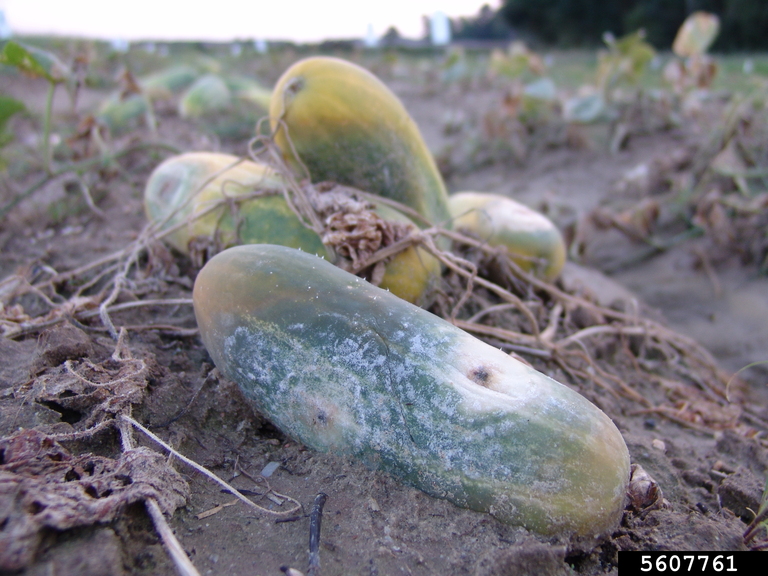
Sporulating lesions on cucumber fruit. Photo credit: Gerald Holmes, Strawberry Center, Cal Poly San Luis Obispo, Bugwood.org
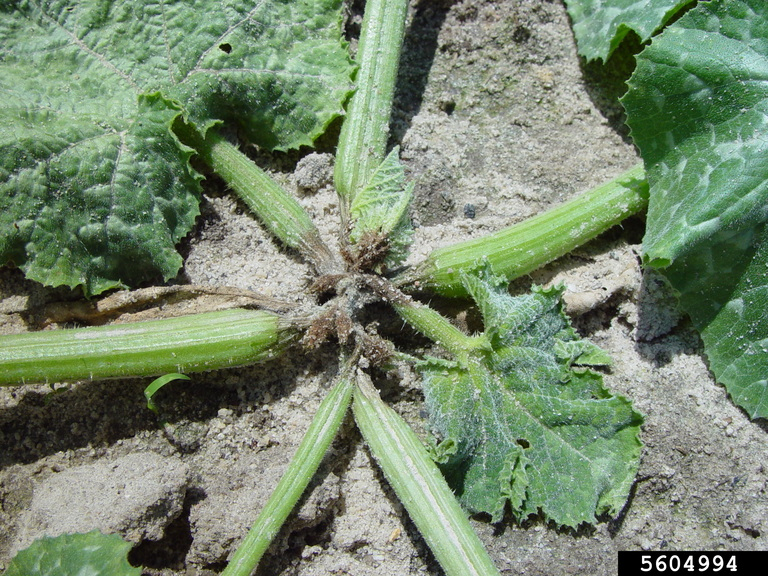
Gerald Holmes, Strawberry Center, Cal Poly San Luis Obispo, Bugwood.org
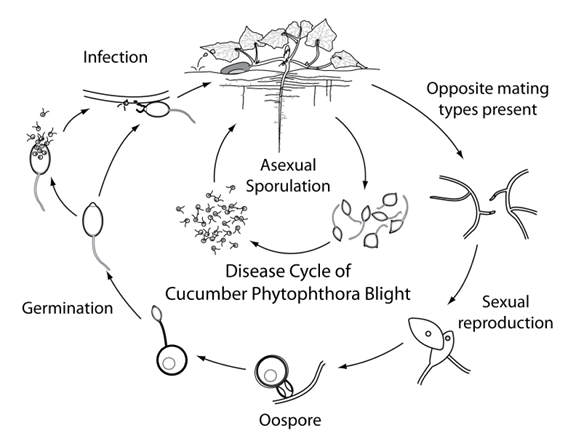
Phytophthora Crown and Fruit Rot caused by the oomycete or water mold pathogen Phytophthora capsici is a soilborne concern once introduced on a farm. The disease cycle shows the multiple spore types of the pathogen which are enhanced by humidity and standing water.
- Rotate away from susceptible crops ( >3 years)
- Plant resistant varieties when possible
- Plant in areas with well-draining soil
- Disinfest tools and equipment
- Maintain proper soil moisture
- Mulch with straw or dropped cover crops to reduce splash
- Destroy infected plant debris
- Do not irrigate from retention ponds that may receive run-off from infested fields (swimming spores can be present in the water and inoculate fields)
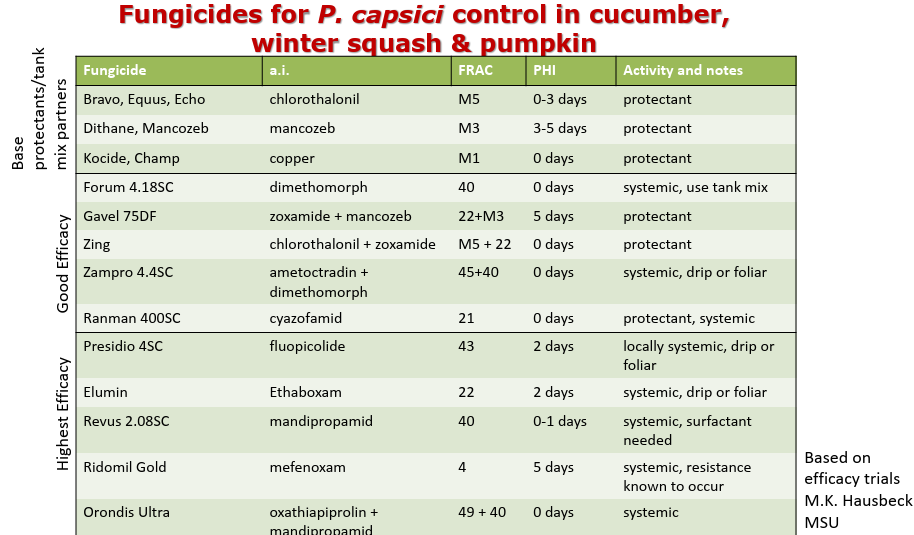
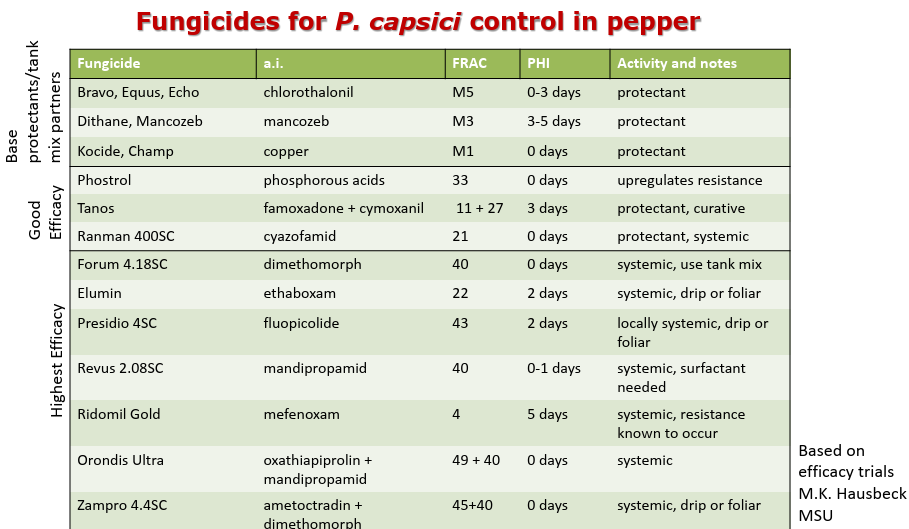 Resources/References
- Commercial Vegetable Production in Wisconsin (A3422) from the UW Extension Learning Store. This guide offers the latest recommendations for disease, insect, and weed management in Wisconsin’s most common commercial vegetable crops. Also included are lime and fertilizer recommendations as well as insect identification information and keys.
- UW Plant Disease Diagnostics Clinic. The University of Wisconsin–Madison/Extension Plant Disease Diagnostics Clinic (PDDC) provides assistance in identifying plant diseases and provides educational information on plant diseases and their control.
- Scheufele, S., and G. Higgins. 2015. “Phytophthora Blight.” Text. Center for Agriculture, Food, and the Environment. January 6, 2015. https://ag.umass.edu/vegetable/fact-sheets/phytophthora-blight.
- Schuh, Marissa, and Michelle Grabowski. 2022. “Phytophthora in Vegetable Crops.” 2022. https://extension.umn.edu/disease-management/phytophthora.
Vegetable Insect Update – Russell L. Groves, Professor, UW–Madison, Department of Entomology, 608-262-3229 (office), (608) 698-2434 (cell), e-mail: rgroves@wisc.edu. Vegetable Entomology Webpage: https://vegento.russell.wisc.edu/
Corn earworm – (https://vegento.russell.wisc.edu/pests/corn-earworm/)
Second generation of the corn earworm has increased rapidly over the past 10-14 days in southern Wisconsin. Pheromone captures (as reported from the Wisconsin Home Pest Survey) continue to confirm significant numbers of adult moths over the past two weeks in select locations in the southern half of the state. These captures will likely continue over the coming week, especially with moderate temperatures forecast. In northern portions of the state, expect increased captures over the next 10-14 days. Insecticides must be present on vulnerable silks when eggs hatch. The first application is the most critical and tank-mixes containing an ovicide (an egg killer) and a larvicide (eg. spinosad, spinetoram, chlorantraniliprole) are recommended. On sweet corn, treat every 3 to 5 days beginning when silks first appear and continuing until they are brown in color. Discontinue treatments 10 days before harvesting fresh market sweet corn as additional sprays will not improve product quality.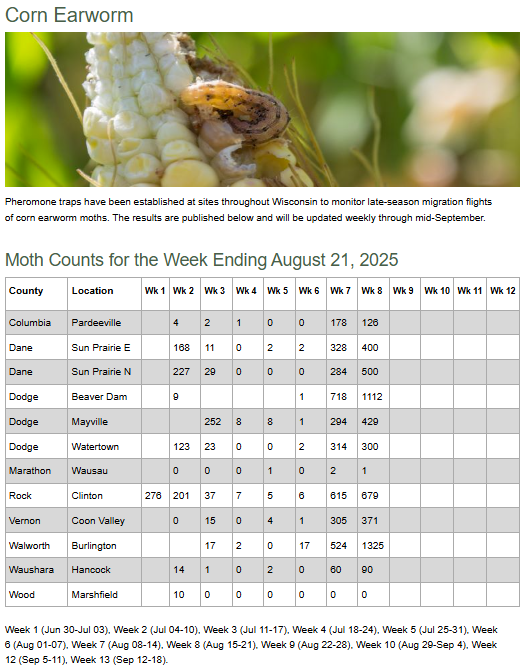
Corn earworm trap counts through Aug 24, 2025. https://datcp.wi.gov/Pages/Programs_Services/CornEarworm.aspx
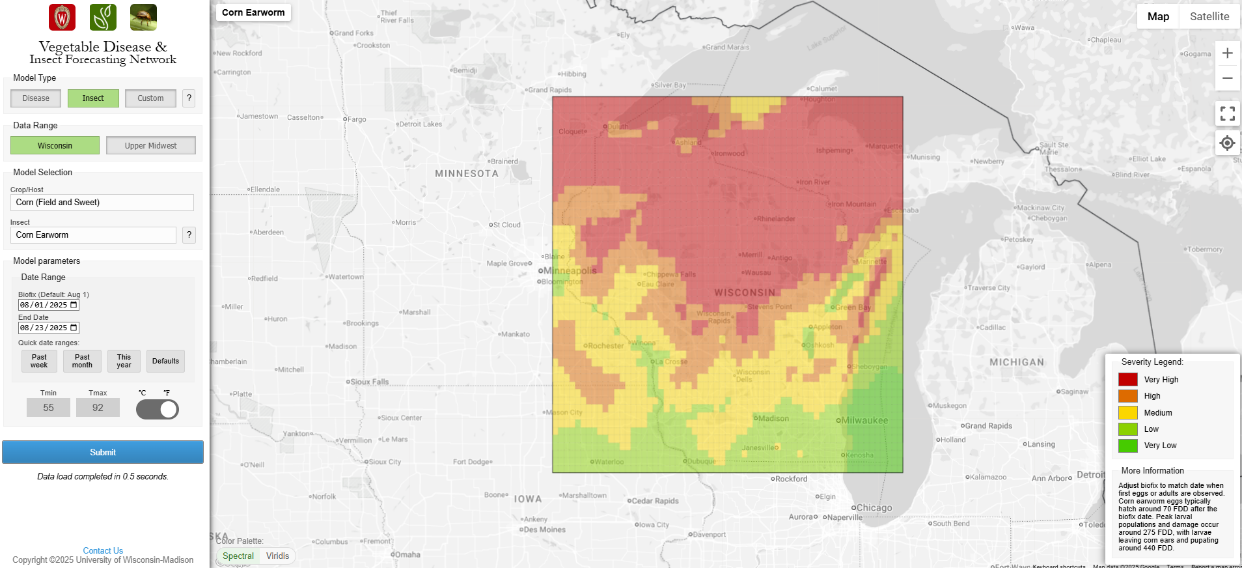
Corn earworm degree-day model prediction, Aug 24, 2025. Source: VDIFN
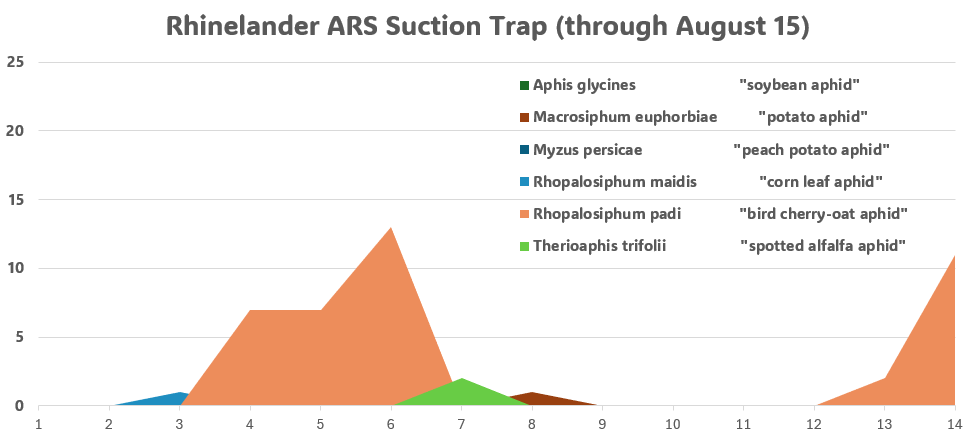
Read this newsletter as a PDF