In This Issue:
- UW Hancock Agricultural Research Station Field Day Agenda 2025
- WI DATCP Pest Survey, Imported Cabbageworm
- Disease forecasting updates for potato early blight and late blight
- Cucurbit downy mildew updates
The Hancock Ag Research Station field day will be held this week – Thursday, Jul 10, 2025. View the full agenda here.
Vegetable Insect Update – Russell L. Groves, Professor, UW–Madison, Department of Entomology, 608-262-3229 (office), (608) 698-2434 (cell), e-mail: rgroves@wisc.edu; Vegetable Entomology Webpage: https://vegento.russell.wisc.edu/
Wisconsin Department of Agriculture Trade and Consumer Protection – (
Wisconsin Home Pest Survey). Producers should begin to direct attention to the resources available through the WI DATCP’s, Wisconsin Home Pest Survey. Pest Survey specialists at DATCP collect and manage data on plant pests that threaten agricultural production and pose trade barriers. This program focuses on surveillance and early detection of economically significant pests, including insects, diseases, nematodes, and weeds. Data is collected through field-based sampling and from networks of cooperators across Wisconsin. The program maintains long-term historical pest surveys, while continually adapting and developing new surveys in response to emerging threats. Much of the Pest Survey’s work is carried out in cooperation with the U.S. Department of Agriculture Animal and Plant and Health Inspection Service and other partners, such as the University of Wisconsin, the Wisconsin Department of Natural Resources, and researchers nationwide.
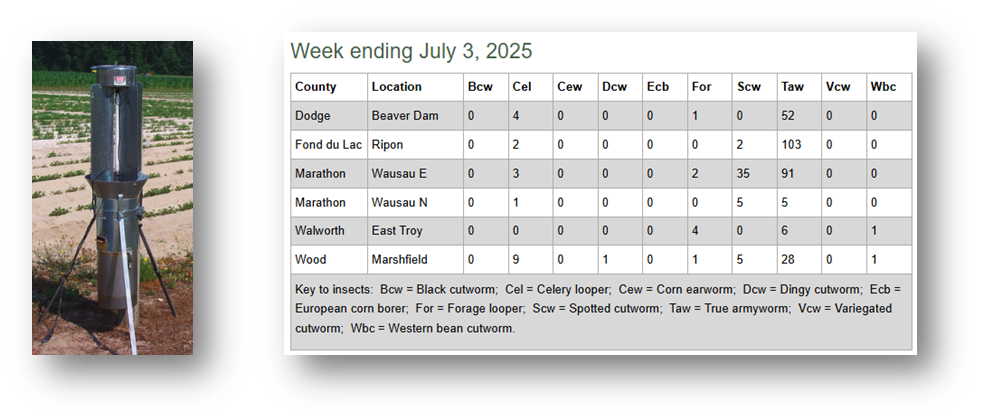
Pest Survey Program cooperators across the state maintain black light traps to monitor moth flights as an early warning of potential pest problems. Insect counts were just initiated in 2025, and the first reports were just released. Each week this report can be used to alert growers to the emergence, abundance, and seasonal occurrence of a variety of nocturnal agricultural pests. The results here represent first captures Thursday, July 3, 2025.
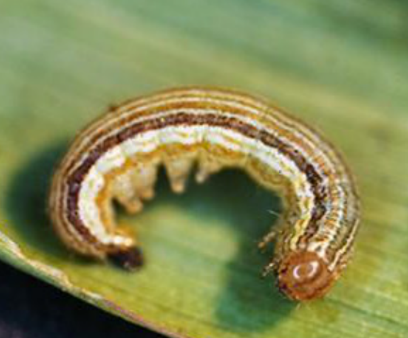
True armyworm larva. Photo credit: Adam Varenhorst
Early black light captures illustrate increasing captures of
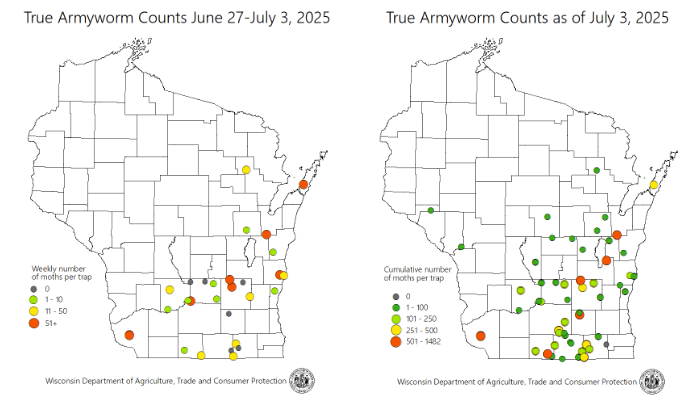
true armyworm across several locations in central and southern Wisconsin. Moth captures at this time are not considered excessive or extreme, but pest managers should pay attention to younger plants or more recently planted crops in areas where pheromone traps indicate moderate to high captures. The WI DATCP more accurately traps for potentially problematic populations of true
armyworm using pheromone traps. A summary of these captures (through July 3, 2025) is illustrated. Armyworms are dark caterpillars measuring up to 2 inches long. They have a dark stripe running lengthwise on the side with a yellow stripe beneath. Dark and light stripes alternate along their back. Armyworms move up from grassy weeds within cornfields or migrate into cornfields from small grain or forage fields. They may hide in soil crevices and beneath clods by day. At night, they chew corn leaves and weaken plants.
True armyworm is perhaps a week or 10 days late in capture activity (pheromone trapping) given the cooler spring. The insect gets its name from the larvae’s behavior of moving to new food sources in large groups (e.g., marching like an army). Large infestations can defoliate fields overnight, leaving only the stalks/stems and major leaf veins. Typically only two damaging generations can occur in Wisconsin throughout the summer, and true armyworm larvae can feed on grassy weeds throughout the entire season. Injury is usually most severe early in the season when plants are small.
Much like the recommendations in corn and soybeans, management options for true armyworms in alfalfa, grassy hay / pastures, or other affected crops depend on size. If larvae are greater than ¾ inch in length, they are difficult to kill and will pupate shortly and fly away as moths (best to just let mother nature take its course). If larvae are still less than ¾ inch in length, then there are insecticides labeled for forages or other crops that will effectively control them, and these are primarily the synthetic pyrethroids. Treatment thresholds vary by crop but are generally 3-5 larvae per square foot. If you are seeing damage in an affected crop and an insecticide is used, applications should be made either early morning or late afternoon when the larvae are the most active, and managers should pay close attention and check the insecticide labels for haying and grazing restrictions and pre-harvest intervals.
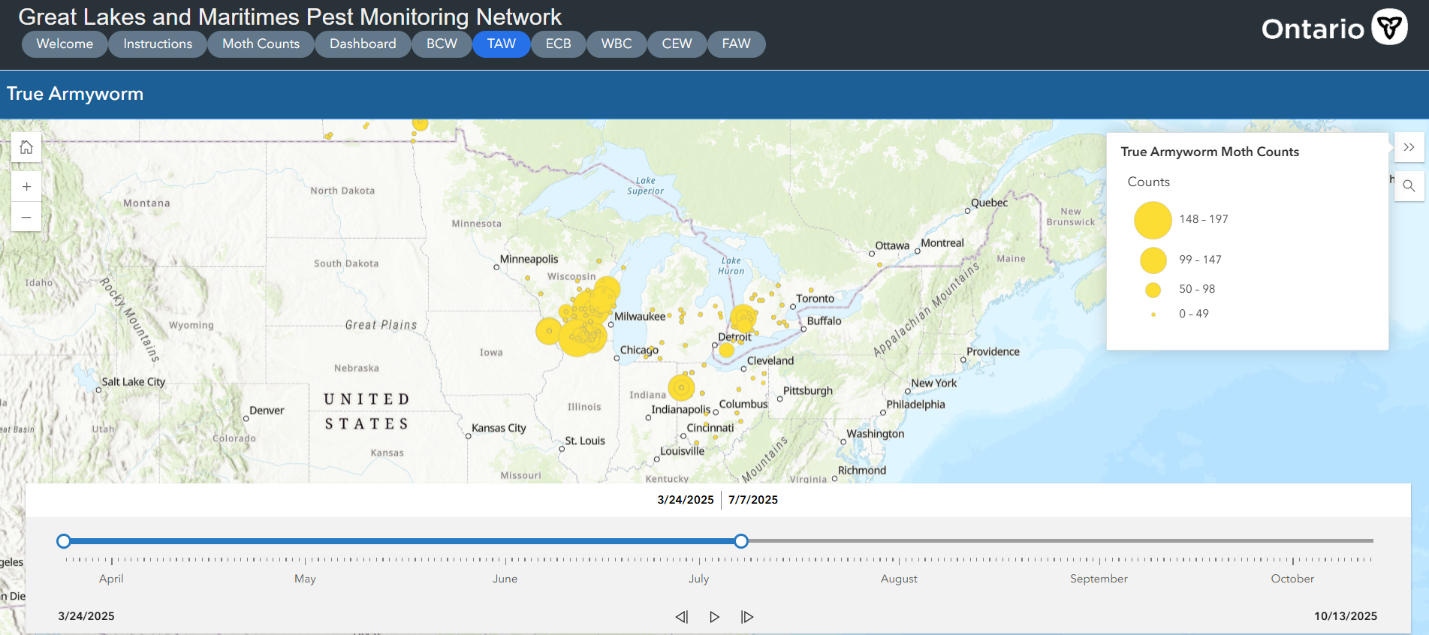
The
Great Lakes and Maritimes Pest Monitoring Network clearly illustrate the relative activity and capture of true armyworm across the upper Midwest and Great Lakes region. At the current time, moth captures for other (potentially) problematic pests (Western bean cutworm, Corn earworm, European corn borer) remain low, but attention should be paid to this site and the Wisconsin Home Pest Survey to remain informed of the captures and pending risk for infestation.
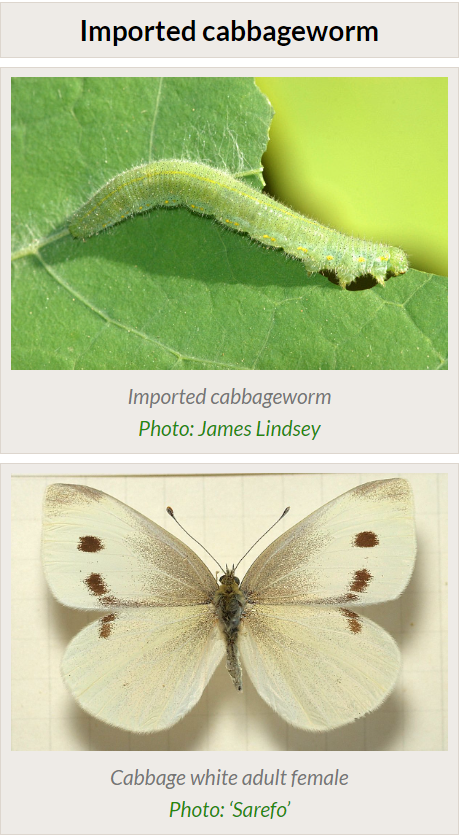 Imported cabbageworm.
 (
https://vegento.russell.wisc.edu/pests/caterpillar-pests-of-cole-crops/). Imported cabbageworm adults will become much more active and apparent in the coming weeks. Second generation adults have been emerging, and larvae from this population will develop on cole crops in the fields. After mating and laying eggs, the eggs will hatch in about 5 days. The caterpillar feeds and develops for approximately 11 to 20 days before forming a pupa from which the adult butterfly will again emerge after 6 to 11 days.
Commonly referred to as the white cabbage butterfly, are white butterflies with black markings on the wing tips. Female butterflies have 2 black dots on each fore wing; males, which are smaller, have 1 dot per wing. Eggs are yellow and conical, laid individually on the leaf surface and occasionally on the stem. An adult butterfly can lay 300 to 400 eggs in her lifetime. Larvae appear as velvety green worms up to 1 inch long with a faint yellow stripe running down the back. The caterpillar is commonly found along the veins of leaves and easily blends into the foliage.
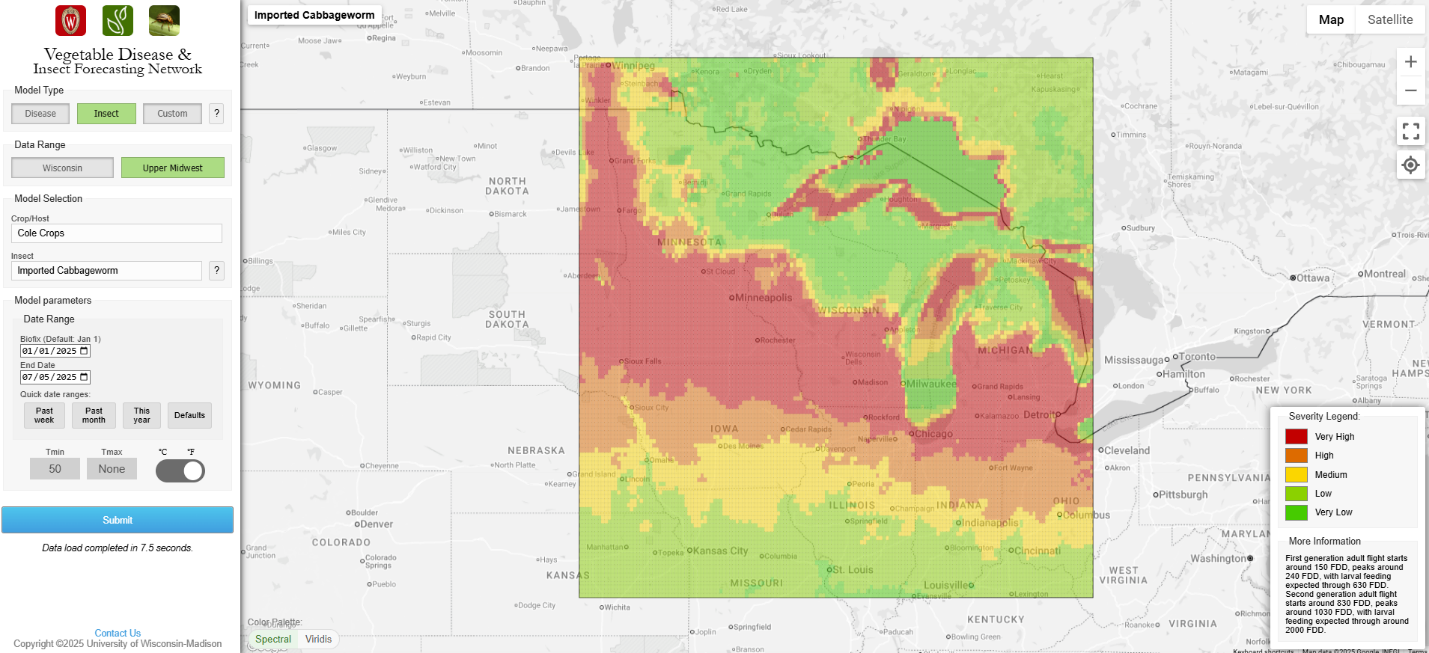
Scout fields weekly throughout the season for damage. Check plants carefully, even if no feeding damage is apparent, to look for eggs that will hatch into small caterpillars several days to a week later. Examine the lower leaves of the plant for the larvae of each pest. Although feeding damage and fecal material are signs of activity, it is better to rely on larvae counts to determine the level of infestation. Caterpillars cause varying amounts of damage depending on the plant’s maturity, so the need for treatment changes as the crop grows. The imported cabbageworm will feed on all ages of leaves but prefers the younger leaves. They feed along the edges of the leaves, leaving only thick veins behind.
Amanda Gevens, Chair, Professor & Extension Vegetable Pathologist, UW–Madison, Dept. of Plant Pathology, 608-575-3029, gevens@wisc.edu, Lab Website: https://vegpath.plantpath.wisc.edu/.
Current P-Day (Early Blight) and Disease Severity Value (Late Blight) Accumulations will be posted at our website and available in the weekly newsletters. Thanks to Ben Bradford, UW–Madison Entomology for supporting this effort and providing a summary reference table:
https://agweather.cals.wisc.edu/thermal-models/potato. A Potato Physiological Day or P-Day value of ≥300 indicates the threshold for early blight risk and triggers preventative fungicide application. A Disease Severity Value or DSV of ≥18 indicates the threshold for late blight risk and triggers preventative fungicide application. Data from the modeling source:
https://agweather.cals.wisc.edu/vdifn are used to generate these risk values in the table below. I’ve estimated early, mid-, and late planting dates by region based on communications with stakeholders. These are intended to help in determining optimum times for preventative fungicide applications to limit early and late blight in Wisconsin.
|
|
Planting Date |
50% Emergence Date |
Disease Severity Values (DSVs)
through 7/5/2025 |
Potato Physiological Days (P-Days)
through 7/5/2025 |
| Spring Green |
Early |
Apr 5 |
May 10 |
21 |
412 |
| Mid |
Apr 18 |
May 14 |
21 |
384 |
| Late |
May 12 |
May 26 |
18 |
327 |
| Arlington |
Early |
Apr 5 |
May 10 |
14 |
412 |
| Mid |
Apr 20 |
May 15 |
14 |
375 |
| Late |
May 10 |
May 24 |
11 |
339 |
| Grand Marsh |
Early |
Apr 7 |
May 11 |
17 |
397 |
| Mid |
Apr 17 |
May 14 |
17 |
377 |
| Late |
May 12 |
May 27 |
17 |
323 |
| Hancock |
Early |
Apr 10 |
May 15 |
19 |
363 |
| Mid |
Apr 22 |
May 21 |
19 |
337 |
| Late |
May 14 |
June 2 |
19 |
282 |
| Plover |
Early |
Apr 14 |
May 18 |
15 |
340 |
| Mid |
Apr 24 |
May 22 |
15 |
336 |
| Late |
May 19 |
June 7 |
15 |
239 |
| Antigo |
Early |
May 1 |
May 24 |
16 |
302 |
| Mid |
May 15 |
June 1 |
14 |
266 |
| Late |
June 1 |
June 15 |
9 |
178 |
| Rhinelander |
Early |
May 7 |
May 25 |
12 |
290 |
| Mid |
May 18 |
June 8 |
12 |
214 |
| Late |
June 2 |
June 16 |
4 |
172 |
Late blight of potato/tomato. The usablight.org website (
https://usablight.org/ now using Plant Aid) indicates no new confirmed reports of late blight on tomato or potato in the US this past week. There was a US-23 late blight strain type confirmation in Collier County FL in 2025 (now > month old). The site is not comprehensive. This genotype/clonal lineage is generally still responsive to phenylamide fungicides meaning that Ridomil and Metastar fungicides (mefenoxam and metalaxyl) can still effectively control late blight caused by these strain types. We saw the accumulation of 0-4 DSVs across WI this past week, with the greatest accumulations in the central part of the state.
All plantings of potatoes in the Spring Green and Hancock areas have reached the Blitecast threshold of 18 DSVs and should receive preventative fungicides for the management of late blight. Please find a fungicide listing for Wisconsin potato late blight management: https://vegpath.plantpath.wisc.edu/documents/potato-late-blight-fungicides/
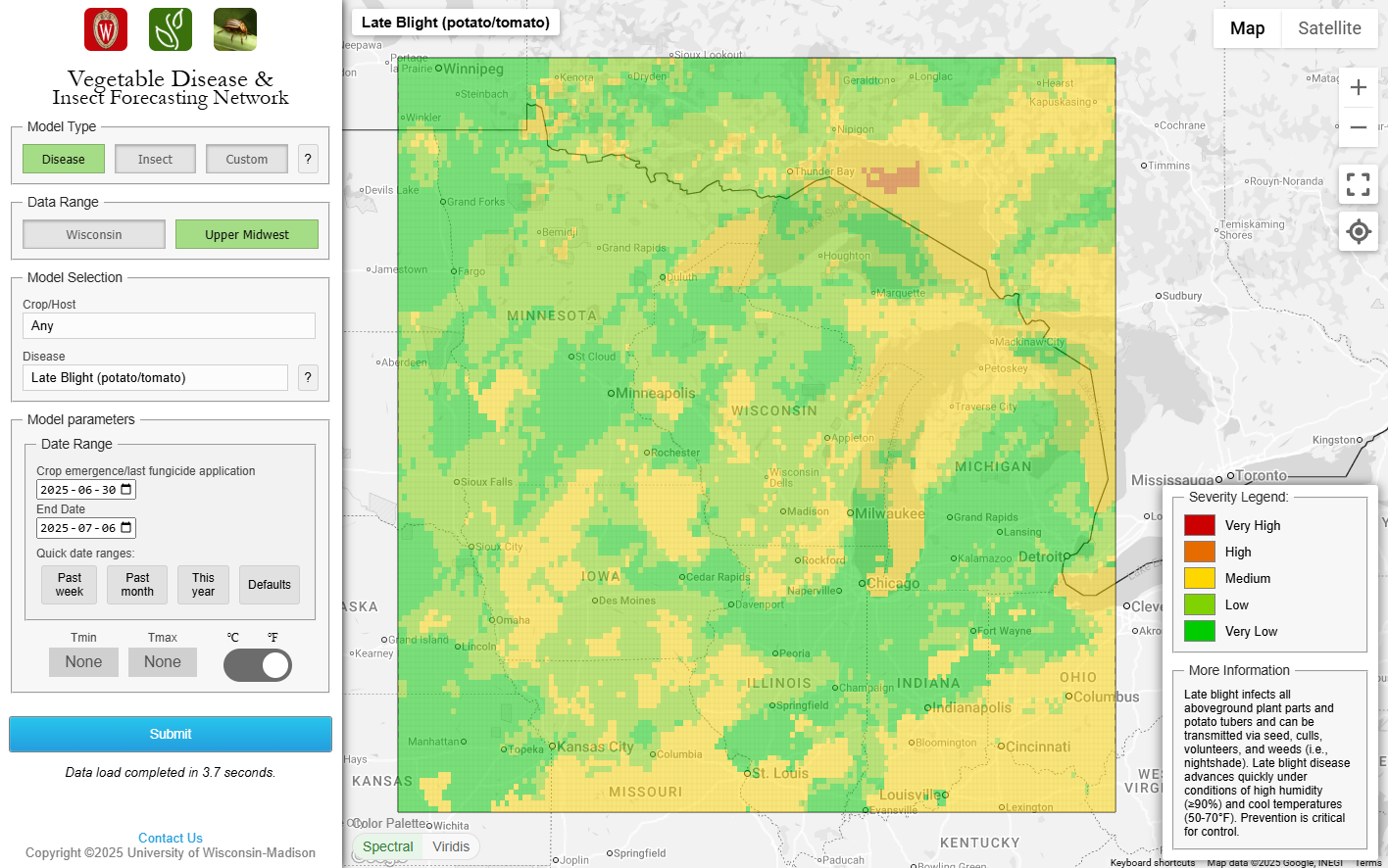
Predicted late blight risk for the week end Jul 6, 2025
The earliest inoculum of
Alternaria solani typically comes from within a field and from nearby fields. Once established, early blight continues to create new infections due to its polycyclic nature – meaning spores create foliar infection and the resulting lesion on the plant can then produce new spores for ongoing new infections in the field and beyond. Early-season management of early blight in potato can mitigate the disease for the rest of the season. Early blight is active in central and southern WI.
https://vegpath.plantpath.wisc.edu/diseases/potato-early-blight/
Fungicides can provide good control of early blight in vegetables when applied early in infection. Multiple applications of fungicide are often necessary to sustain disease management to the time of harvest due to the typically high abundance of inoculum and susceptibility of most common cultivars. For Wisconsin-specific fungicide information, please refer to the Commercial Vegetable Production in Wisconsin (A3422), a guide available here:
https://cropsandsoils.extension.wisc.edu/articles/2025-commercial-vegetable-production-in-wisconsin-a3422/
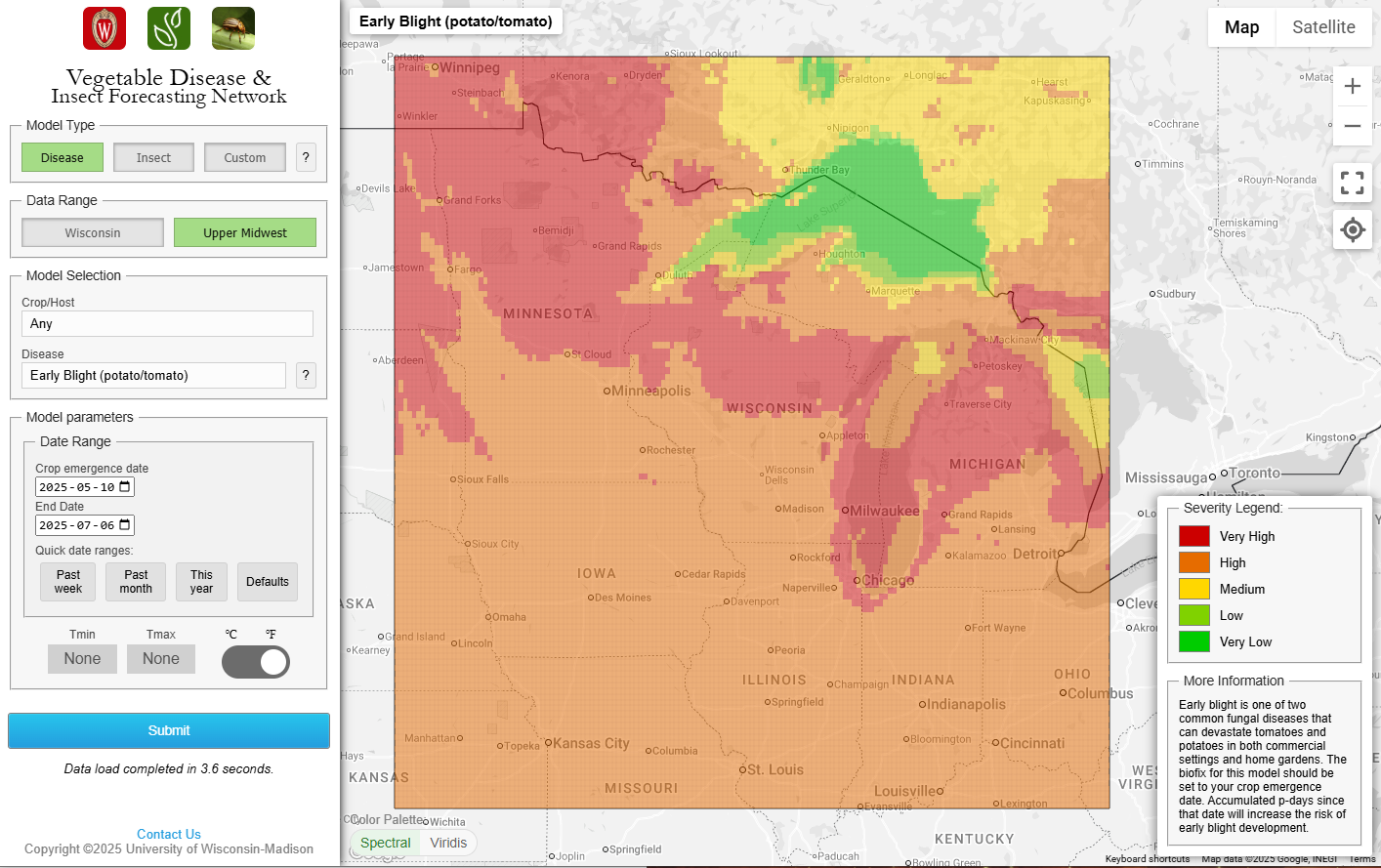
Predicted early blight risk, Jul 6, 2025. Assumes a crop emergence date of May 10.
This national cucurbit downy mildew information helps us understand the potential timing of arrival of the pathogen,
Pseudoperonospora cubensis, in our region, as well as the strain type which can give us information about likely cucurbit hosts in WI – as well as best management strategies. Clade 1 downy mildew strains infect watermelon and Clade 2 strains infect cucumber. I am hosting a cucurbit (and basil) downy mildew sentinel plot at the UW Hancock Agricultural Research Station this summer. This ‘sentinel plot’ is a non-fungicide-treated collection of cucurbit plants observed weekly for disease symptoms. No downy mildew was seen on basil or cucurbits this past week. Additionally, I keep an eye on the downy mildew work of Dr. Mary Hausbeck at Michigan State University and include this information as relevant to WI
https://veggies.msu.edu/downy-mildew-news/. This season, Clade 2 downy mildew spores were confirmed in multiple MI counties and downy mildew has been confirmed in commercial cucumber fields in 4 southern MI counties (reported 6/26/25). The outbreak was in pickling cucumber crops in southeast Michigan (Monroe and Lenawee counties) and southwest Michigan (Cass and VanBuren counties). No new reports of the disease from MI over the past week.
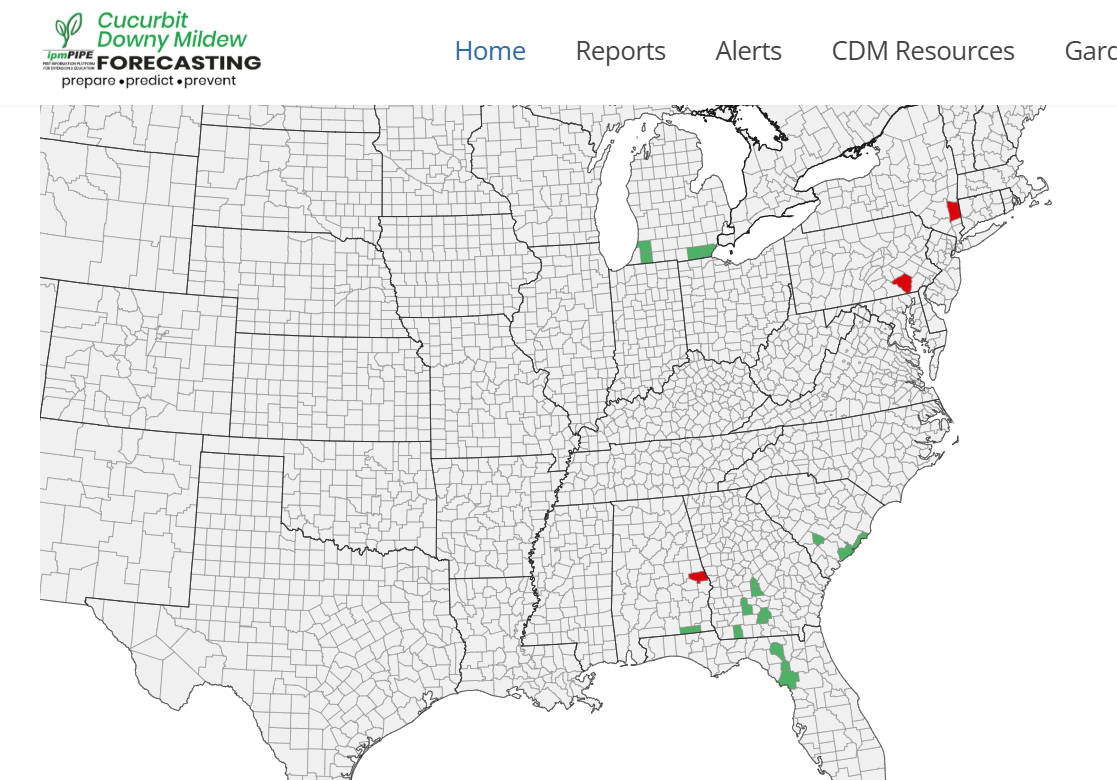
Cucurbit downy mildew was confirmed in multiple counties in the eastern US this past week (red highlighted counties) on cucumber and pumpkin (AL). Green counties indicated reports of the disease from over 1 week ago. https://cdm.ipmpipe.org/
Read this newsletter as a PDF